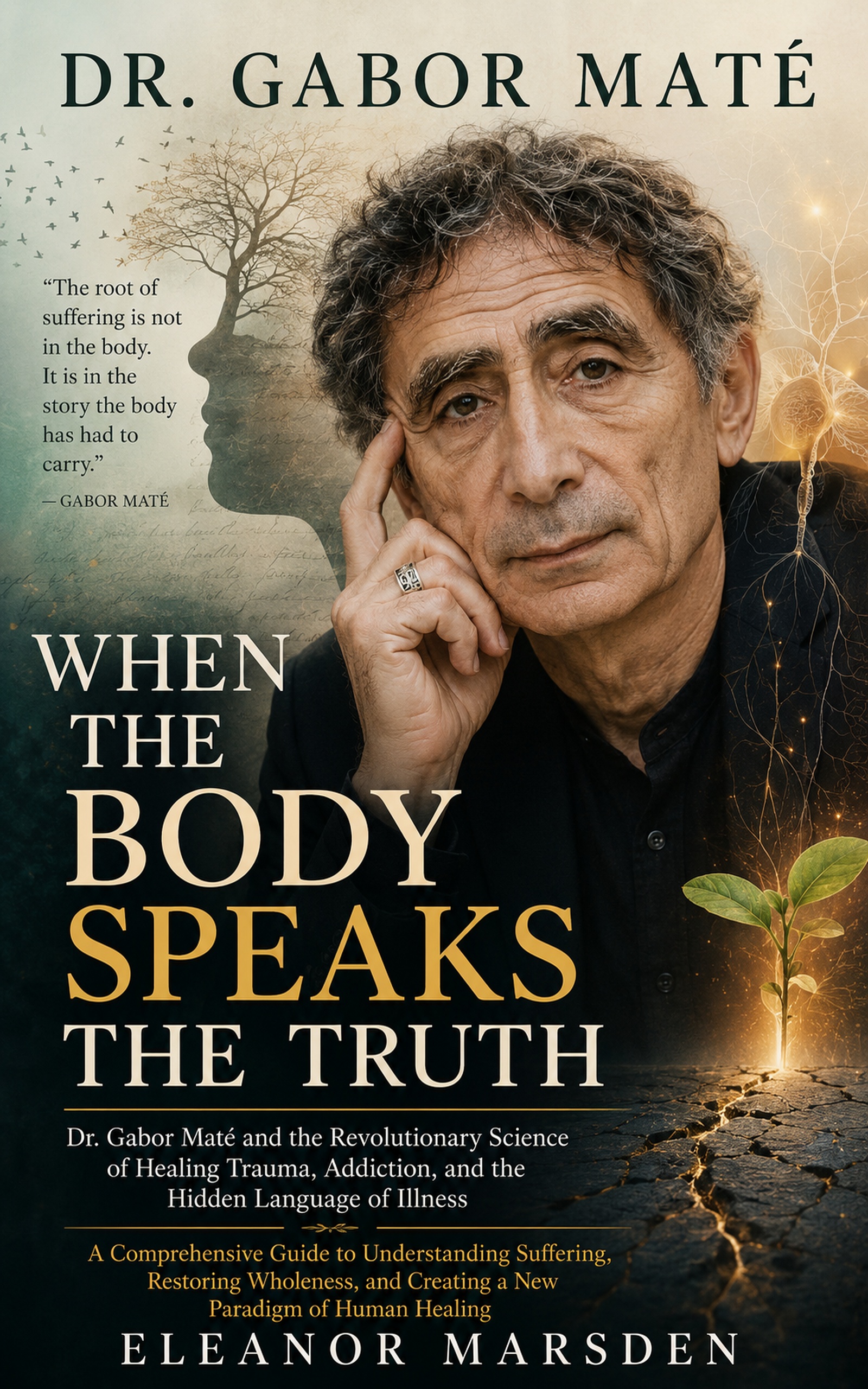
WHEN THE BODY SPEAKS THE TRUTH
Dr. Gabor Maté and the Revolutionary Science of Healing Trauma, Addiction, and the Hidden Language of Illness
by Eleanor Marsden
WHEN THE BODY SPEAKS THE TRUTH
Dr. Gabor Maté and the Revolutionary Science of Healing Trauma, Addiction, and the Hidden Language of Illness
What if your body has been trying to tell you the truth for years, and no one ever taught you how to listen?
Dr. Gabor Maté spent decades practicing medicine before he arrived at a question most physicians are never trained to ask: not simply what disease is present, but what life the disease is responding to. A family doctor, then a palliative care physician, then two decades working alongside some of the most profoundly addicted and traumatized people in Vancouver's Downtown Eastside, Maté came to a conclusion that quietly upends much of modern medicine's most basic assumptions. Illness is rarely random. Addiction is rarely a moral failing. And the body, in ways Western medicine has spent a century learning to ignore, remembers everything the mind has been forced to forget.
This book is not a biography, and it does not pretend to speak for Maté in his own words beyond what he has shared publicly. It is something more useful: a complete, accessible guide to the ideas that have made him one of the most influential voices in trauma-informed medicine alive today, built chapter by chapter around the questions his work keeps circling back to. What does it mean to treat a person instead of a diagnosis? Why does compassionate presence heal in ways that pharmaceuticals alone cannot? How does trauma leave a footprint on the body that no scan or bloodwork will ever show? And what would medicine look like if it stopped asking what's wrong with you, and started asking what happened to you instead?
Across ten chapters, this book walks readers from the moment a young physician first began noticing what his training never taught him to see, through the science connecting mind and body as a single, inseparable conversation, into the harder territory of trauma, addiction, and the social and political conditions that make so much modern suffering not a personal failure but a predictable outcome. It closes not with easy answers, but with something more honest: a picture of what healing actually looks like when it happens, and an invitation to imagine a medicine built around wholeness rather than symptom suppression.
This is a book for the reader who has sat in a doctor's office feeling unseen. For the person who has wondered whether their chronic illness, their anxiety, or someone they love's addiction might be connected to something deeper than bad luck or bad choices. For anyone ready to understand suffering not as something to be fixed, but as something to be finally, fully heard.
The body has been speaking all along. This book is where you finally learn its language.