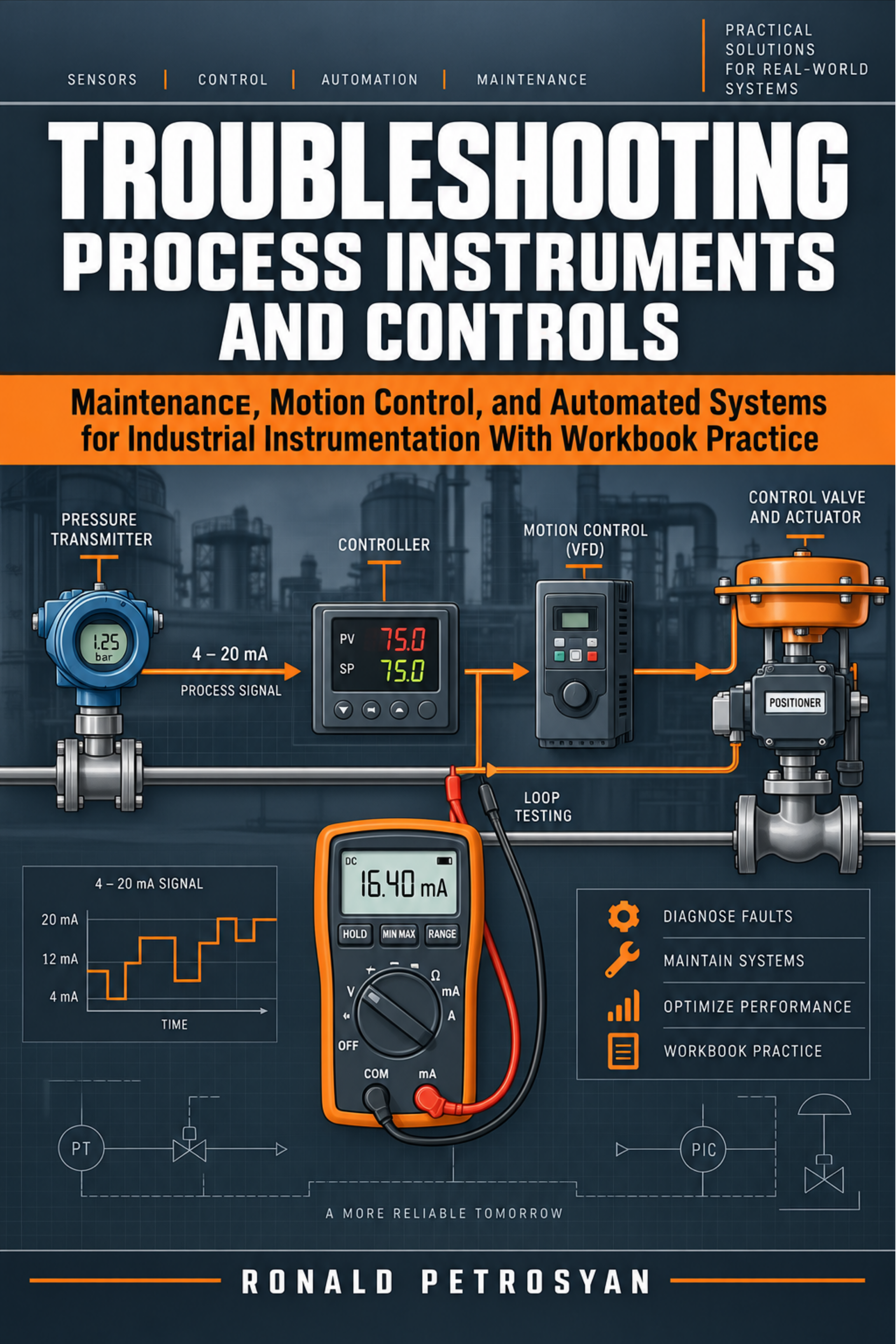
Troubleshooting Process Instruments and Controls
Maintenance, Motion Control, and Automated Systems for Industrial Instrumentation With Workbook Practice
by Ronald Petrosyan
A loop that reads full scale with the process at rest tells you something. So does one that reads twenty-three milliamps, or one that drifts only in the afternoon. This book turns those symptoms into a decision path.
Instrument faults rarely announce themselves. They show up as a reading that will not settle, a valve that hunts, a controller that was fine yesterday, or a calibration record that no longer matches what the transmitter is doing today. Troubleshooting Process Instruments and Controls is built around that reality. It starts with loop anatomy and safe access, so you understand what you are connecting to before you touch it, then moves through each measurement family in turn: pressure, level, temperature, flow, and analytical. For every family you get the failure modes that actually occur in the field, the symptoms they produce, and the checks that separate a sensor problem from a wiring problem from a process problem.
From there the book moves into the parts of the loop that technicians are often left to figure out alone. You will work through control valve trim and positioner behavior, PID tuning against stiction and deadband, cascade and feedforward strategies, drives and encoders, and the controller, network, and alarm faults that stop a loop without stopping the process. Calibration is treated as a documented procedure, not a ritual: as-found and as-left records, traceability, and the paperwork that survives an audit. The final chapter is a workbook of faulted loops with full answer keys, so you can practice the decision path rather than just read about it.
What you will learn:
- How to read, source, and drive a 4–20 mA loop safely, including isolation and troubleshooting practice
- How pressure, level, temperature, flow, and analytical instruments fail, and what each failure looks like at the controller
- How to run a documented calibration with as-found and as-left records that hold up to audit
- How to diagnose control valve trim, actuator, and positioner problems, including stiction and hunting
- How to tune PID loops against real-world valve and process behavior, not ideal responses
- How cascade, feedforward, and multi-loop strategies behave when a secondary measurement degrades
- How drives, encoders, and motion control systems produce faults and how to isolate them
- How to trace controller, fieldbus, network, and alarm faults to a root cause
- How to work through faulted-loop scenarios using structured, repeatable diagnostic steps
This book is written for instrument technicians, maintenance staff, and controls apprentices who are responsible for keeping process loops running and for proving that they are running correctly. It assumes you work with real equipment and need answers you can apply on the next shift, not theory for its own sake.