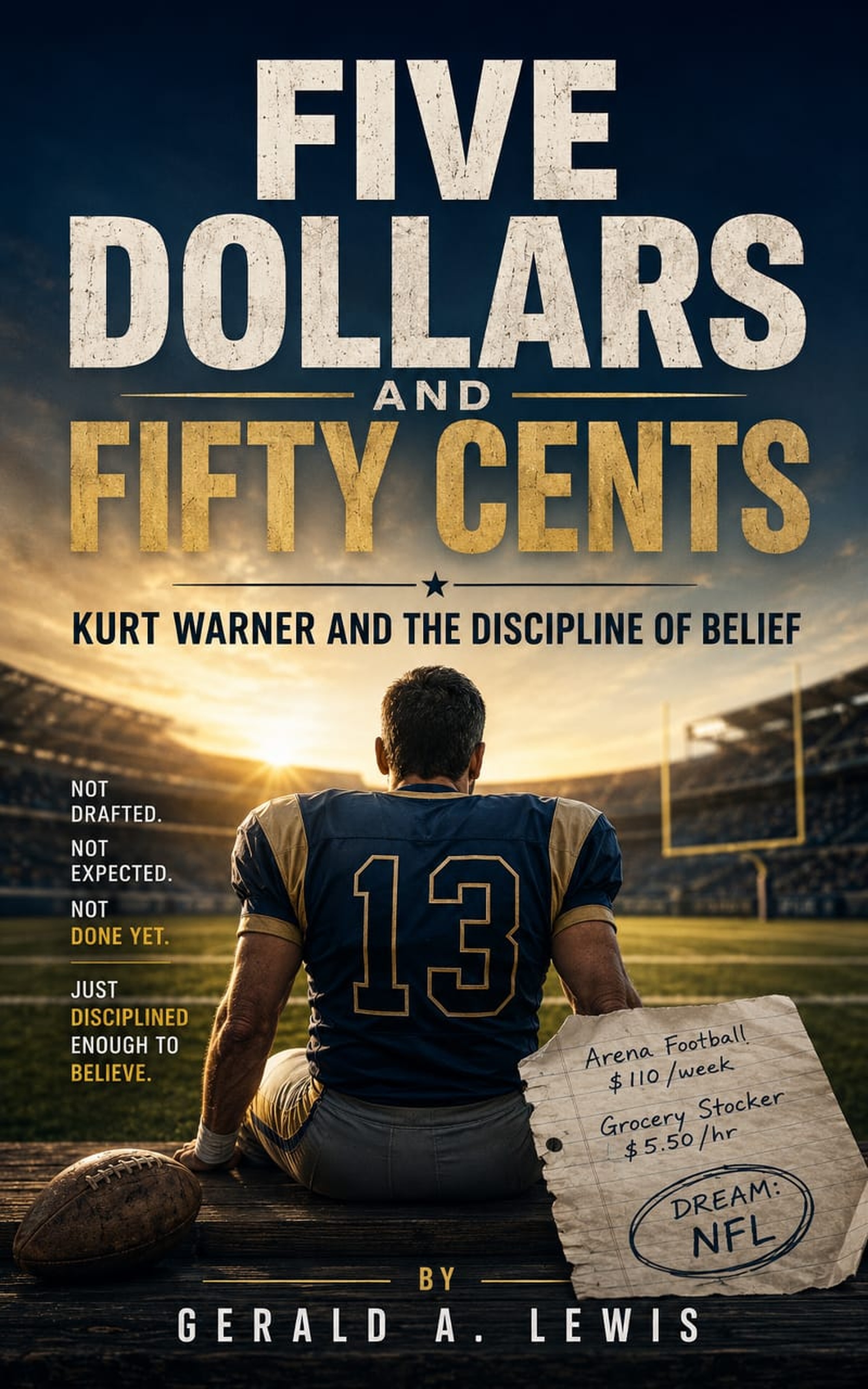
Five Dollars And Fifty Cents
Kurt Warner the Discipline of Belief Previous
by Gerald A. Lewis
He was earning five dollars and fifty cents an hour on the overnight shift at a Hy-Vee grocery store in Cedar Falls, Iowa, when he told anyone who would listen that he intended, someday, to be an NFL starting quarterback. Nobody had much reason to believe him.
Kurt Warner had already been cut by an NFL team after a single training camp. He was playing quarterback in an indoor league on a walled field the size of a hockey rink, in front of crowds most of the country never heard about. When a rare NFL tryout finally arrived, an unidentified insect bite sustained on his honeymoon closed the door before he ever walked through it. The wage was real. The dream sounded, to almost everyone around him, like exactly the kind of thing a young man says right before he gives it up.
This is not the story most people think they know. The familiar version compresses five hard years into a single sentence — the grocery store stock boy who got his shot — and lets the ending explain the beginning. Five Dollars and Fifty Cents resists that shortcut. It follows Warner from a bench at the University of Northern Iowa, where he watched three seasons pass before taking a meaningful snap, through the overnight shifts and empty practice fields of 1994, into an Arena Football League most of the country had never heard of, and across an ocean to a developmental league nobody in America was watching. It follows Brenda Warner's own parallel story with equal weight a Marine Corps veteran raising a son with permanent brain damage, rebuilding a life after betrayal and catastrophic loss, years before she and Kurt built anything resembling a stable home together.
By the time an injury to Trent Green finally put Warner on an NFL field in 1999, he had spent five years training for an opportunity with no scheduled arrival date. What happened next — an MVP season, a Super Bowl won by a single yard, a second MVP, a crushing Super Bowl defeat to an unproven quarterback named Tom Brady is only half the story this book tells. The other half is what came after: two releases in two years, a benching that had nothing to do with performance, a season so discouraging that Warner seriously considered walking away from football at thirty-five years old. And then, in Arizona, at an age when most careers have already ended, one more improbable run to one more Super Bowl, decided by a single fourth-quarter touchdown with thirty-five seconds left.
Five Dollars and Fifty Cents argues that Warner's defining trait was never a talent waiting to be discovered. It was a specific, sustained discipline about preparation during years when that preparation showed no evidence it would ever be used a discipline built on a grocery store's night shift and an empty practice field in Cedar Falls, and tested, again and again, by two more releases, a devastating injury to his own child, and a wait for football's ultimate honor that took two years longer than the record justified.
Written in the tradition of Walter Isaacson and Doris Kearns Goodwin, this is narrative nonfiction that trusts specific, well-documented details over inspirational shorthand. Every fact is drawn from the public record — contemporaneous reporting, official statistics, and Warner's own documented words, including his 2017 Hall of Fame induction speech and where the record was uncertain, the author left it out rather than smoothing it over. The result corrects at least one persistent myth about how Kurt and Brenda actually met, and refuses to let a familiar ending explain away five years that, at the time, looked very much like failure.
Readers who think they already know this story will find it more contingent, more uncertain, and more human than the highlight reel suggests: a career that could plausibly have ended in Green Bay, in an Iowa grocery store, on a honeymoon in Jamaica.