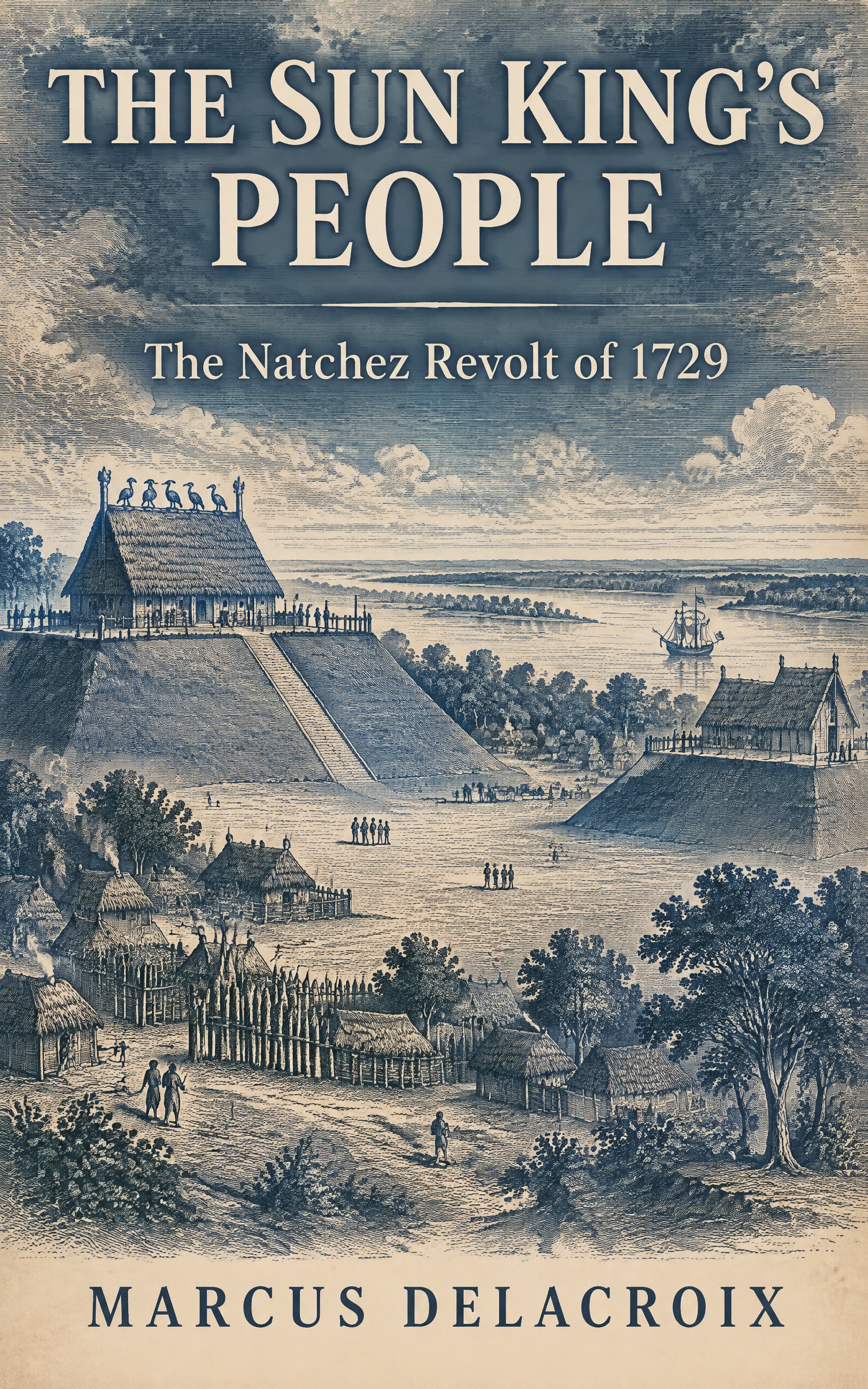
The Sun King's People: The Natchez Revolt of 1729
by Marcus Delacroix
Among the Natchez, a Sun could not marry a Sun. Nobles had to take their husbands and wives from the commoners, the great ordinary body of the nation whom French writers recorded as Stinkards, and because rank passed through the mother, the order of the whole society shifted a little with every generation. Above it all stood the Great Sun, whose title was no figure of speech. To his people he was the Sun.
In the autumn of 1720 a woman the French would one day write down as Fleur de Lis climbs the ramp of the great mound at the Grand Village each clear evening to watch the light go down beyond the Mississippi. Below her lie cane-walled houses, a plaza, and fields of corn, beans and squash in the deep yellow loess of St. Catherine's Creek, soil the French already covet. On the bluffs, they have built Fort Rosalie.
Nine years later, on a November day in 1729, the Natchez rose against the fort and the plantations around it and killed more than two hundred colonists. What followed was France's war of revenge: the answer from New Orleans, the Choctaw warriors who fought as French allies, a long pursuit across the river, refugee bands taken in at the Chickasaw towns, and the capture of the Great Sun and hundreds of his people, who were shipped to Saint-Domingue and sold into slavery.
The fort is long gone. The mounds along St. Catherine's Creek have outlasted it.