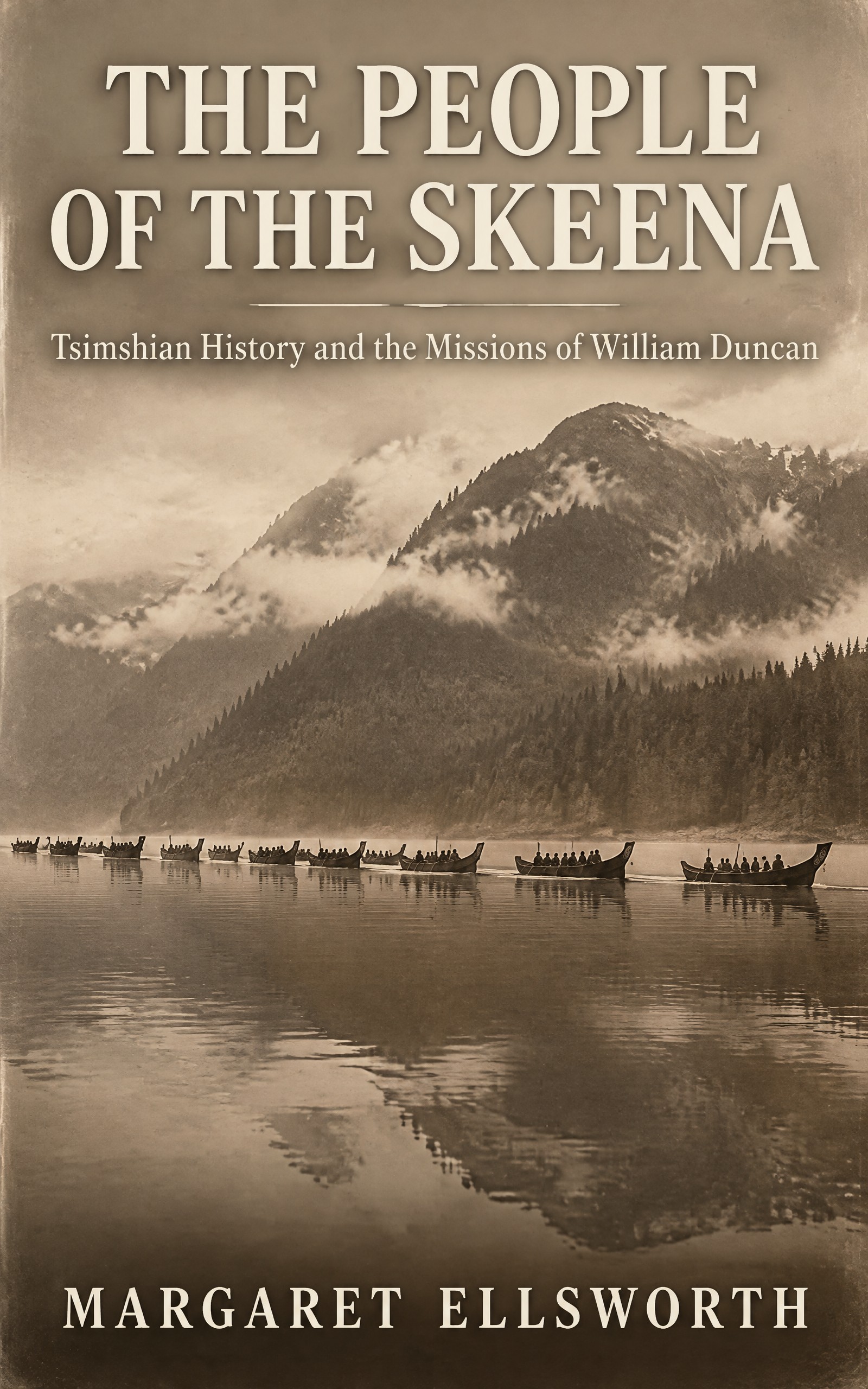
The People of the Skeena: Tsimshian History and the Missions of William Duncan
by Margaret Ellsworth
Among the Tsimshian, a name, a crest or a fishing station did not truly belong to a house until the claim had been witnessed and paid for at a feast. Chiefs held such things in trust for their houses, and the houses belonged to four great clans, Raven, Eagle, Killer Whale and Wolf. The people's name means, roughly, "inside the Skeena River," and for thousands of years they have lived at its mouth and along the coast beside it, where salmon and eulachon run thick in the silty water.
In 1857 a young English lay missionary named William Duncan arrived at the Hudson's Bay Company post of Fort Simpson. Five years later he led Tsimshian converts down the coast to found Metlakatla, a model Christian village with its own church, sawmill, store and rules. He later quarreled with his own church, the quarrel became a fight over who owned the land, and in 1887 some eight hundred Tsimshian followed him north to Annette Island, Alaska. Their story runs on through the potlatch ban, the epidemics, the long road toward aboriginal title in Canada and the return of feast law. The town they built across the border is today the only Indian reservation in Alaska.