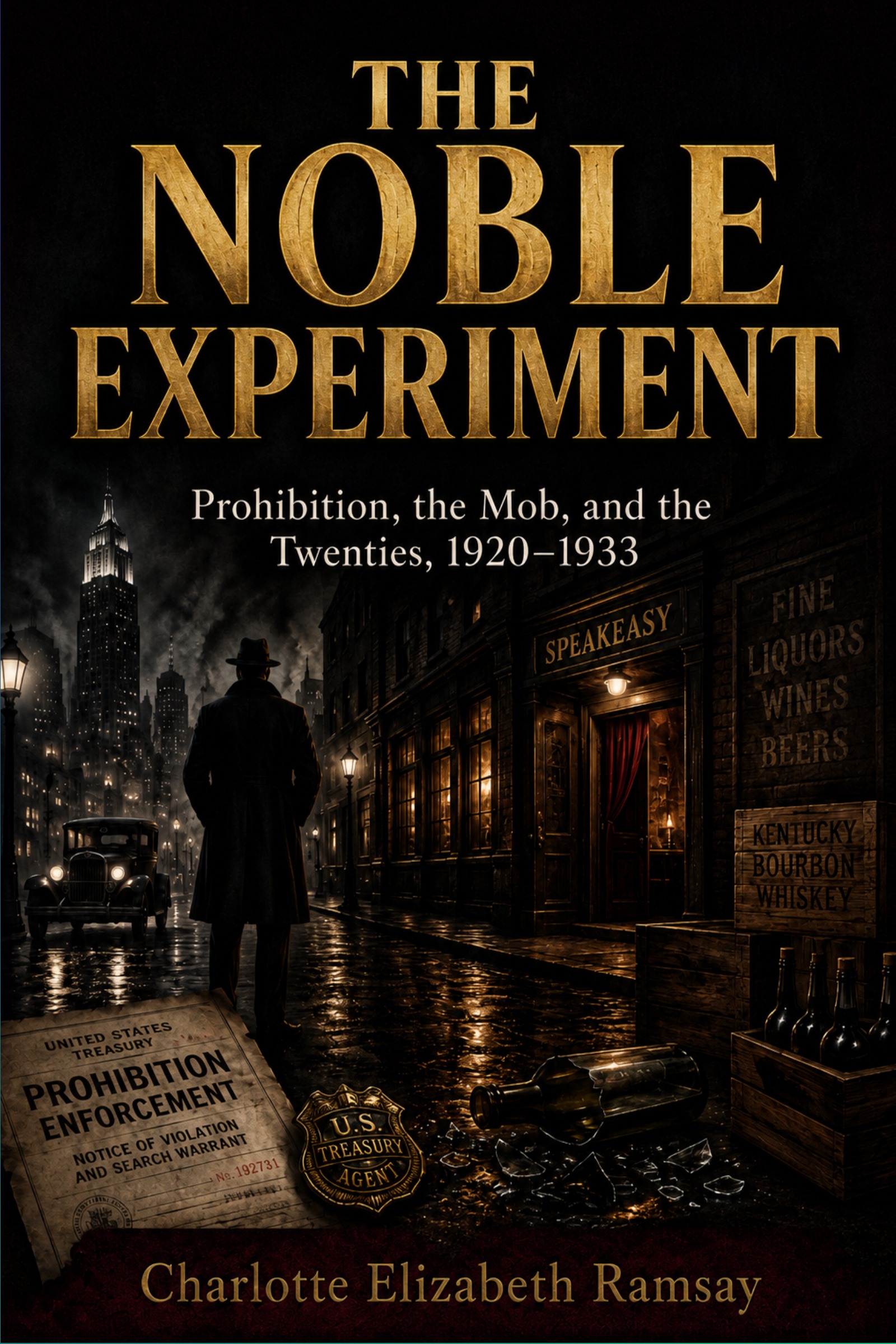
THE NOBLE EXPERIMENT
Prohibition, the Mob, and the Twenties, 1920-1933
by Charlotte Elizabeth Ramsay
At midnight on January 17, 1920, the United States went dry. The Anti-Saloon League and the Women's Christian Temperance Union had spent decades organizing for exactly this moment — the Eighteenth Amendment ratified in thirteen months, the Volstead Act signed into law, the saloon abolished. The reformers had imagined a sober, productive, morally elevated America. What came instead was Al Capone.
This is the full story of America's most ambitious social experiment. Ramsay traces the arc from the evangelical crusades of the 1820s through Frances Willard's WCTU and Wayne Wheeler's Anti-Saloon League — the most effective single-issue lobbying operation in American history — to the wartime patriotism that turned anti-German sentiment against the Pabst and Schlitz brewing families. Then she follows the consequences: Duke Ellington at the Cotton Club, Fitzgerald's Gatsby parties as portraits of bootleg wealth, and the class-differentiated enforcement that raided working-class speakeasies while hotel bars serving politicians stayed open.
The Noble Experiment failed to make America sober. It succeeded magnificently in building organized crime — structures that RICO statutes enacted in 1970 were specifically designed to dismantle, fifty years after Prohibition created them.
Inside this Prohibition history:
- Wayne Wheeler and the ASL machine — the political operative who tracked every legislator's wet or dry record, mobilized church networks in targeted districts, and achieved a constitutional amendment (Chapter 3)
- Al Capone and Chicago — how bootlegging profits built an organization that outlasted Prohibition by generations, and what the St. Valentine's Day Massacre revealed about gang warfare (Chapters 9, 11)
- The Jazz Age underground — the Cotton Club, the speakeasy as cultural institution, F. Scott Fitzgerald's Gatsby as portrait of bootleg wealth, and the cocktail culture Prohibition accidentally created (Chapter 13)
- Class and Prohibition — wealthy cellars stocked before 1920, working-class neighborhoods raided, Izzy Einstein's selective enforcement, and why the law corroded respect for itself (Chapter 14)
- Women on both sides — Frances Willard's WCTU, the flapper in the speakeasy, and Pauline Sabin's Women's Organization for National Prohibition Reform, which eventually claimed more members than the WCTU (Chapter 15)
- Repeal and its lessons — the Wickersham Commission's findings, the Depression-era economic arguments, the Twenty-First Amendment, and December 5, 1933 (Chapters 17-20)
The Noble Experiment is the story of what happens when democratic government tries to legislate virtue against the preferences of millions of its citizens — and discovers that prohibition creates criminal markets rather than eliminating demand. Its lessons have never stopped being relevant.
For readers of Daniel Okrent's LAST CALL and Erik Larson's THE DEVIL IN THE WHITE CITY.