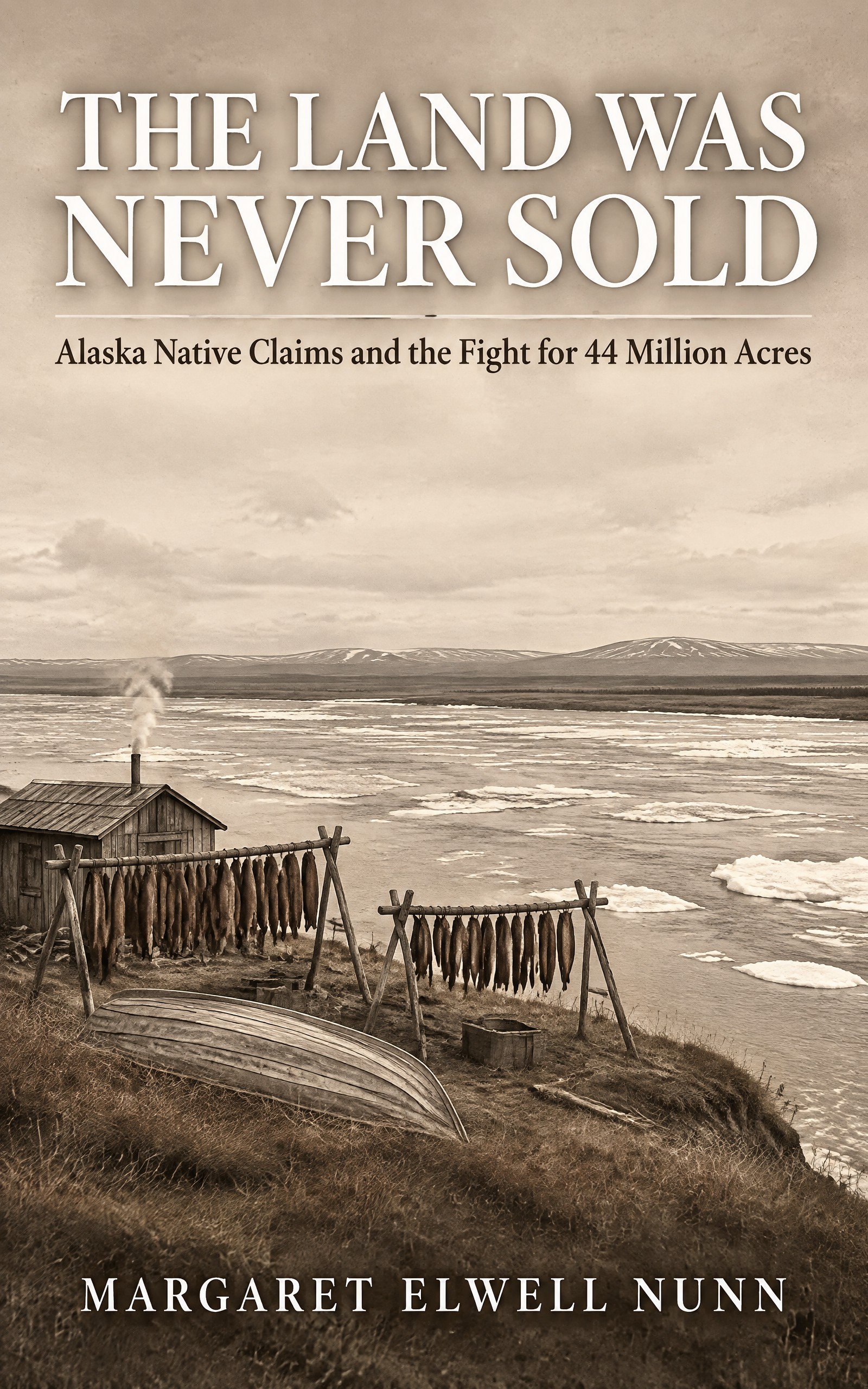
The Land Was Never Sold: Alaska Native Claims and the Fight for 44 Million Acres
by Margaret Elwell Nunn
Forty-four million acres and nearly a billion dollars. That was the bargain President Nixon signed into law on December 18, 1971, and in return Alaska's Native peoples gave up aboriginal title to the rest of the state.
Title to what, exactly? On the lower Yukon, an old Yup'ik man keeps a fish camp on the cutbank where his grandfather kept one before him. No surveyor ever ran a line through it and no clerk ever wrote it down, but every family on the river knows whose bend it is. Nobody had ever sold land held that way. Yet in 1867 the United States paid Russia 7.2 million dollars for Alaska, and for the next century it behaved as if it had bought the ground under every camp.
The book follows Alaska's Native nations, from Inupiat whaling crews on the Arctic coast to Tlingit clans in the Southeast rain forest, through the gold rushes, the canneries and the carving of the Tongass to statehood in 1959, when the new state began choosing more than a hundred million acres of its own. The government froze the land, Native leaders pressed their claims in the late 1960s, and oil turned up at Prudhoe Bay, giving Congress a reason to settle quickly.
The settlement created corporations rather than reservations: twelve regional ones in Alaska and a thirteenth for Natives living outside it, and more than two hundred village corporations, whose shareholders have argued ever since over dividends, oil leases, fish camps and culture. The final chapters ask what it means to hold your homeland as stock.