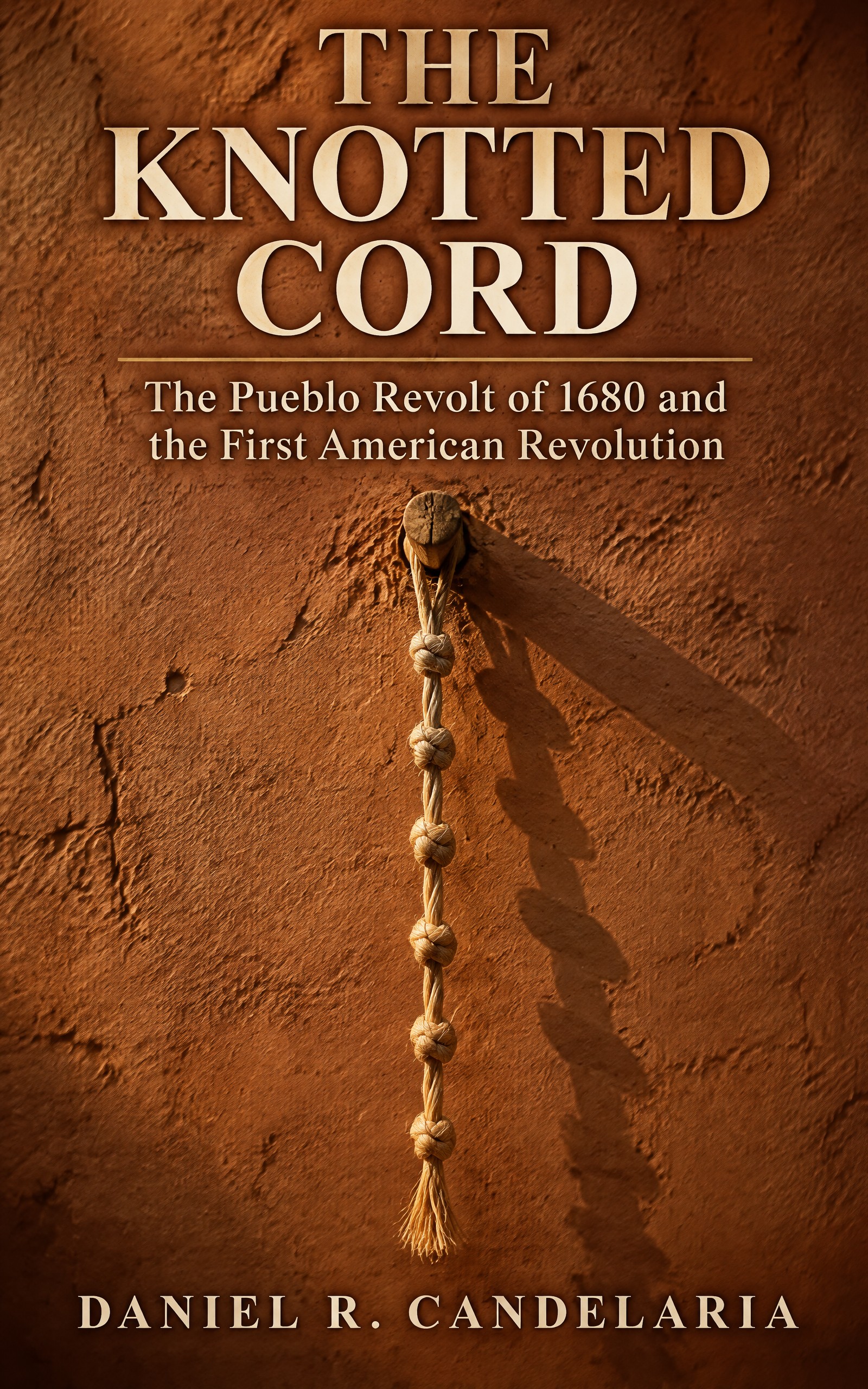
The Knotted Cord: The Pueblo Revolt of 1680 and the First American Revolution
by Daniel R. Candelaria
In August 1680, runners left Taos carrying cords of knotted yucca fiber. Each town that accepted one was to untie a knot every morning, and when the last knot came undone the pueblos would rise together, from the Rio Grande valley to the Hopi mesas, against the Spanish colony that had ruled them for eighty-two years. Two of the runners were caught on the ninth. The rising began on the tenth, a day early, and by the end of September the surviving colonists had fled down the river to El Paso.
The book begins where the colony began, on the riverbank in 1598 where Juan de Oñate had a notary read an act of possession aloud to a country whose people had not been asked. It follows what came after: the destruction of Acoma in 1599, the encomienda that took Pueblo corn and cotton blankets as tribute, the missions raised with Pueblo labor, and the long war on the kivas, which came to a head in 1675 when forty-seven religious leaders were arrested and several of them hanged. The survivors were flogged. One of them was a Tewa man from Ohkay Owingeh named Po'pay.
The rising itself follows, then twelve years of Pueblo self-government, the return of Diego de Vargas in 1692 and the second revolt of 1696, and the long argument between Pueblo memory and the Spanish archive over what it all meant. Three hundred and twenty-five years after the knots ran out, a statue of Po'pay was unveiled in the United States Capitol.