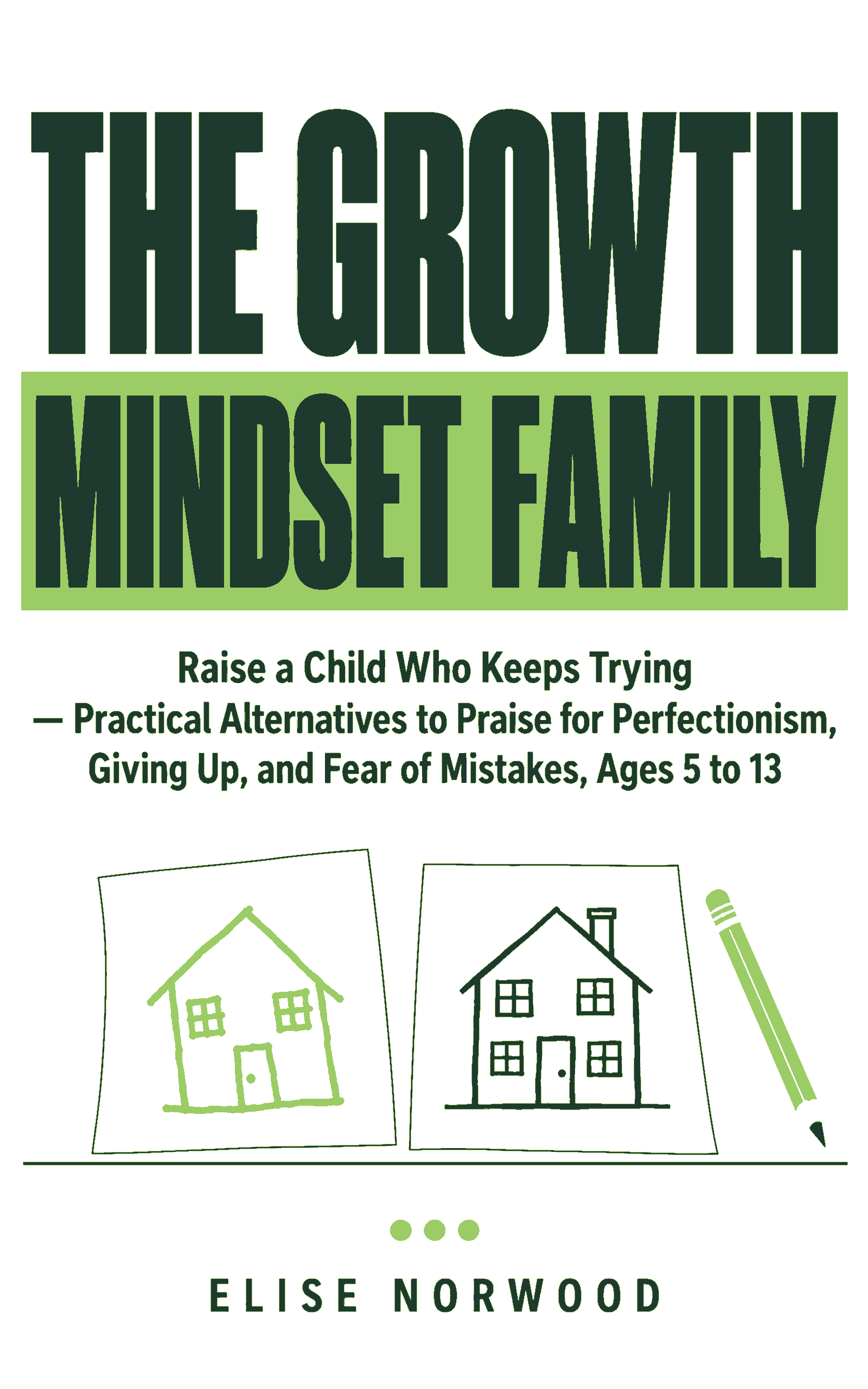
THE GROWTH MINDSET FAMILY
Raise a Child Who Keeps Trying — Practical Alternatives to Praise for Perfectionism, Giving Up, and Fear of Mistakes, Ages 5 to 13
by Elise Norwood
Your child brings you a drawing. You say it is lovely, because it is. It goes on the fridge.
And that is the end of it. Nobody will look at it again with any intention, and your child will never draw that particular thing a second time.
Now multiply that by everything. The homework handed in once. The model built once. The story written once and marked and filed. The test taken, scored, and never taken again.
So ask a question that sounds trivial and is not. When did your child last do something twice?
For a great many children the honest answer is that they cannot remember — that in eight or nine years of making things, they have almost no experience of producing something, seeing it fall short, doing it again, and finding the second one better.
Which is why the posters do not work. You cannot tell a child that effort changes outcomes. Beliefs of that kind are not installed by assertion; they are concluded from evidence, and the evidence is second attempts. A child who has none is reasoning correctly from their own experience, and their experience does not contain it.
The work is not a change of vocabulary. It is manufacturing second attempts until doing something again is unremarkable.
• What actually happens to a mistake in your house — and the fifth option almost nobody uses
• How to ask for a second attempt so it is a task rather than a verdict
• A third kind of response to work that is neither “you’re so clever” nor “you worked so hard”
• Why children cannot see their own progress, and the shoebox that fixes it
• Schoolwork, performance, and the domain that is easiest of all and nobody thinks of
• The child who will not attempt anything — and why not trying is a defence rather than laziness
• When more attempts is the wrong answer entirely
It is honest that the idea on the cover has been oversold, and it says so on page one. It does not ask you to stop saying well done. And it never uses redoing as a punishment, because the moment it becomes one it teaches the opposite of everything intended.
Not a belief you install. A conclusion they draw.