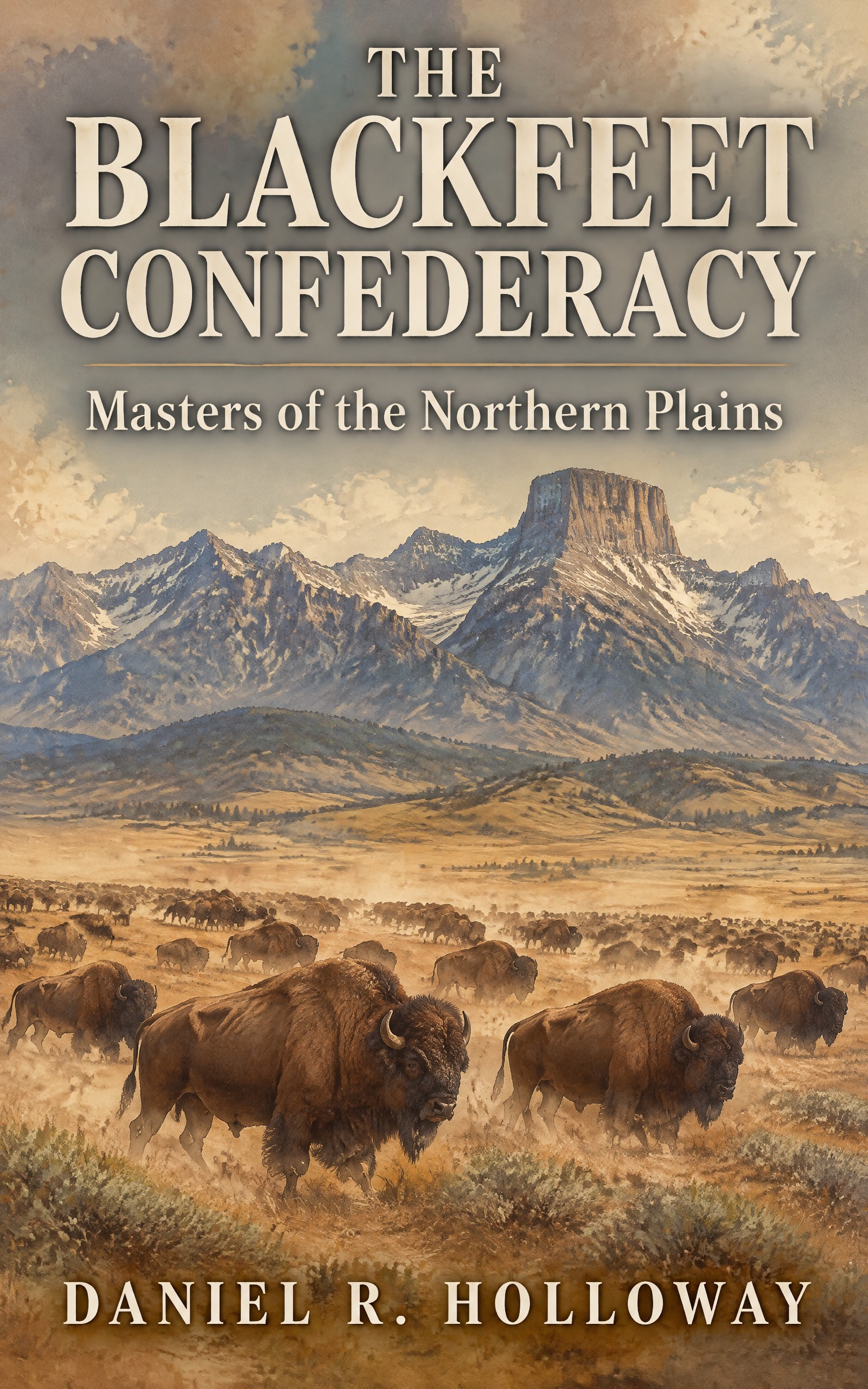
The Blackfeet Confederacy: Masters of the Northern Plains
by Daniel R. Holloway
The waiting is the work. On the eastern face of the Rocky Mountain front, a line of hunters lies flat along a ridge above two thousand grazing buffalo, and the lead hunter, a man of about forty winters who has done this since his father first brought him to such a ridge at nine, has not yet picked up a weapon. The killing, when it comes, will take less time than tying a moccasin.
The people on that ridge were Niitsitapi, the real people: the Siksika along the Bow River, the Kainai between the Red Deer and the Saskatchewan, and the Piikani to the south and west on the upper Missouri. Three nations with one language, they held the passes, fords and sheltered winter bottoms along the mountains they called the backbone of the world. The horse and the gun came north to them, and after them the trading forts of the upper Missouri, the smallpox that tore through their camps in the summer of 1837, the whiskey traders and the war road, treaties signed on both sides of a new border, and the end of the buffalo.
To the hunters on that ridge the mountains were never a wall, only a spine to follow to the herds. Other nations drew the boundaries, and the Niitsitapi spent the twentieth century, in Montana and in Alberta, fighting to govern themselves on either side of them.