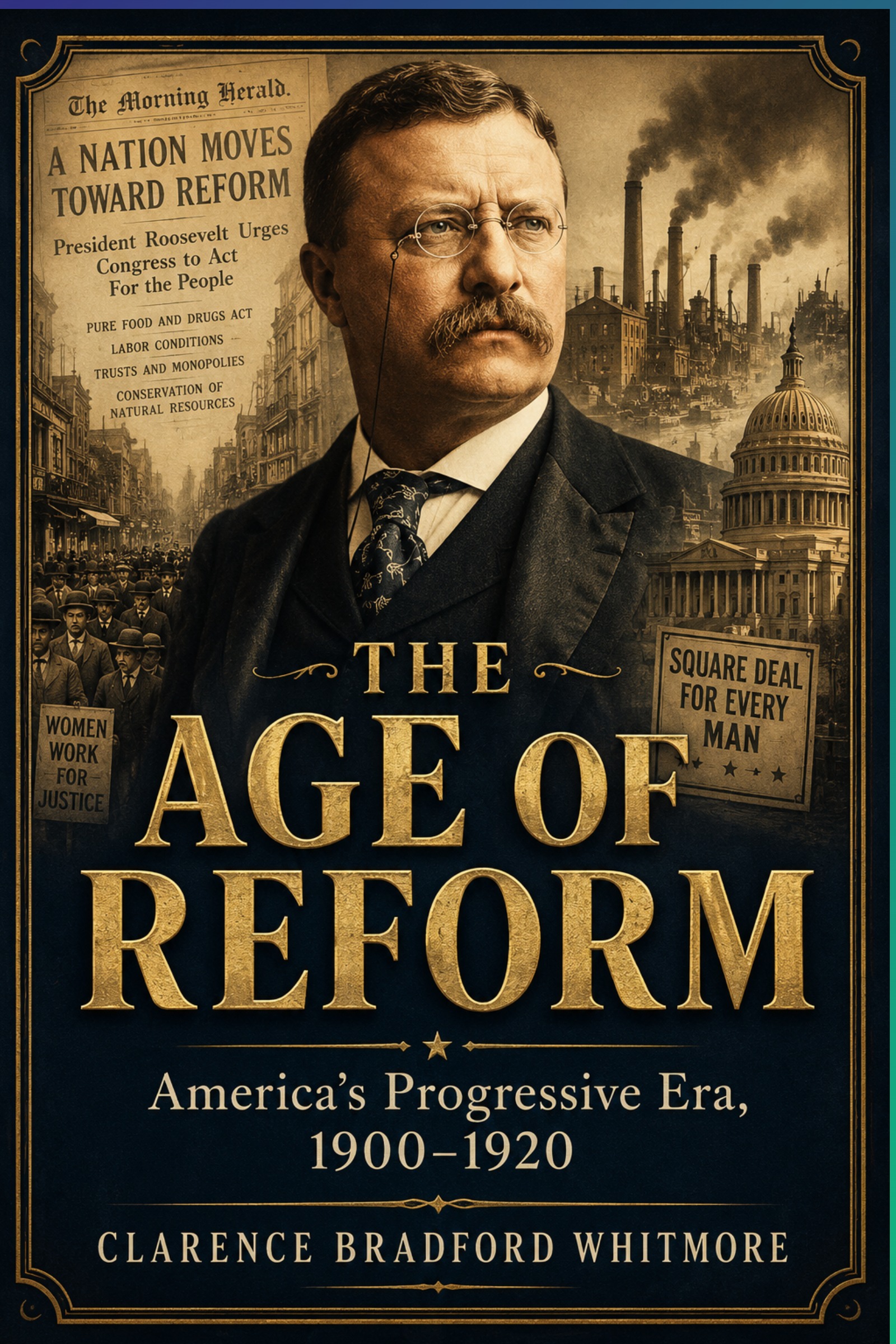
the age of reform
America's Progressive Era, 1900–1920
by Clarence Bradford Whitmore
In the autumn of 1902, a forty-four-year-old journalist named Ida Tarbell sat in the McClure's Magazine offices on East Twenty-Third Street, surrounded by three years of depositions and court records. Her target: the Standard Oil Company, the largest corporation in the world. Her platform: a nineteen-installment expose that would help dissolve a monopoly, reshape American journalism, and ignite the Progressive Era's most consequential reform movement.
This is the story of how Tarbell — and Theodore Roosevelt, Jane Addams, Upton Sinclair, Lincoln Steffens, Jacob Riis, Robert La Follette, W. E. B. Du Bois, and Woodrow Wilson — built the modern American state. Across twenty-four chapters in six parts, historian Clarence Bradford Whitmore traces the full arc of America's Progressive Era from McKinley's assassination in Buffalo in 1901 through the collapse of the reform consensus after World War I.
Inside this Progressive Era history:
- Trust-busting and the Square Deal — how a $4.50 revolver elevated Theodore Roosevelt to the presidency at age 42, and what he did with the antitrust laws (Chapters 1-4)
- The Jungle and the Pure Food and Drug Act — Upton Sinclair's seven weeks in the Chicago stockyards and the Neill-Reynolds report that horrified Roosevelt into action (Chapter 6)
- Hull House and the settlement movement — Jane Addams at 800 South Halsted Street, in a neighborhood with nineteen nationalities and a tuberculosis rate two and a half times the citywide average (Chapter 10)
- The Wisconsin Idea — Robert La Follette's state laboratory of reform that became a template for the New Deal (Chapter 9)
- The NAACP's founding — W. E. B. Du Bois, the Niagara Movement, and civil-rights organizing inside a reform movement that mostly looked away (Chapter 12)
- Wilson's New Freedom — the Federal Reserve, the Clayton Act, the income tax, women's suffrage, and the four constitutional amendments that bear the Progressive fingerprint (Chapters 16-18)
- The honest reckoning — the racial exclusions, paternalism, regulatory capture, and Prohibition gone wrong that the reformers built into the system even as they tried to reform it (Chapters 19, 22-23)
The Progressives left behind institutions that still shape American life — the national parks, the antitrust framework, federal food safety, the income tax, the Federal Reserve. They also left behind a question, the one Ida Tarbell was working on in 1902: can democratic government tame concentrated capital, or does that power always find a way to reconstitute itself? Their answer was provisional. Ours is still being written.
For readers of Doris Kearns Goodwin's THE BULLY PULPIT and Edmund Morris's THE RISE OF THEODORE ROOSEVELT.