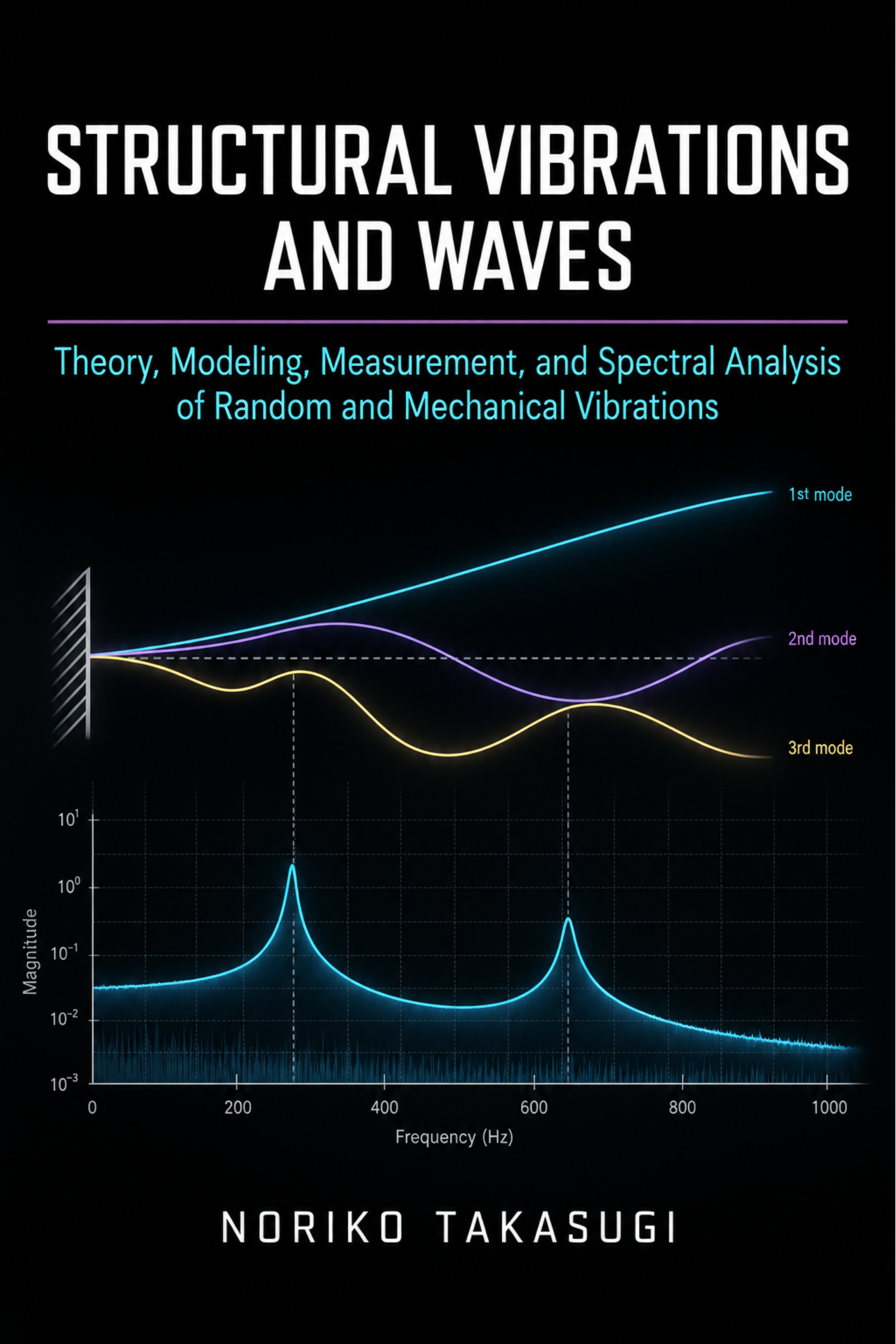
Structural Vibrations and Waves
Theory, Modeling, Measurement, and Spectral Analysis of Random and Mechanical Vibrations
by Noriko Takasugi
A structure does not care whether you modelled it as a lumped mass or a continuum; it responds at the frequencies it has.
This book takes you from a single spring and mass to measured spectra on real hardware without breaking that chain. You will derive frequency response functions and extract damping from half-power bandwidth, design isolators against transmissibility targets, tune a mass damper, assemble and solve multi-degree-of-freedom systems in modal coordinates, and handle beams, plates and dispersive bending waves. Random vibration then gives you power spectral density, root-mean-square response and fatigue damage estimation, followed by the spectral analysis choices — sampling, windows, averaging — that decide whether your measurement means anything. Closing coverage includes modal testing and active control.
For graduate students, structural dynamicists and test engineers, the treatment balances theory, modeling, measurement and spectral analysis so that each concept connects directly to the next. Derivations are presented with enough detail to follow by hand, while numerical methods and finite element vibration are introduced where they become necessary. The result is a coherent path from first principles to practical implementation.
What you will learn:
- Derive the free vibration response of single-degree-of-freedom systems and identify natural frequency and damping ratio from physical parameters.
- Extract damping from half-power bandwidth and interpret frequency response functions for harmonic excitation.
- Design vibration isolators against transmissibility targets and analyze base excitation and unbalance.
- Tune a mass damper and solve two-degree-of-freedom systems for absorber performance.
- Assemble and solve multi-degree-of-freedom systems in modal coordinates, including numerical methods and finite element vibration.
- Model continuous systems, beams and plates, and analyze dispersive bending waves in structures.
- Estimate random vibration response using power spectral density, root-mean-square values and fatigue damage.
- Make spectral analysis choices — sampling, windows, averaging — that determine measurement validity.
- Apply modal testing and active control techniques to real hardware.
This book is for graduate students, structural dynamicists and test engineers who need a rigorous yet practical treatment of mechanical vibrations, from theory and modeling to measurement and spectral analysis.