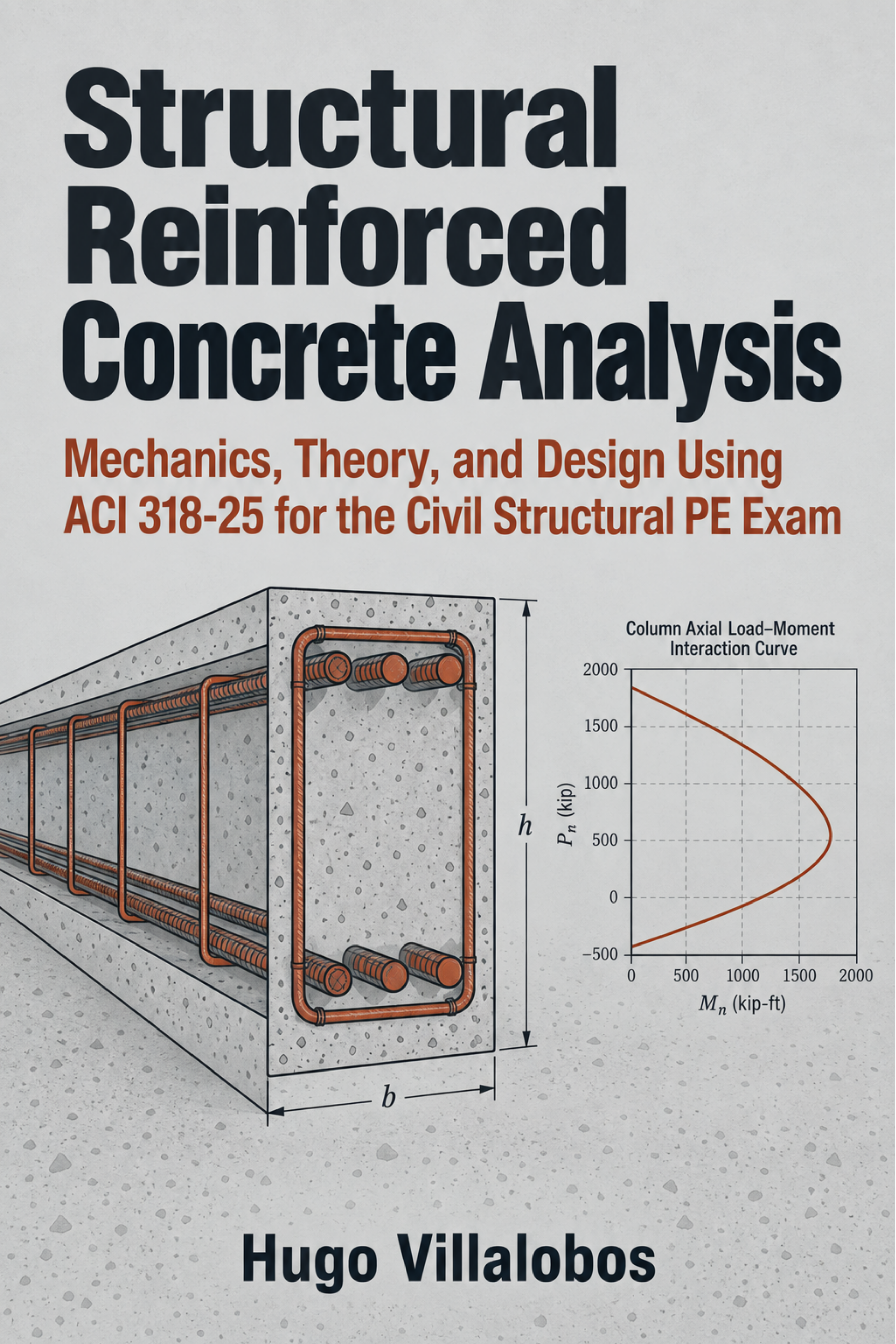
Structural Reinforced Concrete Analysis
Mechanics, Theory, and Design Using ACI 318-25 for the Civil Structural PE Exam
by Hugo Villalobos
Reinforced concrete design goes wrong in the details, not the formulas.
This book builds the mechanics first, deriving the stress block from strain compatibility so you know exactly why a section is tension-controlled, then carries each limit state through to a finished bar schedule. You will design beams in flexure, size stirrups for shear and torsion, calculate development lengths and place cutoffs correctly, control cracking and long-term deflection, construct column interaction diagrams, handle slenderness and moment magnification, and design one-way and two-way slabs including punching shear. Footings and retaining walls follow, with a closing set of licensing-exam problems worked in full under current code provisions.
Every chapter connects theory to practice: start with material behavior and design philosophy, move through flexural analysis and design of rectangular and flanged beams, then tackle shear, torsion, bond, development, and splices. Serviceability, short and slender columns, continuous beams, one-way and two-way slabs, footings, and retaining walls are covered with step-by-step procedures and code-referenced checks. The final chapter integrates systems and provides exam-style practice problems solved in full, so you can verify your understanding and build speed for the structural depth exam.
What you will learn:
- Derive the equivalent stress block from strain compatibility and identify tension-controlled, transition, and compression-controlled sections.
- Analyze and design rectangular and flanged beams for flexure, including reinforcement selection and detailing.
- Size stirrups and design for shear and torsion using ACI 318-25 provisions.
- Calculate development lengths, lap splices, and bar cutoffs, and apply proper detailing rules.
- Control cracking and long-term deflection through serviceability checks.
- Construct column interaction diagrams and handle slenderness and moment magnification.
- Design one-way and two-way slab systems, including punching shear reinforcement.
- Proportion footings and retaining walls for stability and strength.
- Work licensing-exam problems in full, from load takedown to final design.
For structural engineering students, design office engineers, and candidates preparing for the structural depth exam, this book provides a rigorous yet practical path to mastering reinforced concrete analysis and design under current code provisions.