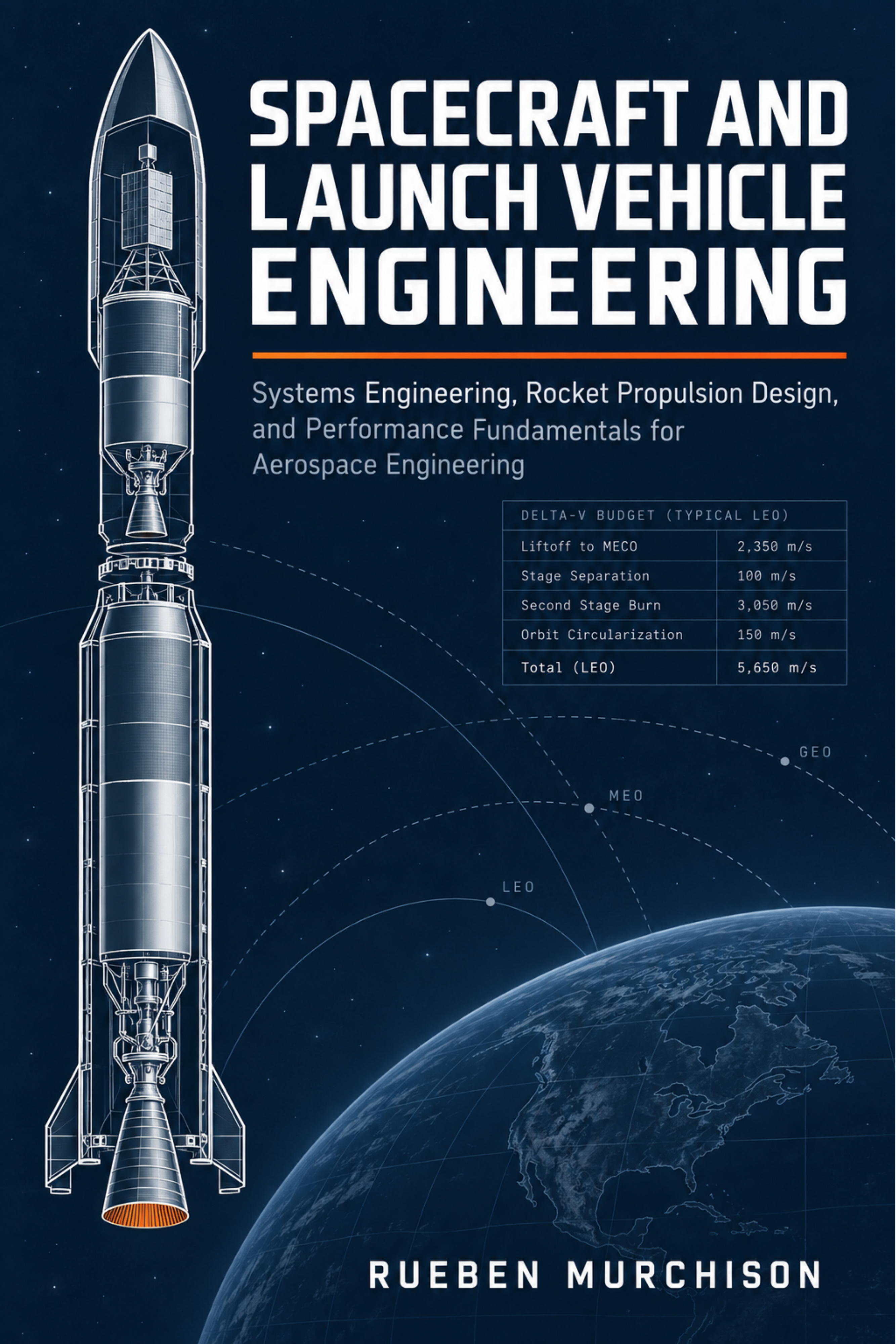
Spacecraft and Launch Vehicle Engineering
Systems Engineering, Rocket Propulsion Design, and Performance Fundamentals for Aerospace Engineering
by Rueben Murchison
Pass your exams—then learn to actually design the vehicle.
You can pass every aerospace course and still not know how a vehicle actually gets designed. This book joins the two halves. It begins with the requirements and review gates that shape every space programme, then hands you the hardware to size yourself: stage mass fractions from a delta-v budget, a regeneratively cooled chamber, a nozzle area ratio, an ascent load case at max-q, a radiator, a solar array against eclipse, a momentum wheel, a downlink budget.
One example mission runs through the whole book, so you watch its mass, power and propellant budgets close chapter by chapter. The final chapter takes it through vibration, acoustic and thermal-vacuum qualification. Rather than treating systems engineering as paperwork and propulsion as isolated equations, this text keeps them coupled—because in real programmes, a change in chamber pressure ripples into tank mass, ascent loads, thermal margins and schedule.
What you will learn:
- Translate a mission need into requirements, concept of operations and review-gate deliverables
- Apply the systems engineering lifecycle to real spacecraft and launch vehicle programmes
- Build a delta-v budget and derive stage mass fractions with the rocket equation
- Design liquid propulsion systems, including regeneratively cooled chambers and nozzle area ratios
- Analyse solid motors, nozzle flow and ascent trajectories with max-q flight loads
- Size structures, mechanisms and mass properties while tracking margins
- Design thermal control, electrical power and solar arrays against eclipse
- Develop attitude determination and control, including momentum wheels
- Close communications and data handling links with a downlink budget
- Plan on-orbit propulsion, environmental verification and qualification testing
Who it is for: Aerospace undergraduates, graduate students and early-career engineers moving from coursework to real design work. If you need the analytical tools and the programme context in one place, this book is written for you.