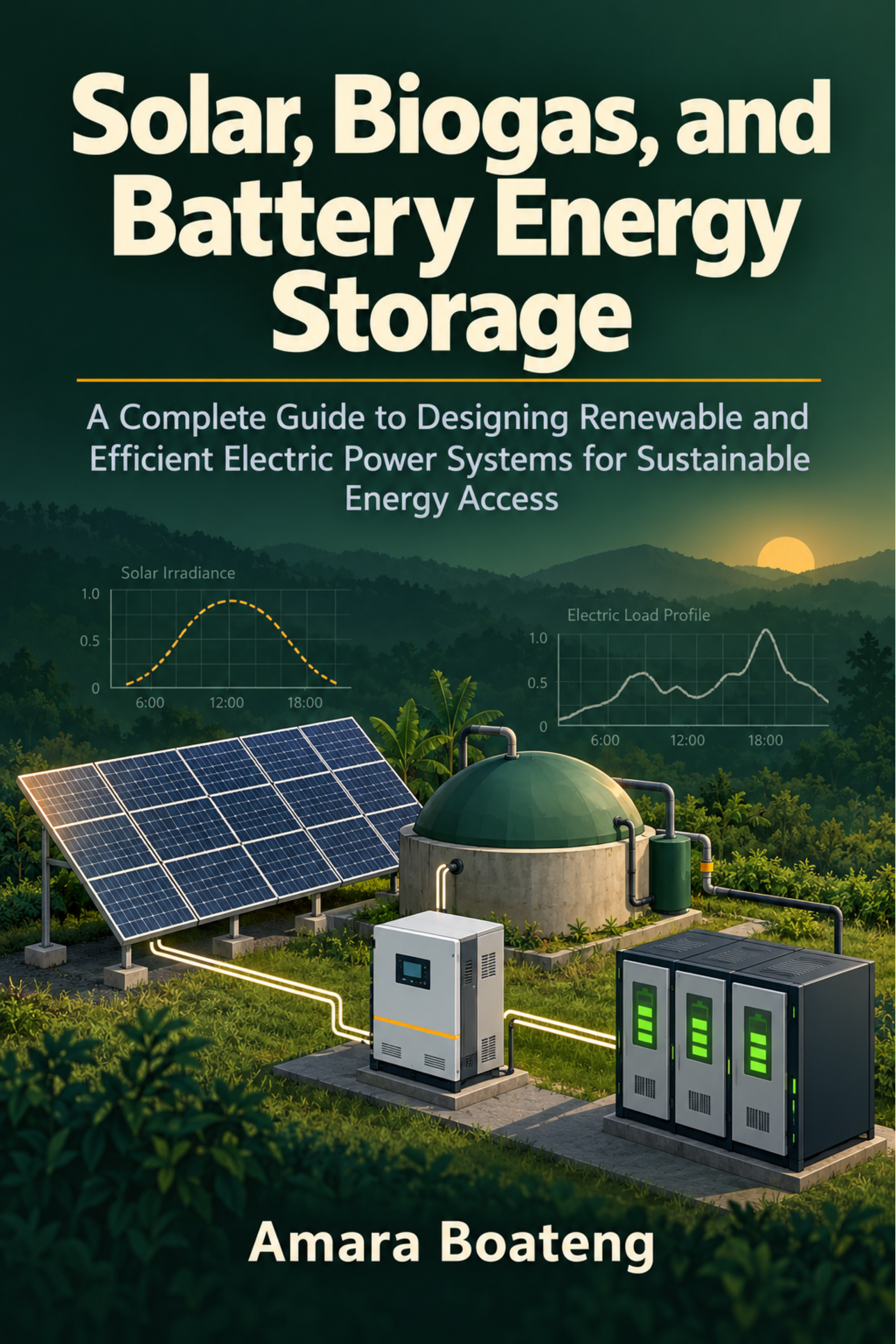
Solar, Biogas, and Battery Energy Storage
A Complete Guide to Designing Renewable and Efficient Electric Power Systems for Sustainable Energy Access
by Amara Boateng
Most renewable systems fail on arithmetic, not equipment. This book fixes that.
You begin with a real load profile, then size an array against measured irradiance, tilt and shading, choose an inverter architecture with clipping understood, and select storage with cycle life and depth of discharge as design inputs rather than marketing claims. Separate chapters take you into lithium pack design and balancing, containerised utility-scale storage and thermal runaway mitigation, and anaerobic digestion from carbon-to-nitrogen ratio through digester construction and gas scrubbing. Wind and micro-hydro are added where the resource justifies them. Wiring, protection, earthing, levelised cost and commissioning close the book.
Written for off-grid builders, energy technicians, project developers and engineering students working on sustainable energy access, this guide treats design as a sequence of measurable decisions. Every chapter connects to the next: demand estimation feeds array sizing, battery selection follows inverter architecture, and economic assessment depends on the load profile you started with. The result is a complete pathway from resource assessment to a commissioned, maintainable system.
What you will learn:
- Build accurate load profiles and demand estimates for off-grid and hybrid systems
- Assess solar irradiance, tilt, shading and array sizing against real site conditions
- Select PV cells, modules and array configurations for reliable output
- Choose inverter and power-conditioning architectures with clipping and efficiency understood
- Size standalone PV systems using cycle life and depth of discharge as design inputs
- Design lithium battery packs with balancing and management systems
- Plan utility-scale storage with thermal runaway mitigation and containerised layouts
- Apply anaerobic digestion fundamentals, digester design and gas handling
- Integrate wind and micro-hydro where the resource justifies them
- Complete wiring, protection, earthing, economics and commissioning
This book is for off-grid builders, energy technicians, project developers and engineering students who need a practical, arithmetic-first approach to renewable and efficient electric power systems. If you are designing sustainable energy access for a community, a facility or a project portfolio, the chapters here give you the sequence and the numbers to do it properly.