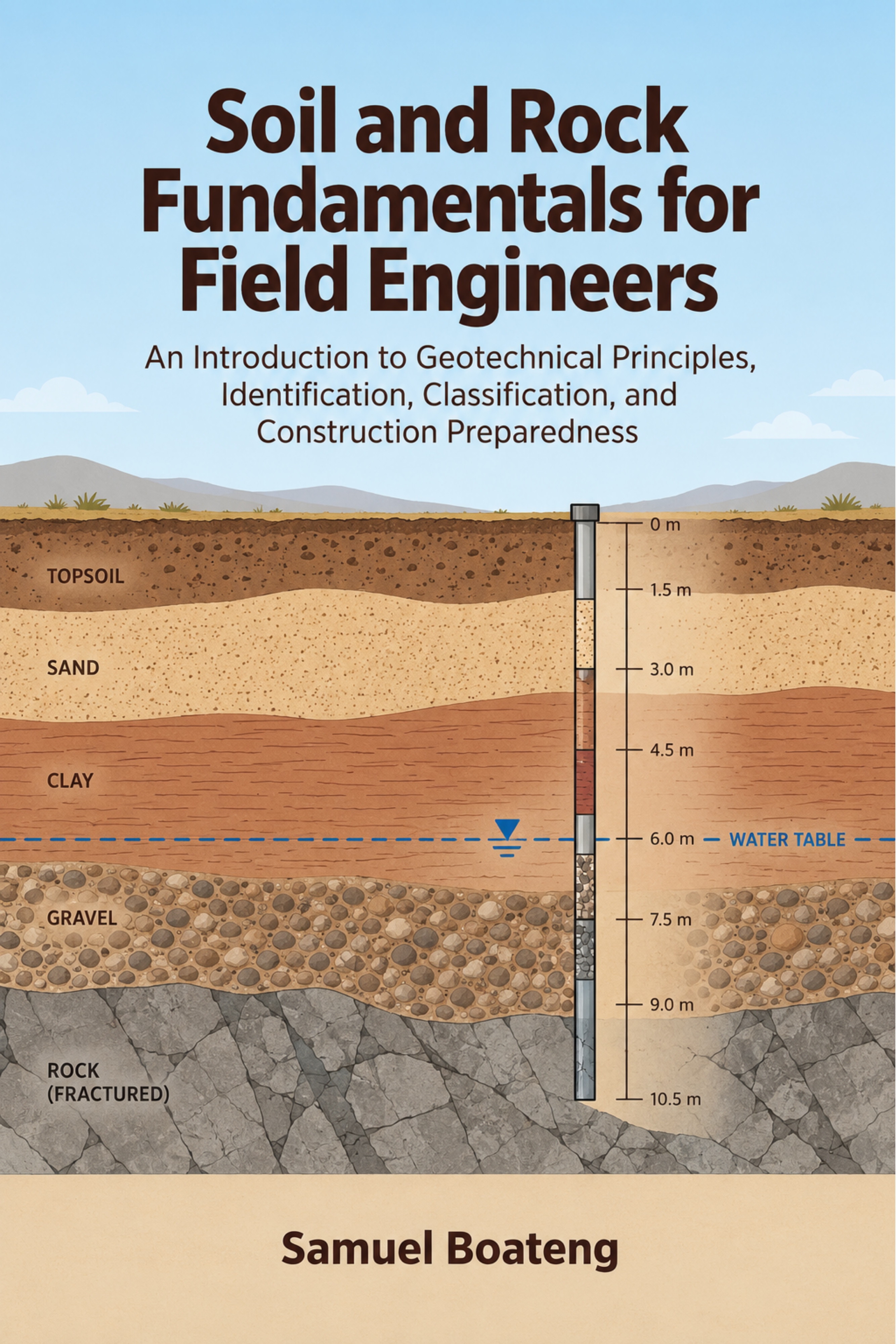
Soil and Rock Fundamentals for Field Engineers
An Introduction to Geotechnical Principles, Identification, Classification, and Construction Preparedness
by Samuel Boateng
Ground conditions decide schedules. The engineer who can read them stops being surprised.
Every delay, claim, and redesign traces back to one thing: what is actually under the site. This field guide closes the gap between textbook theory and the realities of a working construction project. It begins with the geology behind the deposits under your site, then builds phase relationships, gradation, plasticity, and classification until a borehole log becomes readable at a glance. You will identify soils by hand in the field, describe rock and its quality designation, plan an investigation with penetration testing and proper sampling, and interpret the laboratory results that come back.
Earthwork chapters cover moisture-density control, field density testing, and lift discipline—the daily decisions that make or break a fill. Later chapters take you through seepage and effective stress, consolidation settlement, slope stability, bearing capacity, earth pressures, shoring, and the problem soils that cause claims. Each topic is presented for the person standing on site, not in a lecture hall, with the vocabulary and methods needed to communicate clearly with designers, inspectors, and contractors.
What you will learn:
- Read a site's geology and understand how local deposits formed
- Use phase relationships to connect weights, volumes, and moisture content
- Classify soils by gradation, plasticity, and index properties
- Identify soil and rock in the field by hand and simple tools
- Plan site investigations with penetration testing and correct sampling
- Interpret laboratory results and turn them into field decisions
- Control compaction through moisture-density testing and lift discipline
- Apply effective stress, seepage, and consolidation to settlement problems
- Evaluate slope stability, bearing capacity, and earth pressures
- Recognize problem soils and select ground improvement approaches
For field and site engineers, construction supervisors, and civil engineering students, this book is a practical introduction to geotechnical principles that hold up under real project pressure. Keep it in the site office, use it during inspections, and let it turn ground conditions from a source of surprise into a managed part of the schedule.