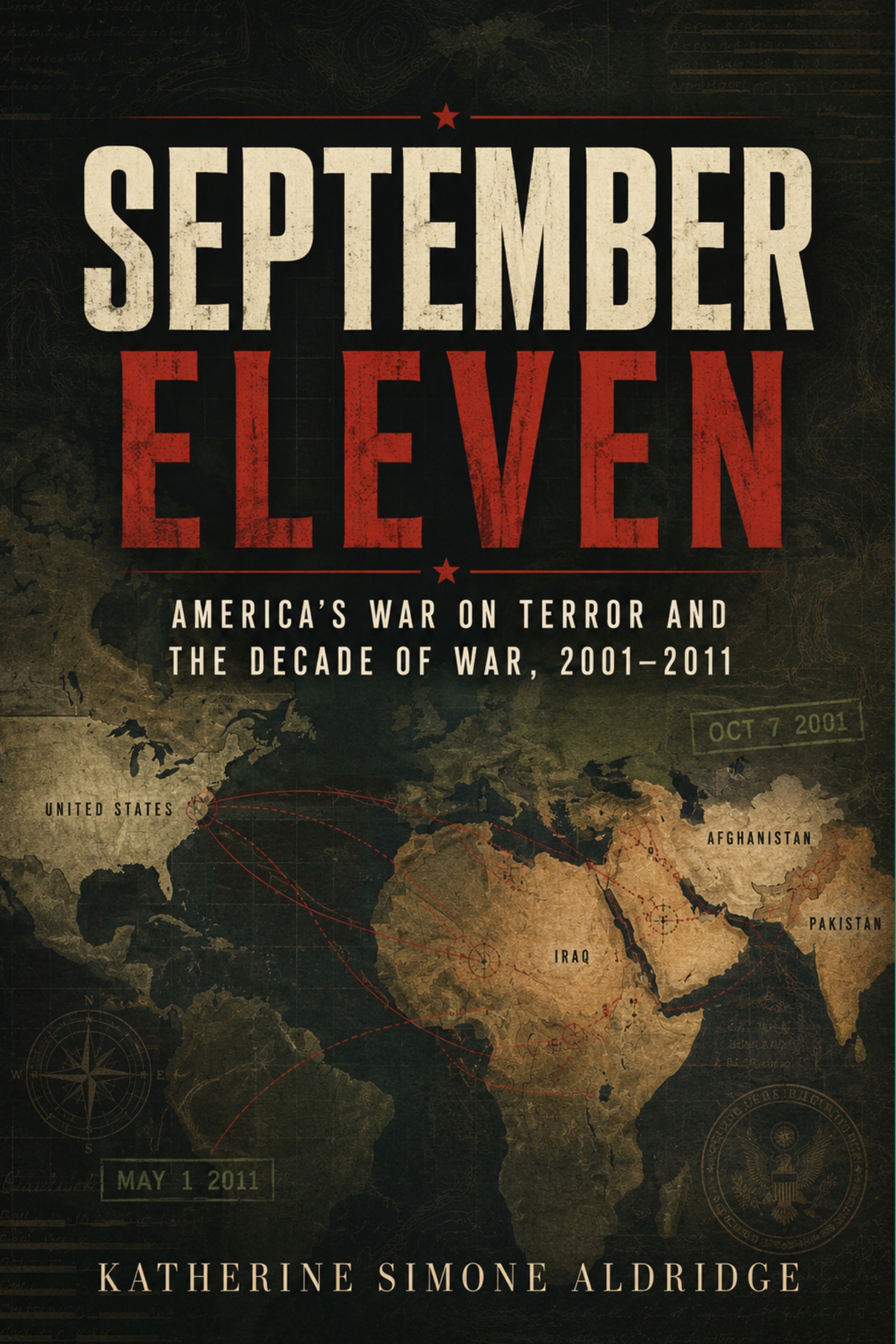
September eleven
America's War on Terror and the Decade of War, 2001-2011
by Katherine Simone Aldridge
The sky over the Northeast on September 11, 2001, was a perfect, cloudless blue. By 10:28 AM, 2,977 people were dead, the twin towers had collapsed into dust, the Pentagon's western facade had been torn open, and a field near Shanksville, Pennsylvania, held the wreckage of a fourth plane brought down by passengers who knew what was coming and chose to fight back. "Let's roll" — Todd Beamer's words before the passengers of Flight 93 charged the cockpit — became one of the defining phrases of a morning that divided American time into before and after.
In this narrative history of September 11 and its aftermath, historian Katherine Simone Aldridge traces the full decade: Osama bin Laden's radicalization in Afghanistan, the $400,000-$500,000 operation that killed nearly 3,000 people, the 9/11 Commission's findings, the Patriot Act, the Afghanistan campaign, Tora Bora, Abu Ghraib, the surge, Guantanamo, drone warfare, and the Abbottabad raid of May 2011 that killed bin Laden ten years after the attacks. She examines each major decision — and each failure — with the same clarity she brings to the attacks themselves.
Inside this 9/11 and war on terror history:
- Al-Qaeda's planning — Khalid Sheikh Mohammed's original concept, nineteen operatives, four carefully chosen transcontinental flights, and an operation estimated to cost $400,000-$500,000 (Chapter 1)
- The four planes — Flight 11 at 8:46 AM, Flight 175 at 9:03 AM, Flight 77 into the Pentagon at 9:37 AM, and Flight 93's passengers who voted, organized, and charged the cockpit door (Chapter 2)
- The towers' collapse — 600 people dead in the south tower's initial impact, more than 400 emergency responders killed, 20 people pulled alive from the rubble, and the toxic dust that produced deaths for decades (Chapter 3)
- Tora Bora: the missed opportunity — bin Laden cornered in December 2001, the request for Rangers to seal the mountain passes denied, and the decision to rely on Afghan militias who let him escape (Chapter 7)
- The Patriot Act and the security state — the 170,000-person Department of Homeland Security, the "wall" between FBI and CIA, and the surveillance architecture built in weeks (Chapters 9-10)
- Abu Ghraib and Guantanamo — the photographs, the legal frameworks, and how America's image shaped the insurgency that followed (Chapters 14, 17)
- The Abbottabad raid — the May 2011 operation that killed bin Laden and what it resolved — and what it did not — about the war on terror he had launched (Chapter 20)
September 11 history that holds two realities at once: the genuine courage of those who ran toward the towers, fought back on Flight 93, and served in the wars that followed — and the strategic failures, intelligence breakdowns, and policy choices that determined whether that courage produced lasting security or lasting war. The morning of September 11 was not a beginning. It was a culmination. And the decade that followed is still being reckoned with.
For readers of Lawrence Wright's THE LOOMING TOWER and Steve Coll's GHOST WARS.