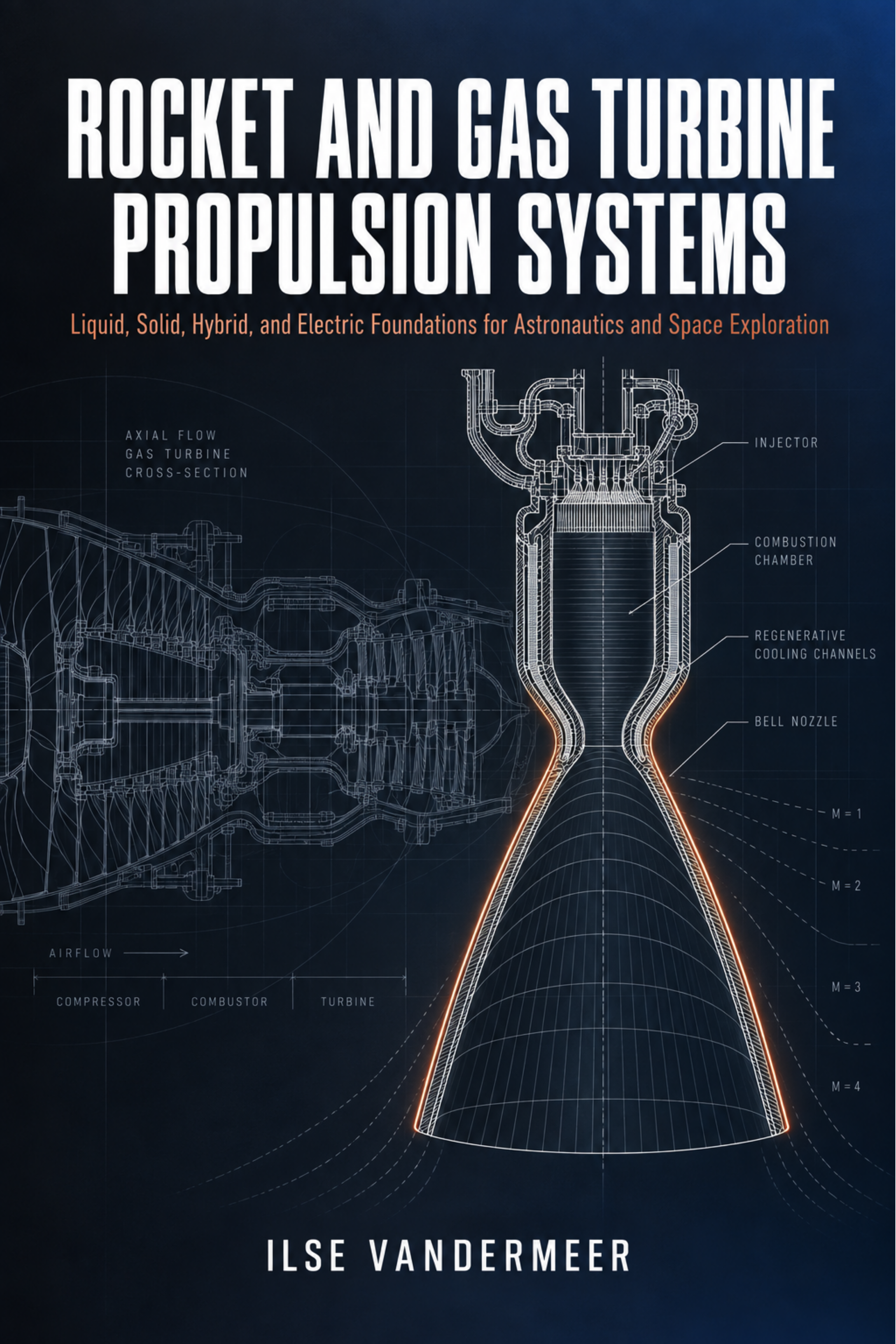
Rocket and Gas Turbine Propulsion Systems
Liquid, Solid, Hybrid, and Electric Foundations for Astronautics and Space Exploration
by Ilse Vandermeer
You have seen the thrust equation. This book shows you what stands behind it.
Rocket and Gas Turbine Propulsion Systems bridges the gap between thermodynamic theory and real hardware. Starting from stagnation properties and isentropic nozzle flow, it builds the full chain of performance parameters—characteristic velocity, thrust coefficient, and specific impulse—then moves directly into the engineering details that determine whether an engine works. You will examine turbopump cavitation margins, the four engine power cycles and their trade-offs, injector mixing and the combustion instabilities it can trigger, regenerative cooling channel design, solid grain geometry and erosive burning, hybrid regression rates, and the throughput limits of Hall and ion thrusters. Gas turbines receive equal depth, from Brayton cycle work terms to bypass ratio selection and ramjet inlet behavior. The final chapters cover staging and mission delta-v, test-stand instrumentation, range safety, materials, manufacturing, and the failure modes that end development programs. Every derivation concludes with a worked number, so you can connect each equation to a concrete design decision.
Written for propulsion students, graduate researchers, and engineers moving between rocket and turbine work, this text treats liquid, solid, hybrid, and electric systems as one connected discipline. It assumes a first course in thermodynamics and fluid mechanics but builds every propulsion-specific result from the ground up. Whether you are sizing a nozzle, selecting a power cycle, or diagnosing an instability, the book provides the analytical framework and the numerical examples to support your work.
What you will learn:
- Apply stagnation properties and isentropic flow to nozzle design and performance prediction
- Calculate characteristic velocity, thrust coefficient, and specific impulse from first principles
- Evaluate turbopump cavitation margins and select among the four engine power cycles
- Analyze injector mixing, combustion instability, and regenerative cooling channel behavior
- Design solid grain geometries and predict erosive burning effects
- Estimate hybrid rocket regression rates and electric thruster throughput limits
- Work through Brayton cycle terms, bypass ratio trade-offs, and ramjet inlet operation
- Perform staging and mission delta-v calculations with test-stand instrumentation in mind
- Identify materials, manufacturing, and failure mode constraints across propulsion systems
This book is for upper-level undergraduates, graduate students, and practicing engineers in aerospace, mechanical, and energy fields who need a unified, quantitatively rigorous treatment of rocket and gas turbine propulsion. If you are transitioning from coursework to design, or moving between rocket and turbine projects, the worked examples and hardware-focused chapters will serve as a lasting reference.