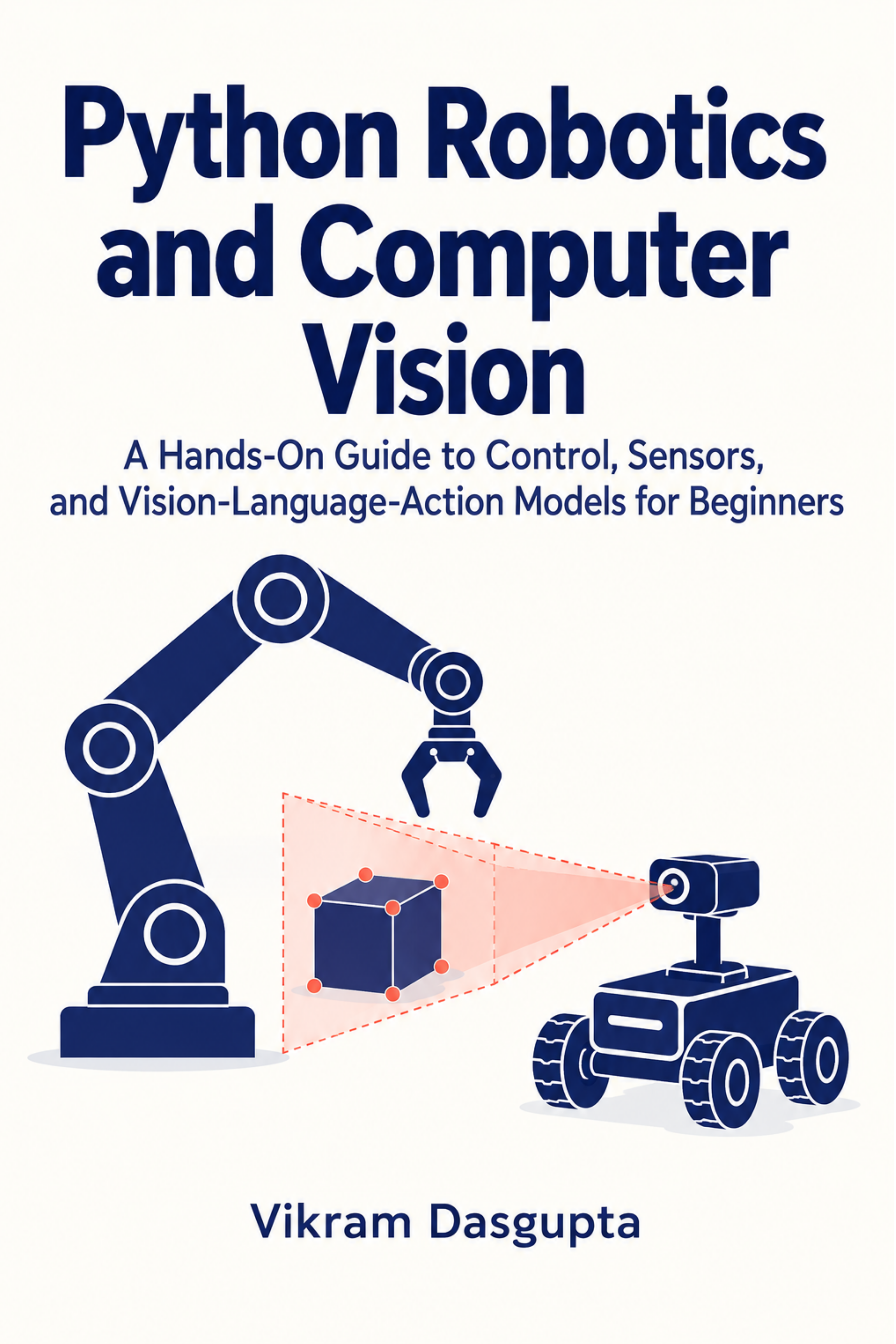
Python Robotics and Computer Vision
A Hands-On Guide to Control, Sensors, and Vision-Language-Action Models for Beginners
by Vikram Dasgupta
Build robots that see, think, and act — with Python as your only toolkit.
You want a robot that senses the world and acts on it, and you want to build it in Python. This hands-on guide starts with transforms and kinematics, then has you driving motors through tuned PID loops, fusing IMU and range data, and calibrating a camera properly before a single pixel is trusted. Every example runs in simulation first, so you can experiment safely before touching hardware.
From there you segment objects in OpenCV, estimate marker poses, run a neural detector on edge hardware, and close the loop with visual servoing and depth-camera grasping. Mapping, particle-filter localisation and path planning turn the robot loose, and the final chapter shows how vision-language-action policies and imitation learning fit alongside classical control. The progression is deliberate: each chapter builds on the last, moving from rigid-body math to a robot that can navigate a room and pick up an object it has never seen before.
What you will learn:
- Set up a complete Python robotics toolchain for simulation and real hardware
- Apply rigid-body transforms and arm kinematics to describe robot motion
- Drive wheeled mobile robots and tune PID loops with encoder feedback
- Fuse IMU and range data into a reliable state estimate
- Calibrate a camera and build classical vision pipelines in OpenCV
- Run deep vision detectors on edge hardware for real-time perception
- Implement visual servoing and depth-camera grasping
- Map an environment, localise with particle filters, and plan paths
- Understand how vision-language-action models and imitation learning complement classical control
For beginners, makers and engineering students taking their first serious step into robotics and machine vision, this book assumes only basic Python and a willingness to experiment. If you have ever wanted to move from blinking an LED to closing a perception-action loop, this is your starting point.