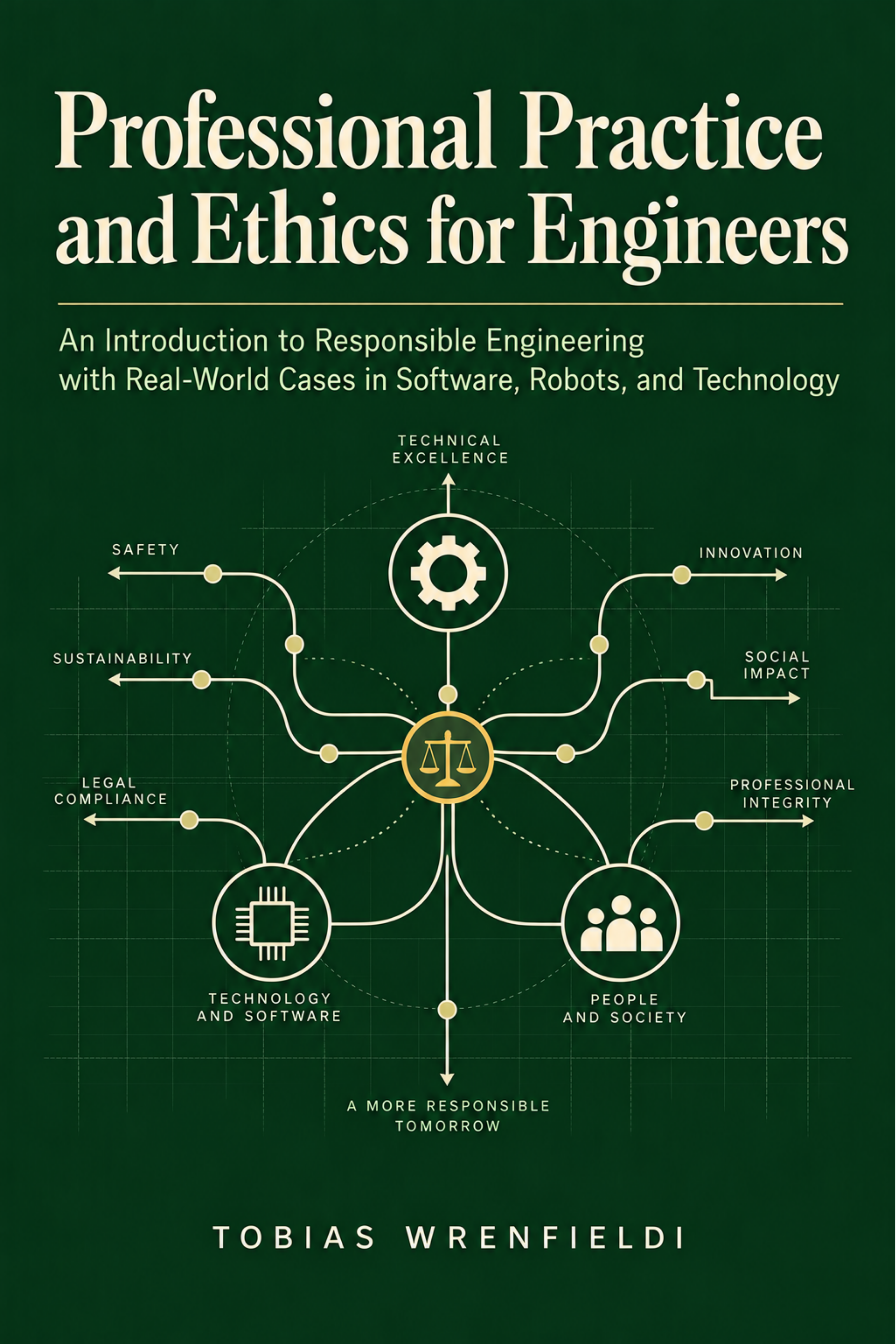
Professional Practice and Ethics for Engineers
An Introduction to Responsible Engineering with Real-World Cases in Software, Robots, and Technology
by Tobias Wrenfield
Engineering ethics is usually taught as a list of principles nobody disputes, followed by cases nobody resolves. This book does the opposite.
It gives you a working method for analysing a decision: establish the facts, identify who is affected and what is owed to them, draw lines against clear cases, search for a middle way, then document what you decided and why. That method is then applied to the situations engineers actually face, from risk acceptance and design margins to test data integrity, dissent and whistleblowing, conflicts of interest and international business norms, intellectual property and post-employment obligations, privacy and algorithmic accountability, and autonomous system oversight.
Historical and contemporary cases are analysed in full, with more left for you. The book is designed for engineering students and practising professionals who want a rigorous, practical approach to responsible engineering in software, robots, and technology.
What you will learn:
- How engineering became a profession and what that means for your obligations
- The structure and limits of professional codes of ethics
- Moral frameworks that are actually useful for practical decisions
- A step-by-step method for case analysis you can apply to any situation
- How to reason about safety, risk, and acceptable risk
- How to maintain truthfulness in technical work and handle data integrity
- How to navigate loyalty, dissent, and whistleblowing
- How to recognise and manage conflicts of interest and business conduct issues
- How to handle intellectual property, confidentiality, and post-employment obligations
- How to address privacy, algorithmic accountability, and autonomous system oversight
Who it is for: This book is written for engineering students and practising professionals who want a working method for ethical decision-making, not just a list of principles. It is suitable for courses in engineering ethics, professional practice, and technology policy, as well as for engineers in software, robotics, and other technology fields who want to think more clearly about responsibility in their work.