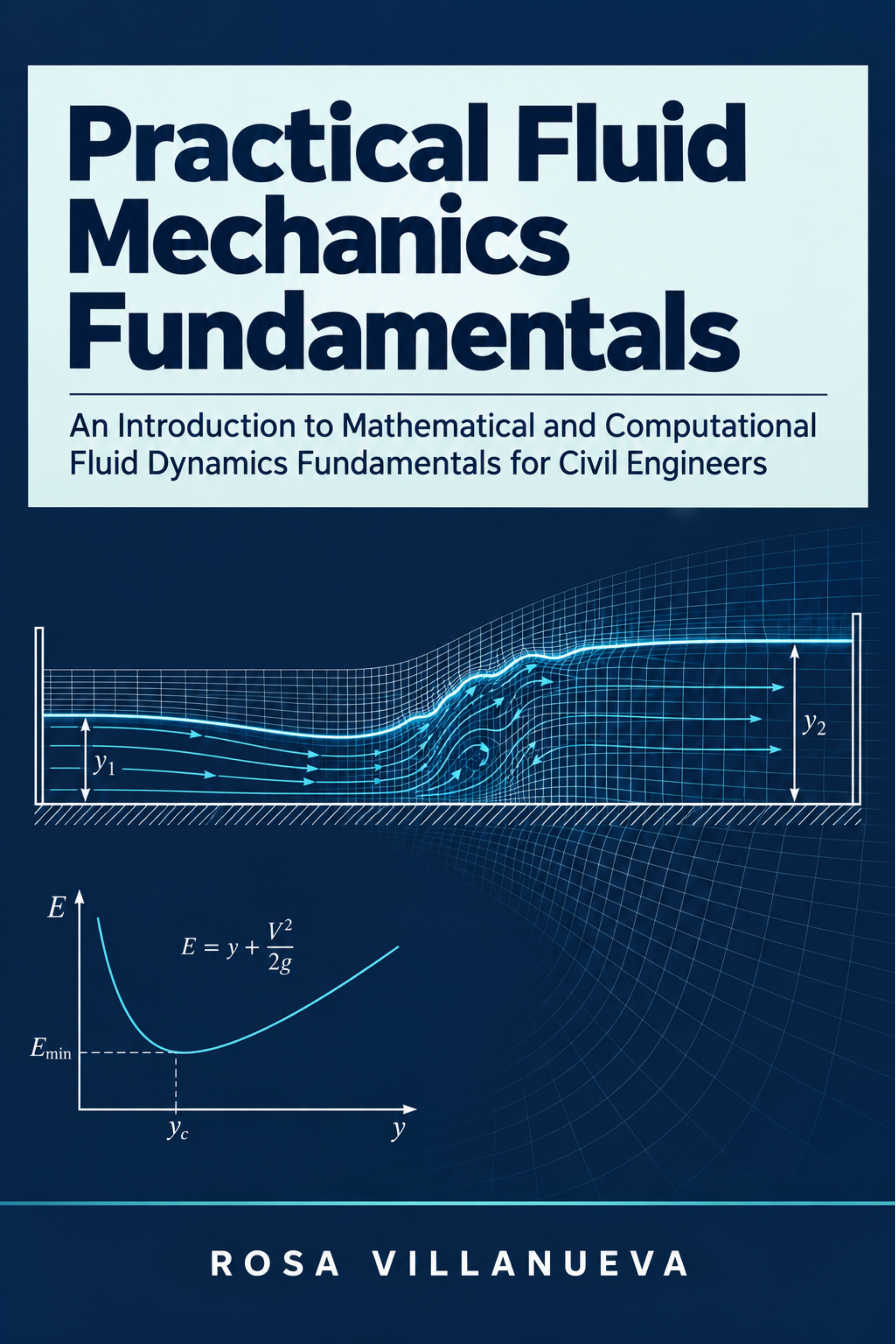
Practical Fluid Mechanics Fundamentals
An Introduction to Mathematical and Computational Fluid Dynamics Fundamentals for Civil Engineers
by Rosa Villanueva
Fluid mechanics only becomes useful when it sizes something. This book takes you there quickly.
Most fluid mechanics textbooks stop at theory. Practical Fluid Mechanics Fundamentals starts with properties and statics, then moves immediately into calculations you can use on real hydraulic works. You compute hydrostatic forces on gates, use control volumes to find the thrust on a bend, and apply the energy equation with hydraulic and energy grade lines to determine pump work. The book does not hide behind derivations; it shows you how to read the Moody chart, add minor losses, balance a looped pipe network, intersect a pump curve with a system curve, and check net positive suction head.
Open-channel chapters take you through Manning's equation, critical depth, backwater profiles, and the hydraulic jump. Later chapters cover flow measurement, drag on piers, a working introduction to computational fluid dynamics, and culvert, spillway, and scour calculations. Each chapter builds from fundamental principles to applied civil hydraulics, with an emphasis on dimensional discipline and practical problem solving. Whether you are a student learning to size a channel or a practising engineer checking a pump installation, this book provides the mathematical and computational fundamentals you need.
What you will learn:
- Compute hydrostatic forces on gates and other submerged surfaces
- Apply control volume analysis to find thrust on pipe bends and other components
- Use the energy equation with hydraulic and energy grade lines to calculate pump work
- Read the Moody chart, account for minor losses, and balance looped pipe networks
- Intersect pump and system curves and evaluate net positive suction head
- Solve open-channel flow problems using Manning's equation, critical depth, and backwater profiles
- Analyze the hydraulic jump and design stilling basins
- Measure flow and estimate drag on piers and other external flow problems
- Apply computational fluid dynamics fundamentals to civil hydraulics, including culvert, spillway, and scour calculations
Who it is for: Civil engineering students and practising engineers who need to size hydraulic works. If you want a concise, calculation-focused introduction to mathematical and computational fluid dynamics fundamentals, this book is for you.