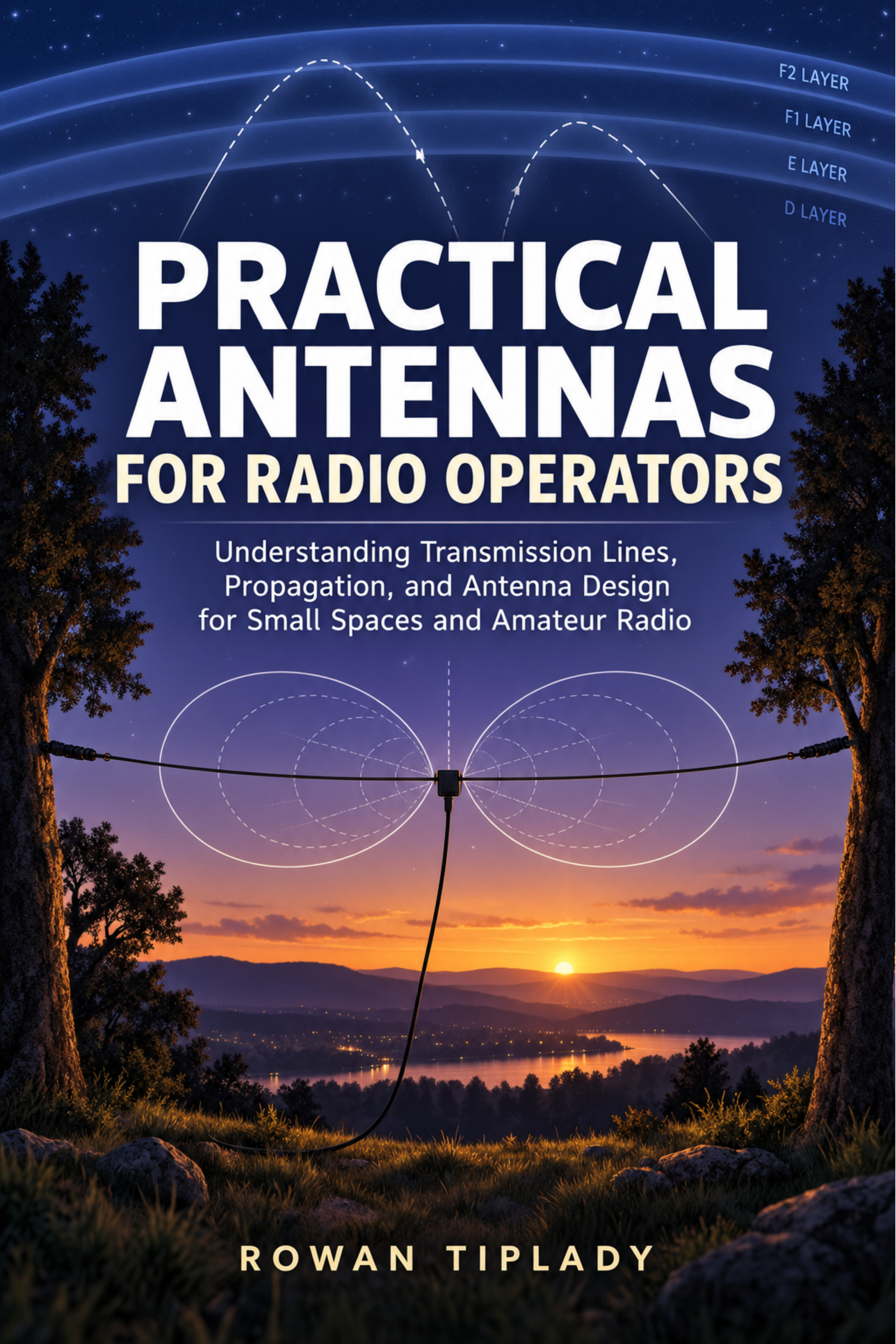
Practical Antennas for Radio Operators
Understanding Transmission Lines, Propagation, and Antenna Design for Small Spaces and Amateur Radio
by Rowan Tiplady
An antenna is a matching network to free space, and once you see it that way most of the arguments disappear.
This book gives you the reasoning and the measurements behind that statement. Rather than offering a collection of recipes or folklore, it builds your understanding from the ground up: how waves behave, why a dipole's feedpoint impedance changes with height, what take-off angle means for the band you are trying to work, how much loss your feedline is really adding at a given standing wave ratio, and when a matching network fixes a problem rather than hiding it.
Antenna chapters cover verticals and radial systems, end-fed wires, loops, Yagis and log-periodics, and a full chapter treats attic, loaded and magnetic loop options for small lots. Propagation chapters connect the ionosphere to band choice, and measurement chapters show you how to verify everything with practical tests. Whether you are a licensed operator, a newcomer, or a radio technician, you will find clear explanations that connect theory to the real world of amateur radio.
What you will learn:
- How waves, wavelength and antenna fundamentals shape everything that follows
- Why the half-wave dipole behaves as it does, including current, impedance and pattern
- How ground effects, height and take-off angle influence your signal
- How to read gain and pattern specifications without being misled
- What SWR really tells you about transmission line loss and system performance
- When matching networks, baluns and common-mode chokes help, and when they do not
- How to design and evaluate verticals, radial systems and counterpoises
- Practical options for loops, end-fed wires and multiband compromises
- How to choose and build Yagi-Uda arrays, quads and directional antennas
- Small-space solutions: attic, loaded and magnetic loop antennas
- How HF propagation and the ionosphere affect band choice
- VHF/UHF line-of-sight paths and what changes at higher frequencies
- How to measure, model and install antennas safely
This book is for licensed operators, newcomers and radio technicians who want to understand antennas from first principles and make informed decisions for their own stations. If you have ever wondered why an antenna behaves the way it does, or wanted to move beyond trial and error, this practical guide will give you the reasoning and the measurements to do so.