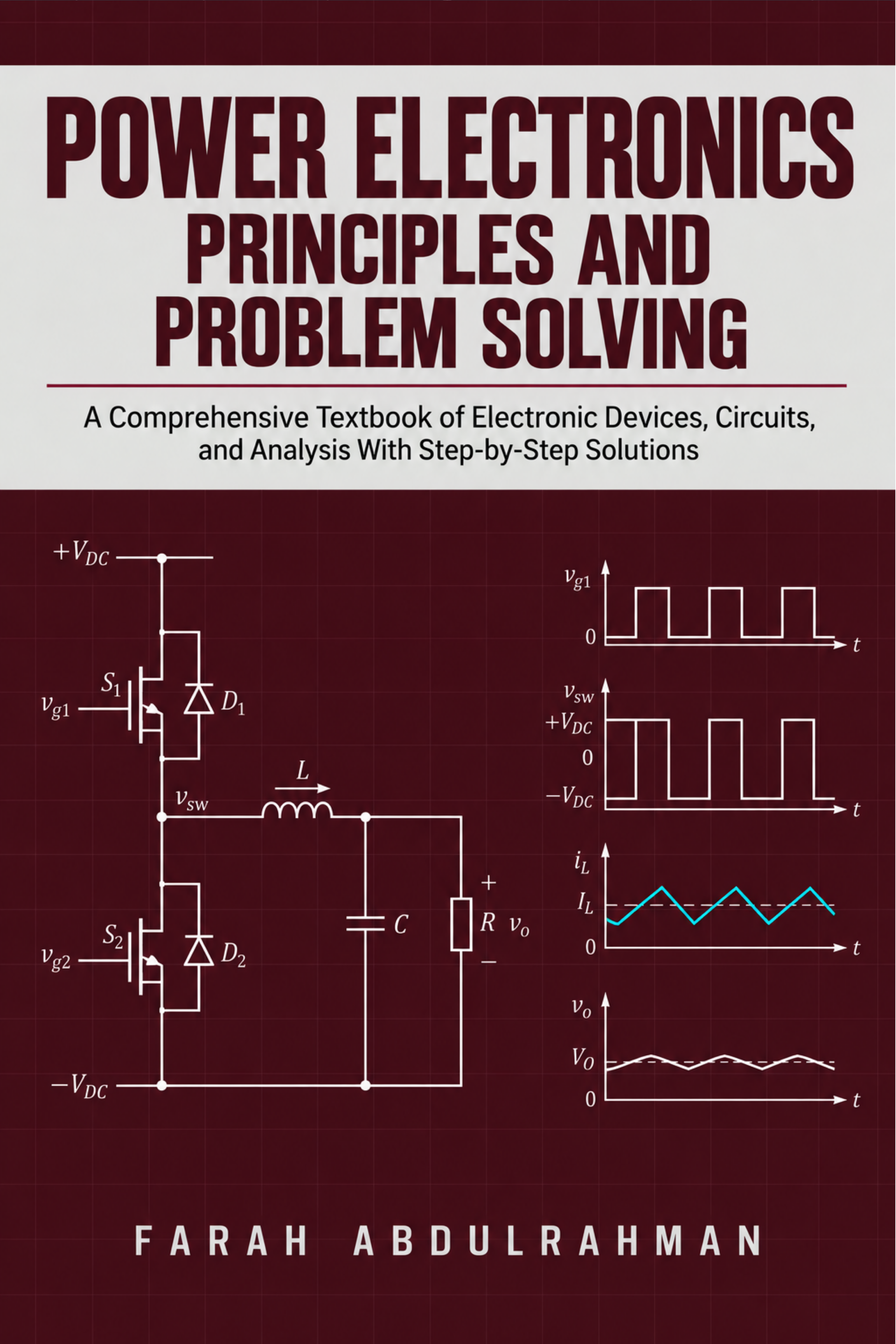
Power Electronics Principles and Problem Solving
A Comprehensive Textbook of Electronic Devices, Circuits, and Analysis With Step-by-Step Solutions
by Farah Abdulrahman
Duty ratio formulas are easy to memorise and useless when the design does not work. This book shows you where they come from and what they cost.
Power electronics is where circuit theory meets real hardware: switching devices, magnetic components, thermal limits, and control loops all interact. This textbook builds the subject from first principles, deriving every converter relation from inductor volt-second balance and capacitor charge balance. You will not just memorise equations; you will understand their assumptions, their limits, and the design trade-offs they represent.
The book begins with power processing roles and semiconductor devices, then develops steady-state analysis tools and applies them to buck, boost, and buck-boost converters, including discontinuous conduction mode. Isolated topologies such as flyback, forward, push-pull, and bridge are covered in detail, followed by a full chapter on magnetics design so you can select and wind real cores instead of guessing. Rectifier harmonics and power factor correction are treated alongside inverter modulation, dead-time distortion, motor drive control, and regeneration. Later chapters close the loop with averaged small-signal models and compensation, then address thermal design, capacitor life, electromagnetic interference, filtering, and layout. A graded problem set with step-by-step solutions completes the book.
What you will learn:
- Derive duty ratio and conversion relations from volt-second and charge balance
- Analyse buck, boost, and buck-boost converters in continuous and discontinuous conduction mode
- Design isolated converters including flyback, forward, push-pull, and bridge topologies
- Select and design magnetic components, including inductors and transformers
- Handle rectifier harmonics and design power factor correction stages
- Apply sinusoidal and space-vector modulation, and manage dead-time distortion
- Model converter dynamics with averaged small-signal techniques and design compensation
- Address thermal design, capacitor life, EMI, filtering, and PCB layout
- Solve graded problems with fully worked step-by-step solutions
This book is written for undergraduate and graduate students in electrical engineering, as well as practising design engineers who need a rigorous, practical reference. If you want to move beyond memorised formulas and build power converters that work reliably, this text provides the analysis tools, design methods, and problem-solving practice you need.