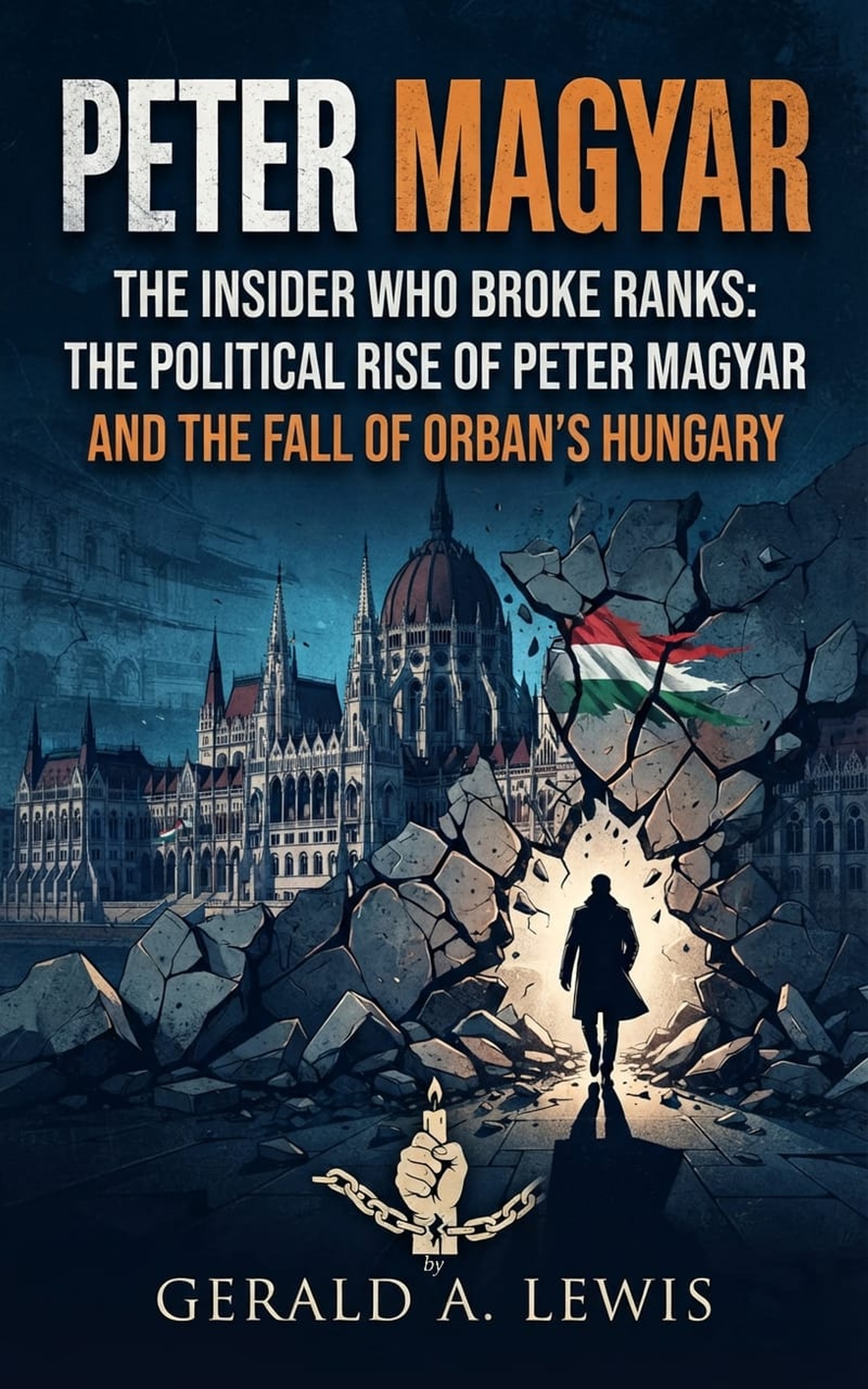
Peter magyar
The Insider Who Broke Ranks: The Political Rise of Peter Magyar and the Fall of Orban’s Hungary
by Gerald A. Lewis
In the spring of 2024, peter Magyar was nobody outside a small circle of Hungarian lawyers and civil servants. Two years later, he was prime minister — the man who ended Viktor Orban's sixteen-year hold on Hungary in a single, landslide election that gave his party a two-thirds parliamentary majority.
PETER MAGYAR: THE INSIDER WHO BROKE RANKS tells that rise from the inside out, because Magyar's story only makes sense from the inside. He was not a lifelong dissident who finally got his chance. He was the opposite: a well-connected lawyer with a board seat at a state-linked bank, a member of an exclusive Fidesz-aligned club, and for eighteen years, married to Judit vagar, one of Orban's most powerful ministers. For nearly two decades he was comfortably embedded in the very system he would later spend two years dismantling — the judiciary, the diplomatic service, the financial institutions built around loyalty to the ruling party.
Then, in February 2024, a national scandal over a presidential pardon in a child-abuse cover-up forced Hungary's president, and its justice minister, out of office within days of each other. Weeks later, Magyar released a secret recording of his ex-wife describing how officials close to Orban's cabinet chief had interfered with a separate corruption case. It was the start of the most explosive political story Hungary had produced in a generation: a presidential resignation, a divorce turned public reckoning, and the birth of a movement, compressed into a single spring.
This book follows the full arc, chapter by chapter: Magyar's upbringing in a family of judges and a former Hungarian president; his two decades inside the institutions of Orban's Hungary; the personal and professional rupture that finally pushed him out; his takeover of a forgotten, dormant party called Tisza; the improvised, three-month sprint that turned it into the country's second-largest political force in a single European Parliament election; and the two years that followed, as Tisza's lead in national polling held for over a year before the April 2026 election that ended Fidesz's sixteen-year rule.
It does not tell that story as a simple triumph. Magyar's own early backers have accused him of running his party with the same top-down loyalty culture he once served under. His platform borrows as much from Orbán's own nationalist positions on Ukraine and Russian energy as it does from the pro-European opposition he now claims to represent. And months into his premiership, the machinery built over sixteen years to answer to Fidesz — a president who has so far refused to resign, a reshaped judiciary, a state broadcaster still staffed by the old order — has not simply reorganized itself around the man who won. Even his first concrete achievement, the release of billions of euros in long-frozen EU funds, arrived as a reminder of how much of the old system remains standing around him.
Drawing on public reporting, court records, and election results rather than access or authorization, this is an independent account of how a government built specifically to be difficult to remove was removed anyway — and of the unresolved, still-being-tested man who did it. Readers looking for a clean hero's journey should look elsewhere. What this book offers instead is a fact-driven portrait of ambition, disclosure, and power in a country that just changed hands for the first time in sixteen years, written for anyone trying to understand not just how Péter Magyar won, but what kind of leader winning has actually revealed him to be.
For readers of European politics, biographies of unlikely reformers, and anyone who has watched an entrenched government insist it could never lose, this is the closest thing yet to a full accounting of how it actually happened.