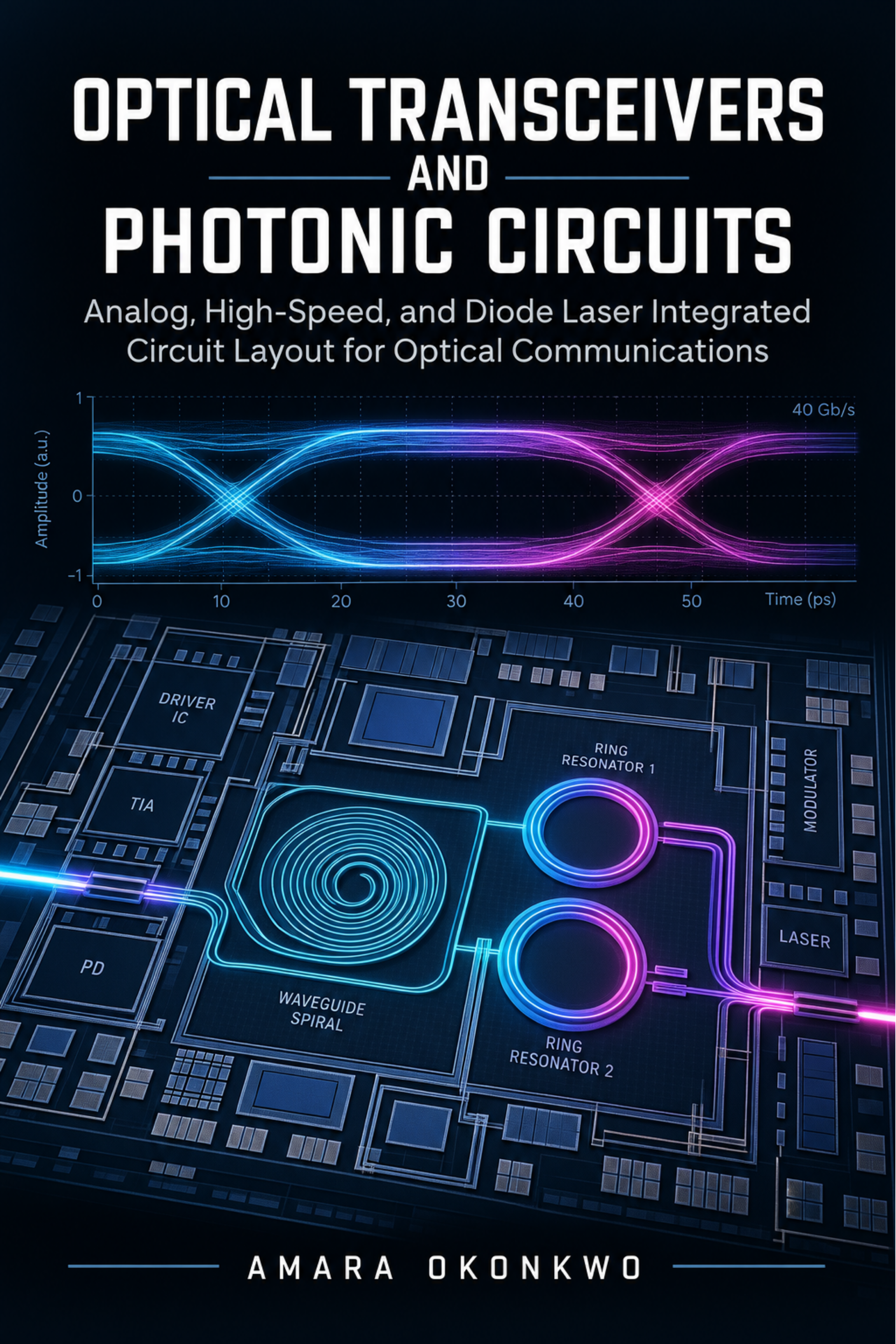
Optical Transceivers and Photonic Circuits
Analog, High-Speed, and Diode Laser Integrated Circuit Layout for Optical Communications
by Amara Okonkwo
Between the laser and the recovered bit sit a dozen circuits that must all meet budget. This book designs them with you.
An optical transceiver is not one invention but a chain of compromises: a laser that must be biased, modulated and kept cool; a driver that must swing fast without ringing; a photodiode whose every stray picofarad costs sensitivity; a transimpedance amplifier pushed against the transimpedance limit; and a clock recovery loop that must lock onto a signal already blurred by jitter and dispersion. Each stage has its own budget, and a link only closes when every one of them does. This book works through that chain from first principles, with the equations and the practical numbers side by side.
You will begin with the optical link budget and the fibre propagation limits that set the target, then work through laser rate equations to understand chirp, relaxation oscillation and noise, and use that understanding to choose between direct modulation, electroabsorption and Mach-Zehnder drive. On the receive side you will select PIN or avalanche detection, size a shunt-feedback transimpedance amplifier against the transimpedance limit and its input-referred noise, chain limiting stages, cancel offset, and close a clock recovery loop that survives real jitter. Later chapters extend the design to equalisation and four-level signalling, silicon photonic waveguides, couplers and ring modulators, and the layout, shielding, electrostatic discharge and packaging choices that decide whether a transceiver works on the bench and in the field.
What you will learn
- Build and close an optical link budget from transmitter power to receiver sensitivity
- Apply laser rate equations to chirp, relaxation oscillation and noise in diode laser design
- Compare direct modulation, electroabsorption and Mach-Zehnder drive for a given reach and rate
- Design laser and modulator driver circuits that meet speed and integrity targets
- Choose between PIN and avalanche photodetectors and predict their noise contribution
- Size a shunt-feedback transimpedance amplifier against the transimpedance limit
- Chain post-amplifiers, AGC and offset control without losing dynamic range
- Close a clock and data recovery loop that tolerates real jitter
- Extend a link to equalisation, PAM4 and higher data rates
- Lay out, shield, protect and package a transceiver so it works outside simulation
Written for analog and photonics IC engineers and graduate students, the book assumes comfort with small-signal circuit analysis and basic semiconductor device physics, and takes you from the link budget to the packaged module. It is equally suited to engineers moving into optical communications from wireline or RF design, and to graduate students who need the full signal chain in one place rather than scattered across papers.