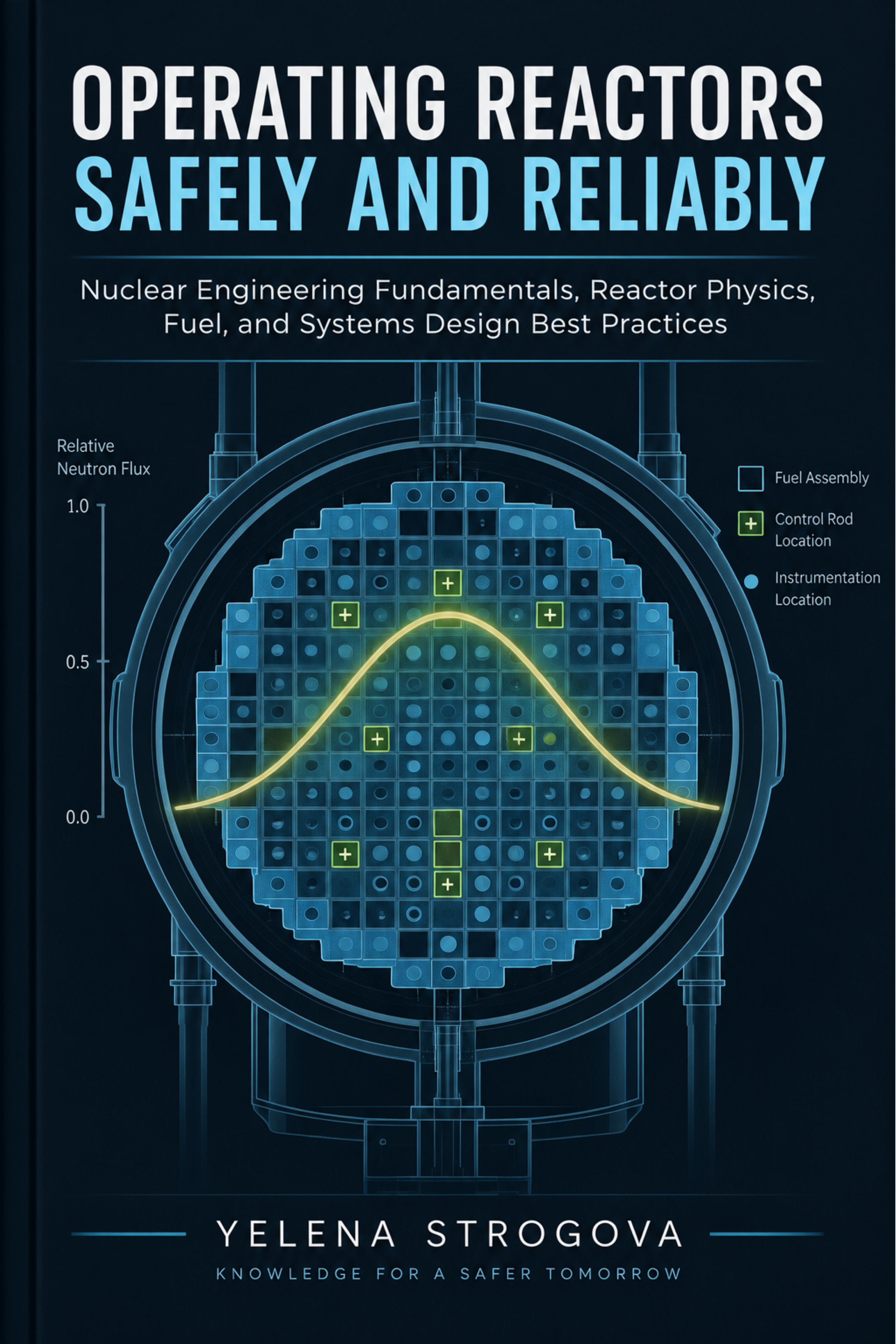
Operating Reactors Safely and Reliably
Nuclear Engineering Fundamentals, Reactor Physics, Fuel, and Systems Design Best Practices
by Yelena Strogova
A reactor is a controlled neutron economy—and every indication on the panel traces back to it.
This book makes that connection explicit. You will build the neutron life cycle and the six-factor formula from the ground up, learn why delayed neutrons make a reactor steerable at all, compute rod worth and shutdown margin, and follow a xenon transient through a power reduction to see why a restart window closes. Rather than treating physics, fuel, thermal hydraulics, and plant systems as separate subjects, the text links them into one operating picture: how reactivity is created, controlled, and ultimately limited by the fuel and the coolant.
Fuel chapters cover burnup, pellet-clad interaction, and the reliability practices that keep cladding intact. Thermal-hydraulic chapters take you to critical heat flux and the margin that defines safe power. Plant chapters compare pressurized water, boiling water, heavy water, gas-cooled, and small modular designs, then work through startup, power maneuvering, shutdown cooling, decay heat, and emergency core cooling. The final chapters connect defense in depth, containment, probabilistic risk, radiation protection, outages, and operating experience to the daily decisions made in the control room and in engineering support.
What you will learn:
- How cross sections, fission energy, and the neutron life cycle determine criticality and the six-factor formula
- Why delayed neutrons and reactivity feedback make a reactor controllable, and how kinetics governs power changes
- How control rods, soluble boron, and shutdown margin are calculated and verified
- How temperature coefficients and inherent feedback stabilize or challenge a core
- How xenon and samarium transients constrain power maneuvering and restart windows
- How fuel design, burnup, and pellet-clad interaction affect fuel reliability
- How core thermal hydraulics, departure from nucleate boiling, and critical heat flux define safe power limits
- How pressurized water, boiling water, heavy water, gas-cooled, and small modular reactors differ in systems and operation
- How decay heat, shutdown cooling, emergency core cooling, containment, and probabilistic risk support defense in depth
For nuclear engineering students, plant staff in training, and technically literate readers who want a rigorous but accessible path from neutron economy to safe, reliable operation.