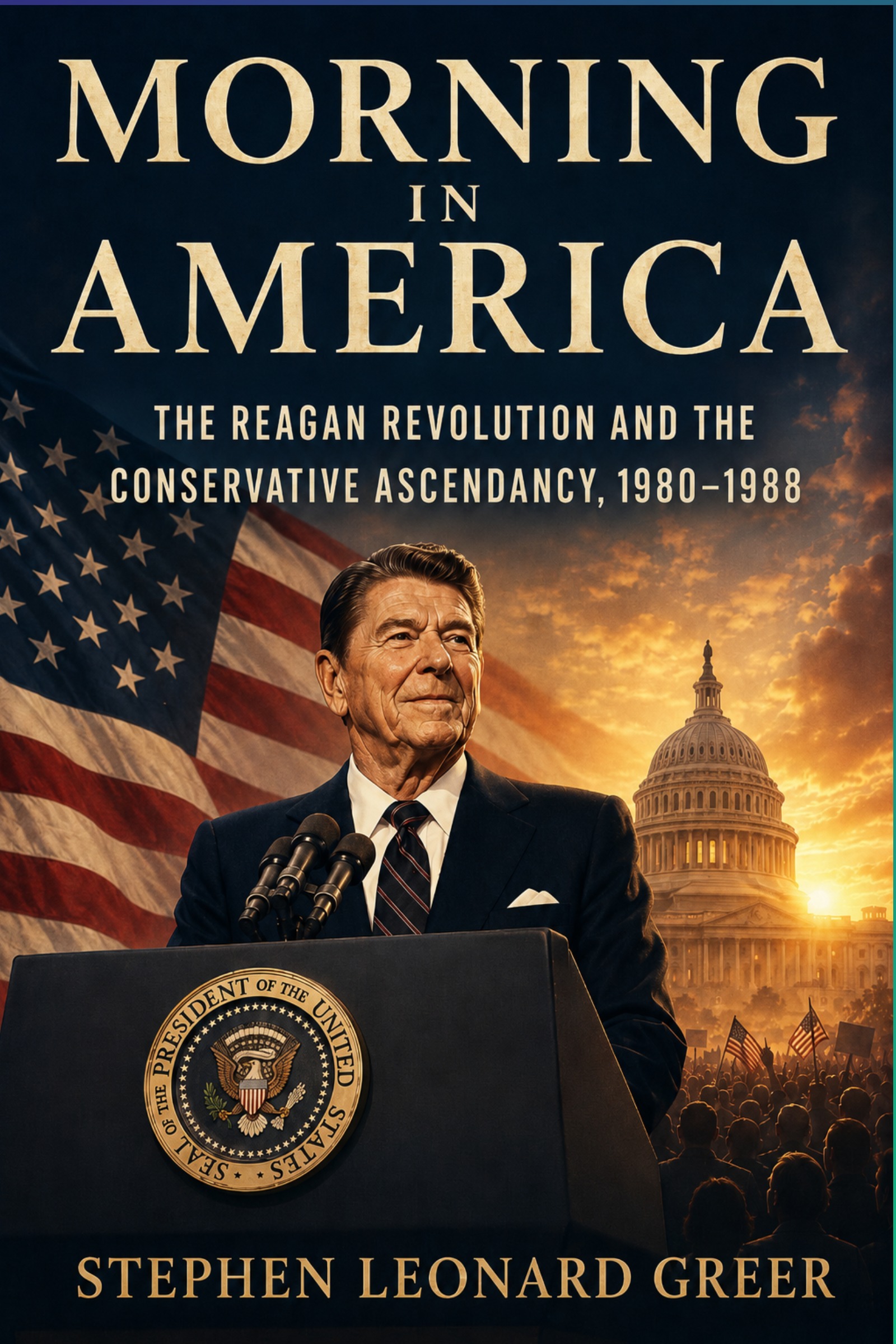
Morning In America
The Reagan Revolution and the Conservative Ascendancy, 1980-1988
by Stephen Leonard Greer
On January 20, 1981, Ronald Reagan said seven words that announced a governing philosophy: "Government is not the solution to our problem." Sixteen years earlier he had delivered "A Time for Choosing" on behalf of a man losing in a landslide. The journey from that 1964 speech to the presidency was the founding of modern conservatism as a governing ideology — and its consequences, America has been living with ever since.
This Reagan Revolution history traces the conservative ascendancy across twenty-four chapters. Historian Stephen Leonard Greer follows the movement from Goldwater's loss through the coalition Reagan assembled — Falwell's Moral Majority, Heritage Foundation infrastructure — to Reagan's 44-state landslide. The book examines what the revolution delivered: the Economic Recovery Tax Act cutting the top rate from 70 to 50 percent; the PATCO strike; the Evil Empire speech; the Reykjavik summit; and the Iran-Contra affair. Greer also delivers the record admirers prefer not to examine: the AIDS crisis in which Reagan gave no major address until 1987, after more than twenty thousand Americans had died; the 100-to-1 crack sentencing disparity; and the structural deficit that permanently altered American fiscal politics.
Inside this conservative history of the Reagan era:
- The road to Reagan — "A Time for Choosing" in 1964, stagflation and the Iran hostage crisis, Viguerie's direct mail operation, and Heritage Foundation's "Mandate for Leadership" distributed to the incoming cabinet (Chapters 1-4)
- Reaganomics — the Laffer Curve, Stockman's admission that supply-side was "trickle-down," the deficit rising from 2.7 to 6 percent of GDP, and the 1986 Tax Reform Act driving the top rate to 28 percent (Chapters 5, 7)
- Reagan's Cold War — SDI, the Reykjavik summit that nearly produced total nuclear disarmament, and the INF Treaty (Chapters 9, 11-12)
- The AIDS crisis — twelve thousand deaths before Reagan mentioned the epidemic publicly in 1985, ACT UP's die-ins at the FDA, and Surgeon General Koop's 1986 report the White House was reluctant to authorize (Chapter 15)
- Iran-Contra — North's document shredding, the Tower Commission's finding that Reagan was too detached from his own policy, and the constitutional question about covert operations never adjudicated (Chapter 16)
- The Reagan legacy — income inequality through the 1980s, the Cold War's end and the credit Reagan deserves, and the conservative era's consequences four decades on (Chapters 21-24)
In 1980, after stagflation and the Iran hostage crisis, Reagan's optimism was a genuine resource. Whether the morning he promised arrived — and for whom — is the question this Reagan Revolution history answers with the full weight of evidence from the eight years that followed.
For readers of Rick Perlstein's THE INVISIBLE BRIDGE and Sean Wilentz's THE AGE OF REAGAN.