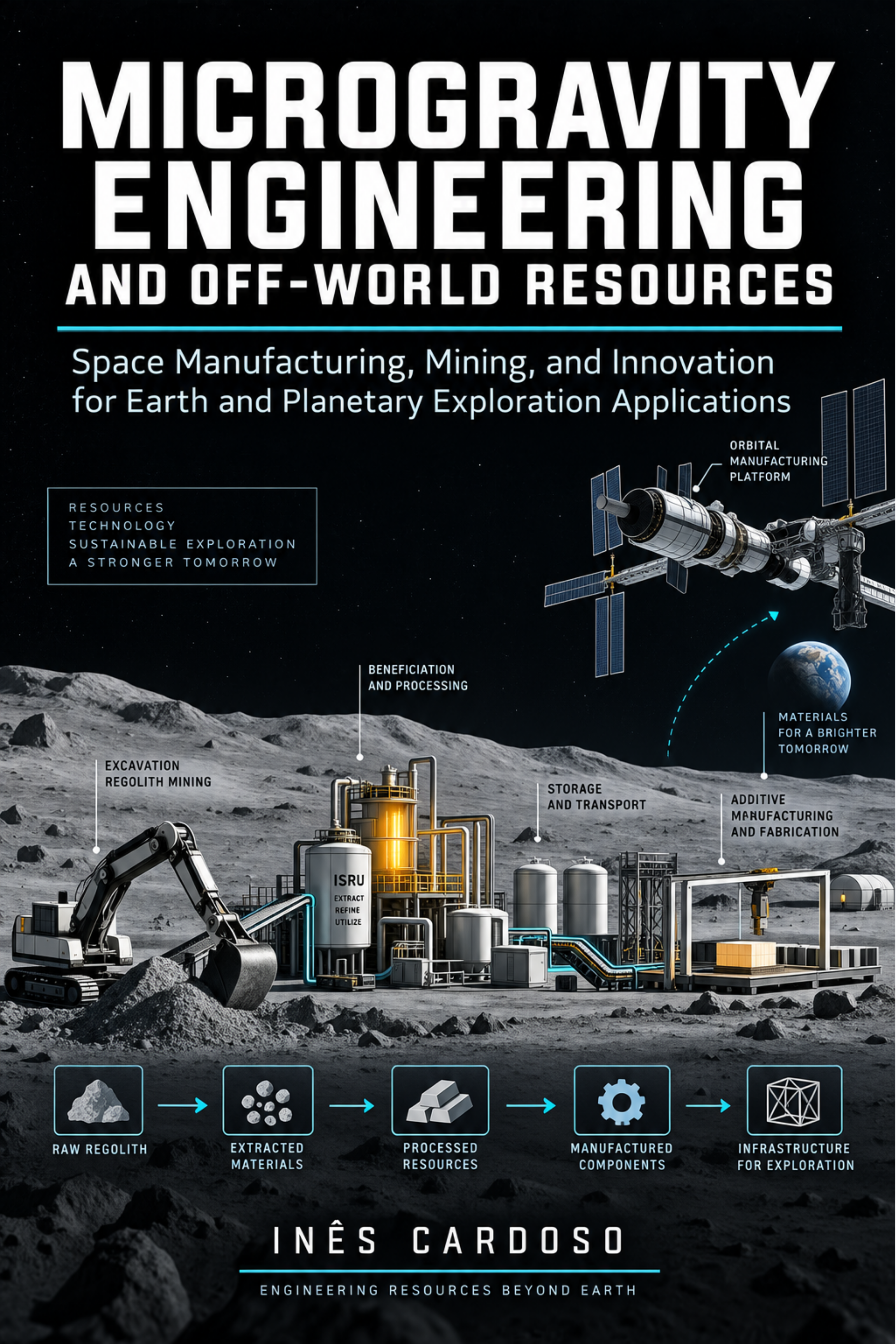
Microgravity Engineering and Off-World Resources
Space Manufacturing, Mining, and Innovation for Earth and Planetary Exploration Applications
by Inês Cardoso
Off-world mining is usually sold to you as a story. This book gives you the numbers instead.
Microgravity Engineering and Off-World Resources is a quantitative engineering reference for turning asteroid, lunar and orbital material into useful products. It treats space manufacturing as an industrial system: feedstock, energy, heat rejection, autonomy, logistics and law. You will see what microgravity does to melting, mixing and settling, work through the delta-v that separates a near-Earth asteroid from a lunar pole, and compare hydrogen reduction, carbothermal reduction and molten regolith electrolysis on kilowatt-hours per kilogram of oxygen.
The book follows the full chain from prospecting to product. It explains how ice is thermally mined and turned into propellant, how regolith is beneficiated into printable feedstock, how extrusion and wire-fed metal deposition behave in free fall, and why fluoride optical fibre and semiconductor crystals may be worth pulling in orbit. Power, radiators, dust, autonomy, cost per kilogram and the legal framework each get a chapter, so the engineering is never separated from the mission economics that decide whether a process closes.
What you will learn:
- How microgravity changes melting, mixing, settling and solidification, and what that means for process design
- How to compare orbits, delta-v budgets and mission architectures for near-Earth asteroid and lunar resource access
- Where the material is, and how to prospect and assess resources with remote and in-situ methods
- How excavation, material handling and dust control work at low gravity
- How water ice is thermally mined and converted into propellant
- How oxygen and metal are extracted from regolith by hydrogen reduction, carbothermal reduction and molten regolith electrolysis
- How refining and feedstock preparation produce printable and manufacturable materials
- How manufacturing in orbit and microgravity materials processing differ from terrestrial practice
- How power, thermal control, autonomy, cost per kilogram and the legal framework constrain real operations
Written for aerospace and mining engineers, graduate students and serious space-industry followers, this book assumes you want the engineering numbers, not the narrative. If you are designing processes, evaluating mission concepts, teaching off-world resource systems, or investing in the space industrial base, it gives you the quantitative grounding to judge what is feasible and what is not.