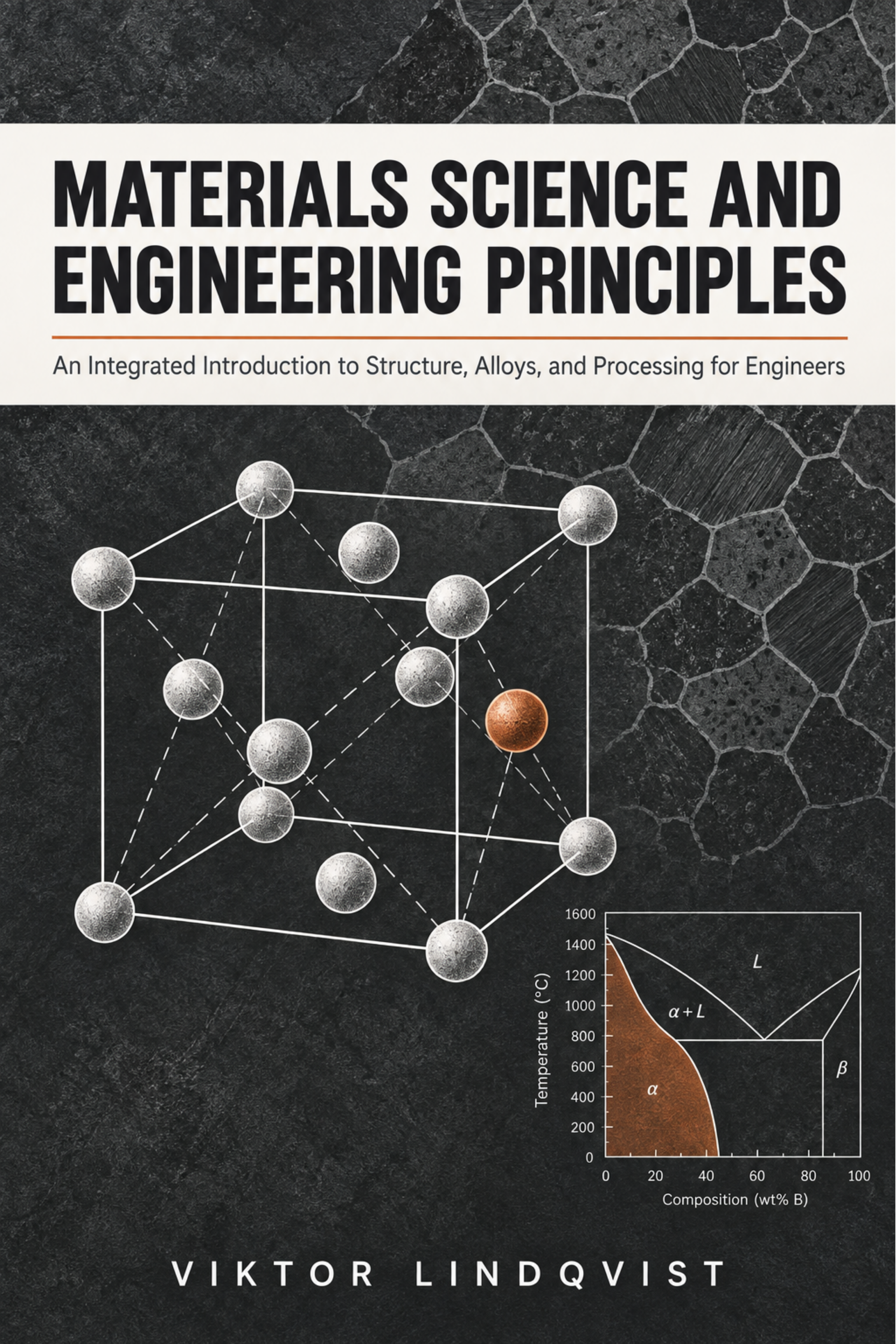
Materials Science and Engineering Principles
An Integrated Introduction to Structure, Alloys, and Processing for Engineers
by Viktor Lindqvist
Structure decides everything. This book keeps that connection in view from the first bond to the final material selection.
Why does quenched steel crack, and annealed copper bend forever? Because the arrangement of atoms, defects, and phases controls every property an engineer can measure. Materials Science and Engineering Principles builds that understanding as one continuous argument rather than a catalogue of facts. You begin with atomic bonding, crystal structures, and crystallography, then examine imperfections and diffusion before using dislocations to explain yielding, work hardening, and every strengthening mechanism in real use.
The middle of the book turns theory into practice. You read phase diagrams with the lever rule, take the iron-carbon system through transformation curves into practical heat treatment, and follow the same logic into cast irons, aluminium alloys, ceramics, glasses, polymers, and composites. Failure chapters cover fracture toughness, fatigue crack growth, and creep, while the closing chapters address corrosion mechanisms, protection methods, and a structured procedure for choosing a material and its process together. Worked numbers appear throughout, from diffusion depths to laminate stiffness, so the equations stay tied to components you can picture.
What you will learn
- How atomic bonding and crystal structure set the stage for every later property
- How point, line, and planar defects control real material behaviour
- How diffusion drives processes from carburising to sintering
- How dislocations explain yielding, work hardening, and strengthening mechanisms
- How to read phase diagrams and apply the lever rule with confidence
- How iron-carbon transformation curves translate into practical heat treatment
- How fracture toughness, fatigue crack growth, and creep lead to failure
- How ceramics, glasses, polymers, and composites differ in structure and processing
- How to select a material and its manufacturing process as one integrated decision
Written for engineering undergraduates and design engineers specifying materials, this book assumes only introductory chemistry and mechanics. Each chapter connects structure to processing to performance, giving you the reasoning to predict behaviour instead of memorising tables. Whether you are preparing for a materials course, supporting a design project, or returning to the subject from industry, the integrated approach helps you choose alloys, treatments, and processes with evidence rather than habit.