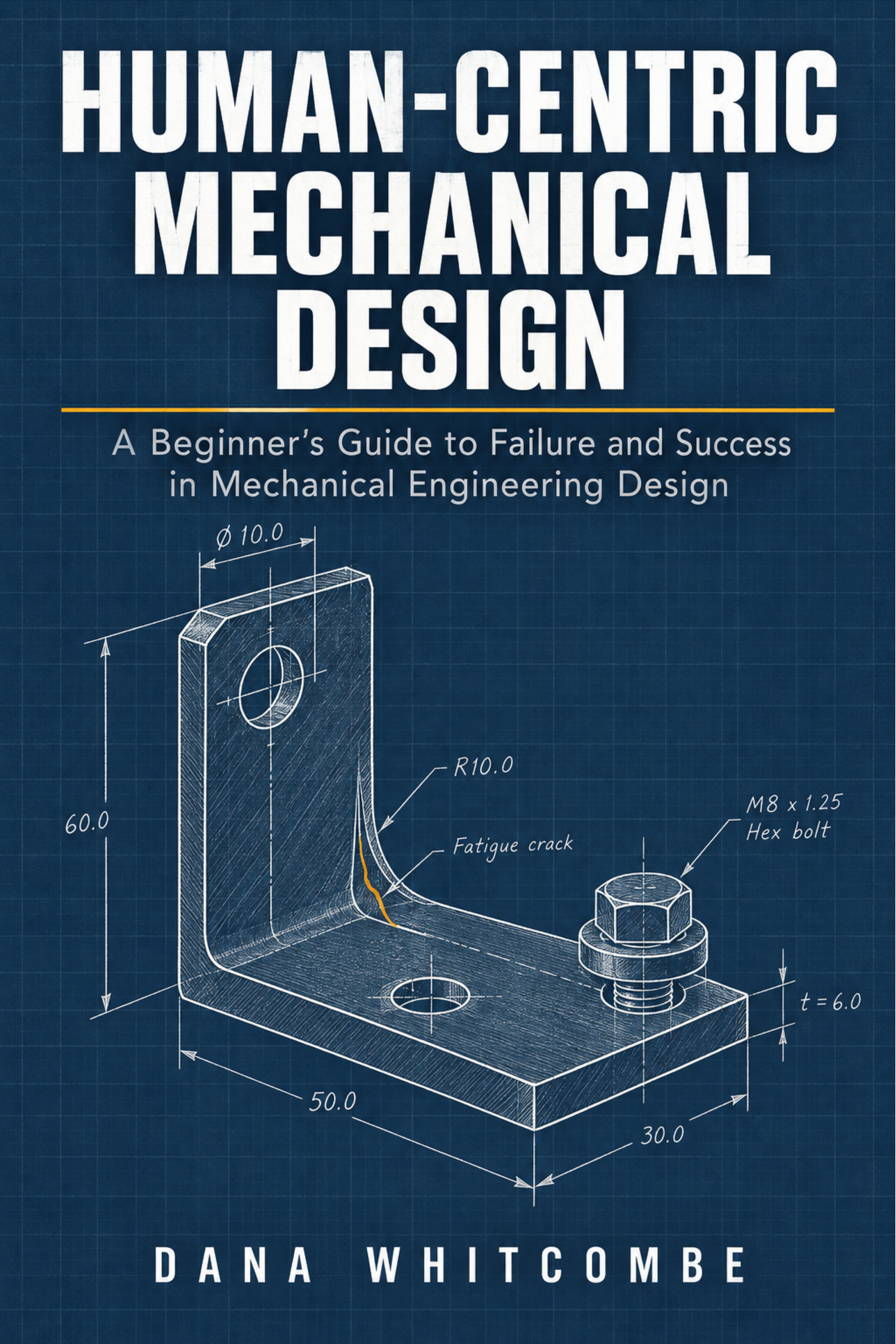
Human-Centric Mechanical Design
A Beginner's Guide to Failure and Success in Mechanical Engineering Design
by Dana Whitcombe
You can size a part correctly and still watch it break. This book shows you why.
Most mechanical engineering design texts teach you to calculate a stress and compare it to a strength. That approach works right up until it doesn't: a shaft that passes every static check cracks at a keyway after ten thousand cycles, a bracket that looked conservative buckles in service, a bolted joint that was torqued to spec loosens and leaks. Human-Centric Mechanical Design starts from the design loop that working engineers actually follow, then builds your judgement around the failure modes that cause real breakages: yielding, buckling, fatigue cracking at a notch, corrosion at a joint, and creep in a hot section.
Each technical idea is demonstrated on a component you could hold in your hand. You will work through factor-of-safety selection, S-N life estimates, crack-size limits, material property charts, tolerance stack-up, and bolt preload, seeing how each decision changes the hardware. Four famous failures are analysed in enough technical detail to identify the specific decision that caused them, not just the outcome. The final chapters turn that knowledge into practice: how to run a design review, what to document, and which tests actually verify a design rather than merely exercising it.
What you will learn:
- How the real design loop differs from the textbook version, and why iteration is the point
- How to recognise yielding, buckling, fatigue, corrosion, and creep before they choose your design for you
- How to select a factor of safety with a reason instead of a habit
- How to estimate component life from an S-N curve and set a crack-size limit
- How to read material property charts and choose a material for the failure mode you fear
- How to calculate tolerance stack-up and specify fits that can actually be manufactured
- How to set bolt preload and design joints, fasteners, and welds that stay tight
- How to run an FMEA and a design review that surface problems while they are still cheap to fix
- How to document and verify a design so the next engineer can trust it
Written for engineering students, apprentice designers, and technicians moving into design work, this guide assumes you can handle basic mechanics but does not assume you have ever had to defend a design decision. If you want to move from calculating parts to understanding why they succeed or fail, this book is your starting point.