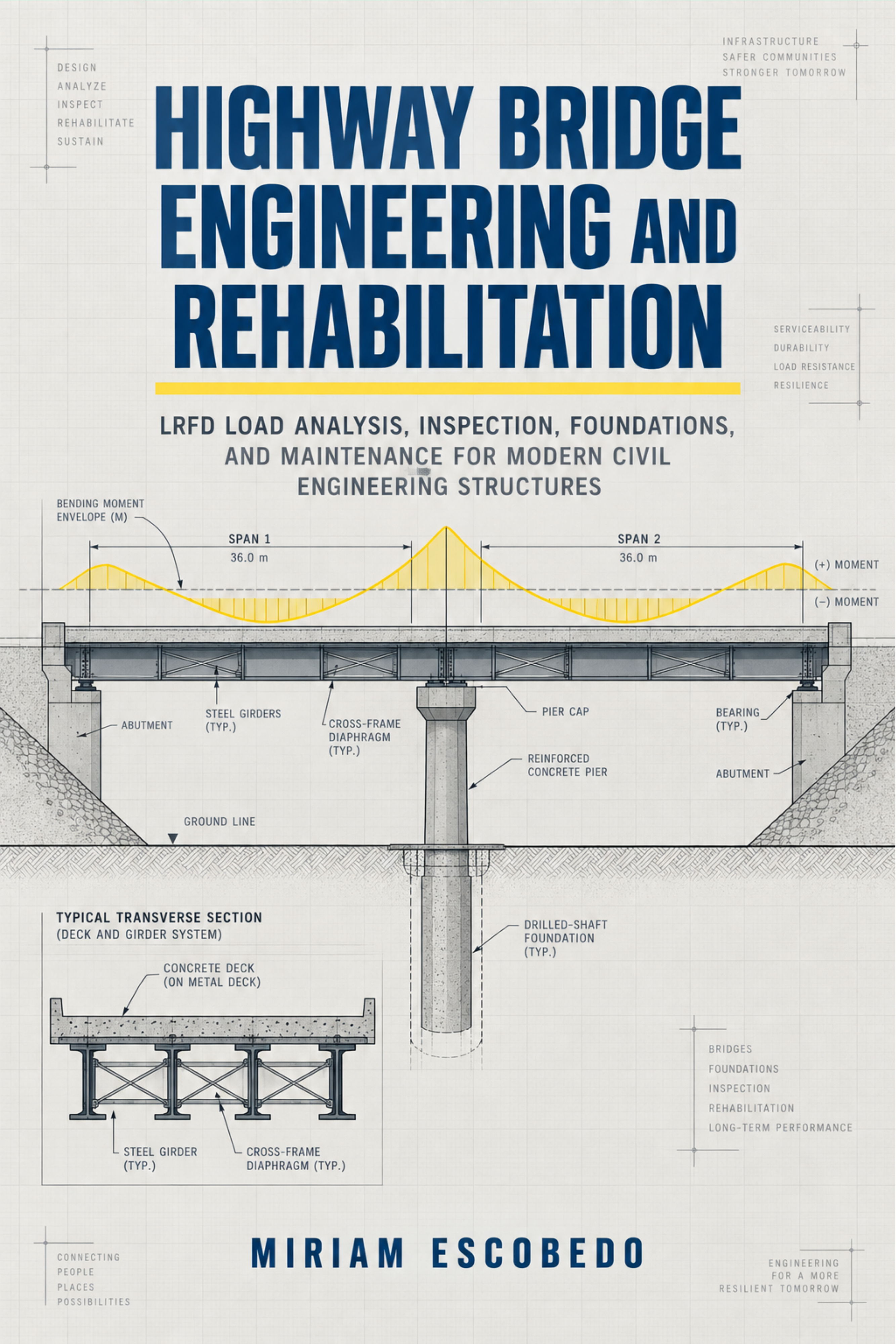
Highway Bridge Engineering and Rehabilitation
LRFD Load Analysis, Inspection, Foundations, and Maintenance for Modern Civil Engineering Structures
by Miriam Escobedo
Design it once. Judge it for seventy-five years. This is the bridge engineer's complete working reference.
A highway bridge is designed once and then inspected, rated, and repaired for the rest of its service life. Highway Bridge Engineering and Rehabilitation prepares you for both halves of that career. It begins with the fundamentals of bridge types, anatomy, and project delivery, then builds load combinations under load-and-resistance-factor design (LRFD), computes live-load distribution, and carries a single worked two-span example through flexure, shear, deflection, and fatigue checks so you can see how the pieces fit together on one real structure.
From there the book moves into member and system design: reinforced concrete decks, prestressed girders including losses and end zones, steel girders and composite action, stiffeners and shear studs, bearings, joints, piers, abutments, foundations, and scour. Later chapters turn to the assessment side of the profession. You will learn how chloride corrosion, alkali-silica reaction, and fatigue cracking actually present in the field, how element-level inspection and non-destructive evaluation are performed, how load ratings are computed from as-inspected sections, and how overlays, post-tensioning, and composite strengthening are staged under live traffic.
Whether you are checking a new design or deciding what to do with a deteriorating structure, the book connects code-based analysis to the physical bridge in front of you.
What you will learn:
- Assemble LRFD load combinations and compute live-load distribution for highway bridges
- Check a composite girder for flexure, shear, deflection, and fatigue on a worked two-span example
- Design reinforced concrete decks and detail prestressed girders, including losses and end zones
- Size stiffeners and shear studs, and evaluate bearings, joints, piers, and abutments
- Analyze foundations, scour, and geotechnical behavior, with seismic and extreme-event design
- Recognize how chloride corrosion, alkali-silica reaction, and fatigue cracking present in service
- Perform element-level inspection and non-destructive evaluation of existing bridges
- Compute load ratings and posting decisions from as-inspected sections
- Stage overlays, post-tensioning, and composite strengthening under live traffic
Who it is for: Bridge designers, inspection and rating engineers, public-agency and consulting professionals, and graduate civil engineering students who need one volume that spans LRFD analysis, design, inspection, load rating, and rehabilitation of modern highway structures.