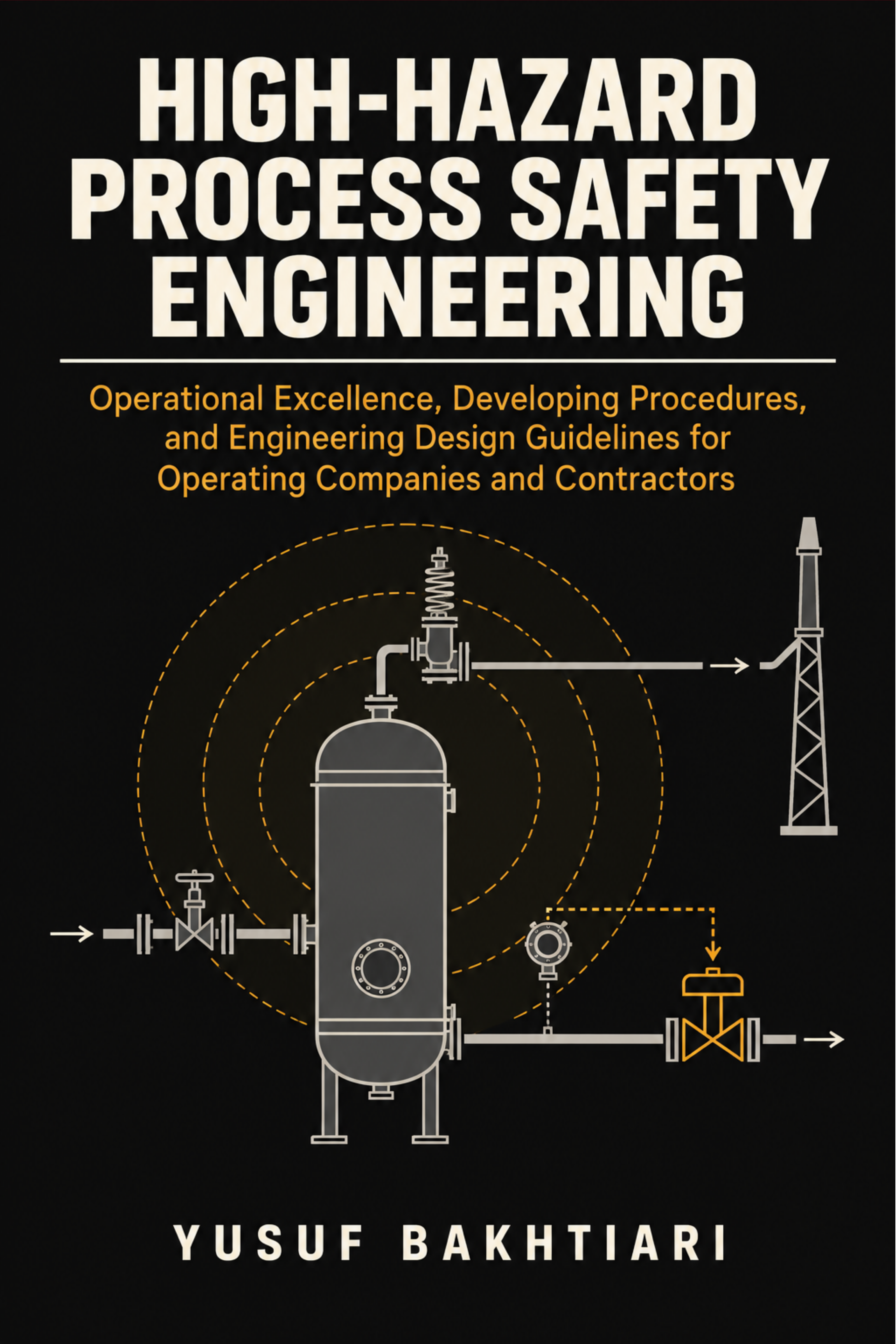
High-Hazard Process Safety Engineering
Operational Excellence, Developing Procedures, and Engineering Design Guidelines for Operating Companies and Contractors
by Yusuf Bakhtiar
High-hazard facilities rarely fail for want of a rule. They fail where the rule was written for a plant that no longer exists, or where the procedure was accurate but nobody used it as written.
This book addresses both halves of that failure. On the engineering side, it covers hazard analysis and layer of protection work, inherently safer design, layout and separation, materials and corrosion allowance, relief and effluent design, area classification, fire and gas detection, and safety instrumented function integrity. On the operating side, it covers procedure development from task analysis, conduct of operations with handover and field verification, management of change, risk-based inspection and deficiency handling, contractor oversight and permit systems, and investigation with metrics that actually lead.
Written for operating companies and contractors in high-hazard service, the book connects engineering design guidelines to the operational discipline that keeps them valid over time. It treats process safety as an integrated system, not a collection of documents. Each chapter provides practical guidance that can be applied directly to existing facilities, new projects, and contractor scopes of work.
What you will learn:
- How to build and sustain a risk-based process safety programme that fits your organisation
- Methods for process hazard analysis and layer of protection analysis that produce usable results
- How to apply inherently safer design principles and plant layout to reduce risk at the source
- Materials selection, corrosion allowance, and design for mechanical integrity
- Pressure relief and effluent handling design that accounts for real operating scenarios
- Electrical area classification, ignition control, and fire and gas detection system design
- Safety instrumented system integrity, including function testing and proof test intervals
- Procedure development from task analysis, plus conduct of operations and operational discipline
- Management of change, risk-based inspection, contractor control, permit systems, and incident investigation with leading metrics
Who it is for: Process safety engineers, operations and maintenance managers, EHS professionals, and contractors working in oil and gas, chemicals, petrochemicals, and other high-hazard industries. It is also suitable for engineers moving into process safety roles and for teams responsible for closing the gap between written procedures and actual practice.