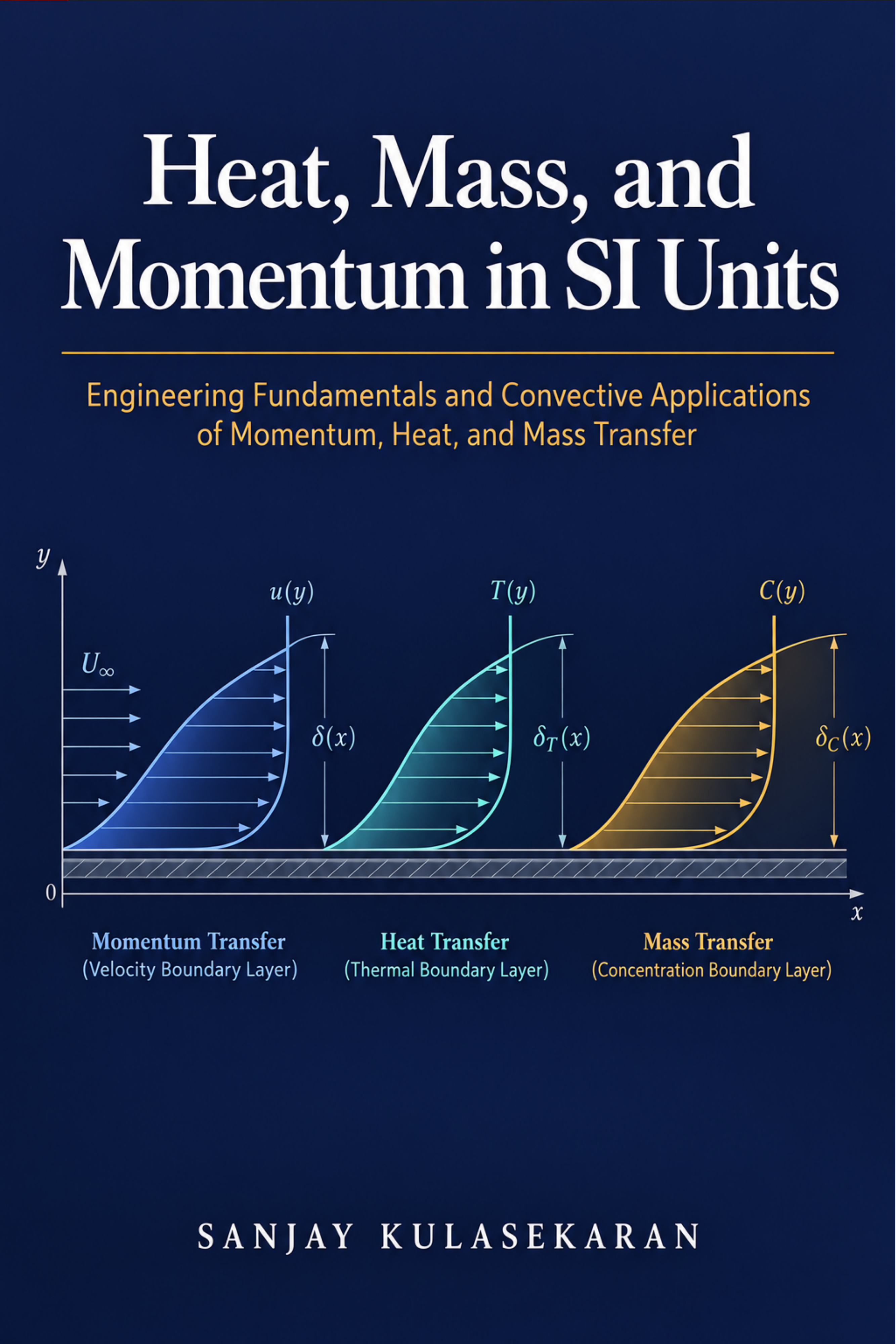
Heat, Mass, and Momentum in SI Units
Engineering Fundamentals and Convective Applications of Momentum, Heat, and Mass Transfer
by Sanjay Kulasekaran
Three courses. One physics. Finally, a book that shows you the structure.
Momentum, heat, and mass transfer are usually taught as three separate courses and examined as three separate courses, yet they are one piece of physics with three conserved quantities. This book makes that structure explicit and keeps it in front of you from the first chapter to the last. You will build integral and differential balances, derive the dimensionless groups that govern every correlation you later use, and follow the same reasoning through friction factors, boundary layers, conduction networks, convection correlations, exchanger effectiveness, radiation view factors, and finally Fick diffusion and mass transfer coefficients.
Everything is presented in SI units with property evaluation stated explicitly, so you always know what value to use and where it came from. One worked scenario is carried through all three transport modes, which means the analogies stop being a formula on a card and become a way of thinking. Derivations are shown step by step, assumptions are named, and the links between the three transport modes are highlighted rather than left for you to discover on your own.
What you will learn:
- How to set up integral and differential balances for control volumes and derive the governing equations from first principles
- How dimensional analysis and similitude produce the dimensionless groups behind every friction factor and convection correlation
- How to analyze viscous flow in ducts, external flow, and boundary layers with the same momentum reasoning
- How turbulence and turbulent transport change the equations and what that means for engineering estimates
- How to solve steady, transient, and multidimensional conduction problems using resistance networks and standard solutions
- How to select and apply forced, natural, boiling, and condensation convection correlations correctly
- How to design and rate heat exchangers using effectiveness-NTU and LMTD methods
- How to compute radiation heat transfer with view factors and surface properties
- How to apply Fick diffusion and convective mass transfer coefficients using the same framework as heat and momentum
Who it is for: Undergraduate mechanical and chemical engineering students taking transport phenomena, fluid mechanics, heat transfer, or mass transfer, and anyone revising these subjects who wants the three transport modes connected instead of memorized separately. If you have ever wondered why the same dimensionless groups keep appearing in different chapters, this book is written for you.