Engineering Thermodynamics and Thermal-Fluid Sciences
An Introduction to the Fundamentals and Laws of Thermodynamics for Engineering
by Owen Castellano
Thermodynamics stops being abstract the moment you attach it to hardware. This book keeps it attached.
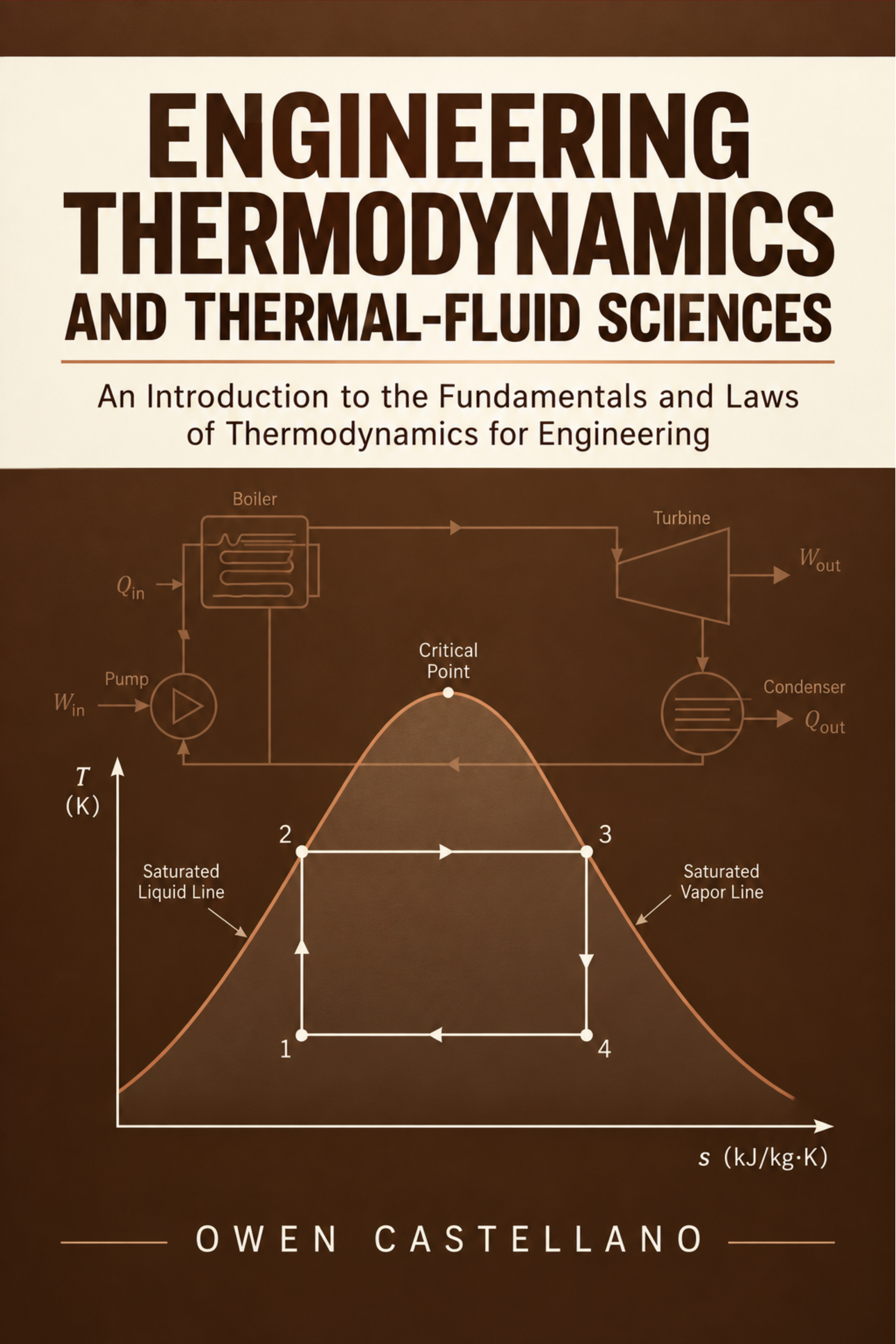
You build the first law on closed systems, then apply the steady-flow energy equation to turbines, compressors, nozzles, throttles and heat exchangers, using property tables and quality rather than memorised formulas. The second law arrives through real limits: Carnot efficiency, entropy generation, isentropic efficiency and exergy destruction you can locate in a plant. From there you analyse Otto, Diesel, Brayton, Rankine and refrigeration cycles, psychrometric processes on cooling coils and towers, and combustion with excess air and flame temperature, then cross into fluid flow and the three modes of heat transfer. Every cycle appears as a state table and a property diagram.
This book is designed for engineering undergraduates and technical professionals refreshing thermal-fluid fundamentals. It bridges theory and practice by consistently linking thermodynamic principles to hardware and real systems. Each chapter builds on the previous one, with clear explanations and worked examples that reinforce understanding. The focus is on applying concepts to analyse and design thermal systems, not just solving equations.
What you will learn:
- Master the first law for closed systems and control volumes, applying the steady-flow energy equation to turbines, compressors, nozzles, throttles and heat exchangers.
- Use property tables and quality to determine thermodynamic properties of pure substances, avoiding reliance on memorised formulas.
- Apply the second law through Carnot efficiency, entropy generation, isentropic efficiency and exergy destruction to identify real limits in power and refrigeration plants.
- Analyse gas power cycles (Otto, Diesel, Brayton) and vapour power cycles (Rankine) using state tables and property diagrams.
- Evaluate refrigeration and heat pump cycles, including psychrometric processes on cooling coils and cooling towers.
- Perform combustion calculations with excess air and determine flame temperatures.
- Understand the fundamentals of fluid flow and the three modes of heat transfer: conduction, convection and radiation.
- Connect thermodynamic analysis to practical hardware and system performance.
For engineering undergraduates and technical professionals refreshing thermal-fluid fundamentals, this book provides a solid foundation in engineering thermodynamics and thermal-fluid sciences. It is ideal for those who want to understand how thermodynamic principles apply to real-world engineering systems.