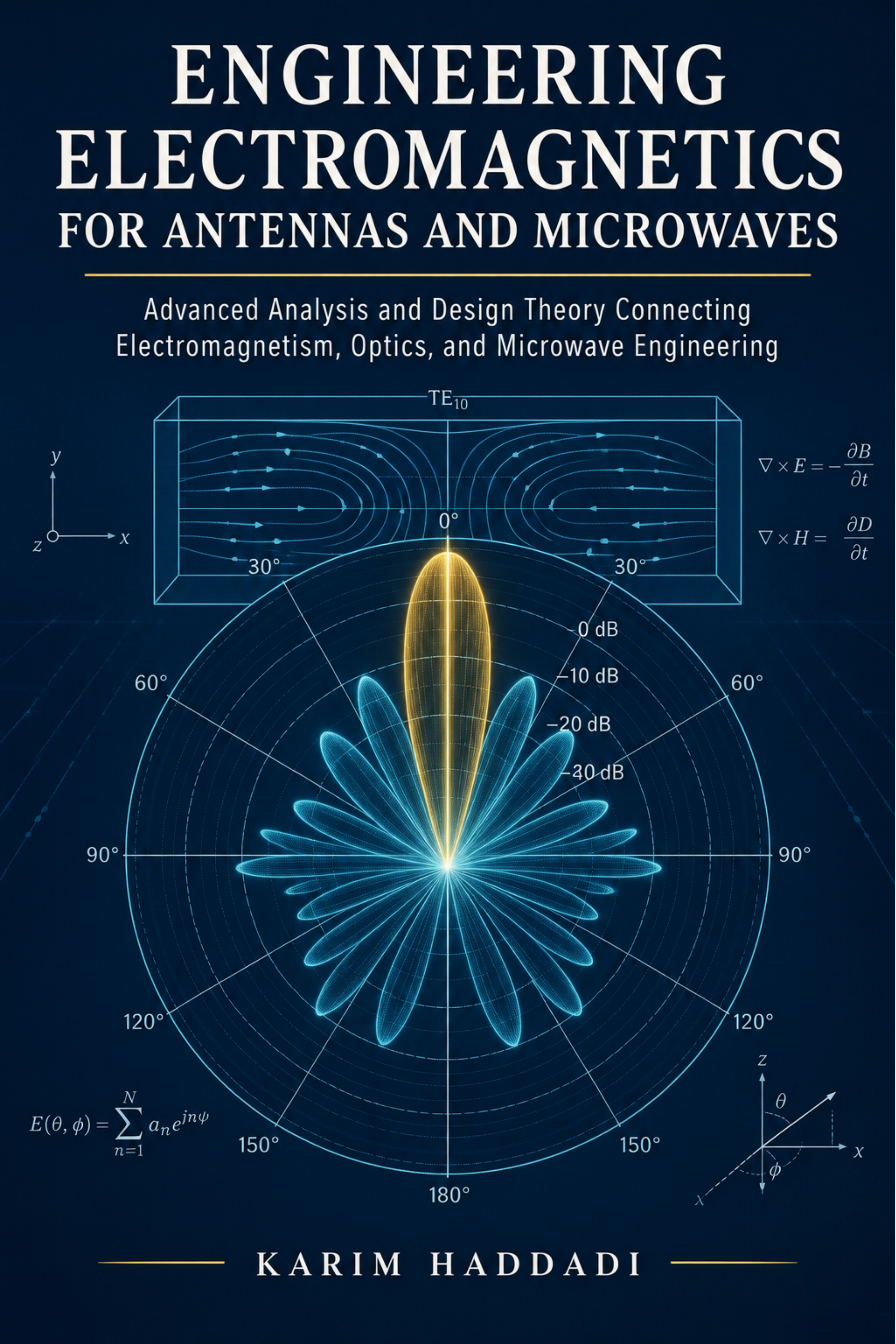
Engineering Electromagnetics for Antennas and Microwaves
Advanced Analysis and Design Theory Connecting Electromagnetism, Optics, and Microwave Engineering
by Karim Haddadi
Derive the field. Build the component. Master both halves of advanced electromagnetics.
Most books stop at the mathematics of Maxwell's equations or jump straight to a catalog of microwave components. This book keeps both halves in view. You will move from Maxwell's equations and boundary conditions through plane wave reflection, waveguide modes, and cavity quality factors to transmission lines, scattering parameters, and matching networks. Every derivation is tied to the design decisions that follow, so you understand not only why the field behaves as it does but also how to turn that behavior into a working antenna, filter, or amplifier.
Radiation chapters build Green's functions and radiation integrals from first principles, then apply them to dipoles, loops, mutual coupling, array factors, and Chebyshev synthesis, aperture and horn antennas, reflectors, and microstrip patches on real substrates. Later chapters develop physical optics and diffraction for scattering problems, implement method of moments, finite element, and finite difference time domain formulations, and close with couplers, filters, cascaded noise figure, and amplifier design. The result is a continuous thread from electromagnetic theory to system-level microwave engineering.
What you will learn:
- Apply Maxwell's equations and constitutive relations to practical boundary-value problems
- Analyze uniform plane waves, polarization, reflection, transmission, and layered media
- Design rectangular and circular waveguides, cavity resonators, and dielectric guides
- Use transmission lines, the Smith chart, and matching networks for impedance transformation
- Build Green's functions and radiation integrals for wire antennas, loops, and mutual coupling
- Synthesize array patterns with Chebyshev and other advanced techniques
- Design aperture, horn, reflector, and microstrip patch antennas on real substrates
- Model scattering and diffraction with physical optics and computational methods including MoM, FEM, and FDTD
- Integrate couplers, filters, cascaded noise figure, and amplifier design into microwave systems
Written for graduate students, antenna and microwave engineers, and candidates preparing for advanced qualifying examinations, this book assumes a working knowledge of vector calculus and undergraduate electromagnetics. It serves as both a rigorous course text and a lasting reference for professionals who need to connect electromagnetism, optics, and microwave engineering in one coherent framework.