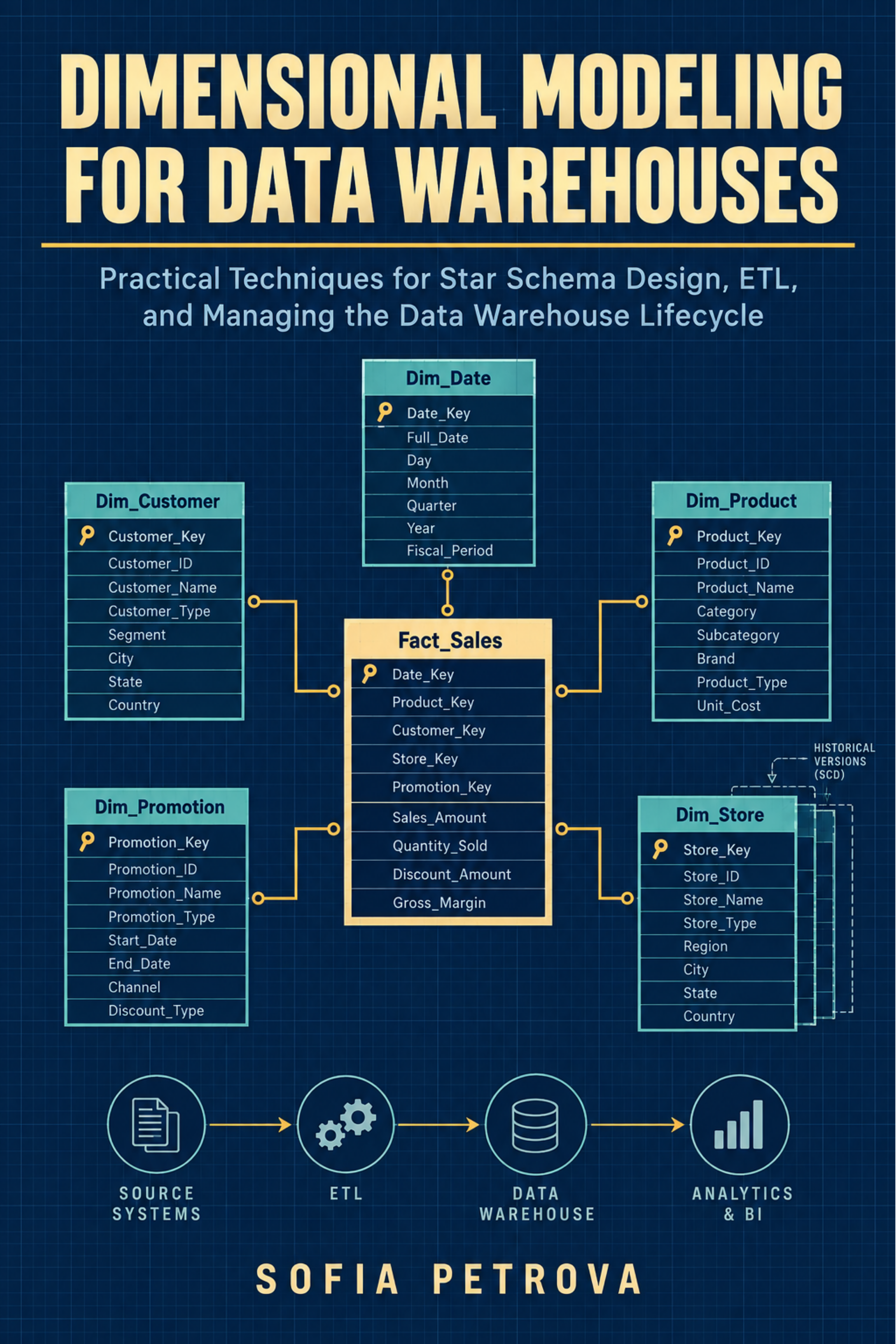
Dimensional Modeling for Data Warehouses
Practical Techniques for Star Schema Design, ETL, and Managing the Data Warehouse Lifecycle
by Sofia Petrova
A warehouse fails one grain statement at a time. This book makes the method explicit.
Most dimensional models do not collapse in a dramatic moment. They erode through vague grains, department-shaped requirements, and dimensions that cannot answer the next question. Dimensional Modeling for Data Warehouses gives you a repeatable method for building star schemas that survive real analytical pressure. You will learn to identify business processes rather than departments, build a bus matrix that sequences delivery, and declare a grain in one sentence that holds up when the business asks something new.
The book moves from architecture and requirements through the four-step dimensional design method, then into fact table types and additivity. You will choose between transaction, periodic snapshot, accumulating snapshot, and factless fact tables, handle semi-additive balances correctly, and design dimensions with surrogate keys, hierarchies, and the slowly changing approach the business actually needs. Advanced chapters cover role-playing, junk, outrigger, and mini-dimensions, bridge tables for multi-valued relationships, and complete models for retail sales, inventory, order management, and finance. Later chapters cover change data capture, quality screens, surrogate key pipelines, late-arriving data, partitioning, aggregates, semantic layers, governance, and testing on modern cloud platforms.
What you will learn:
- Apply the four-step dimensional design method to any business process
- Build a bus matrix that sequences delivery across subject areas
- Declare a grain in one sentence and defend it against real questions
- Choose between transaction, periodic snapshot, accumulating snapshot, and factless fact tables
- Handle semi-additive balances and additivity correctly
- Design dimensions with surrogate keys, hierarchies, and slowly changing dimensions
- Use advanced patterns: role-playing, junk, outrigger, mini-dimensions, and bridge tables
- Model retail sales, inventory, order management, and finance end to end
- Implement ETL subsystems, CDC, quality screens, surrogate key pipelines, and late-arriving data handling
- Plan physical design, partitioning, aggregates, semantic layers, governance, and testing
Written for data engineers, analytics engineers, and warehouse architects, this book is for practitioners who need models that stay coherent as platforms change and questions multiply. If you are responsible for the warehouse lifecycle, from requirements to evolution, this is your practical guide.