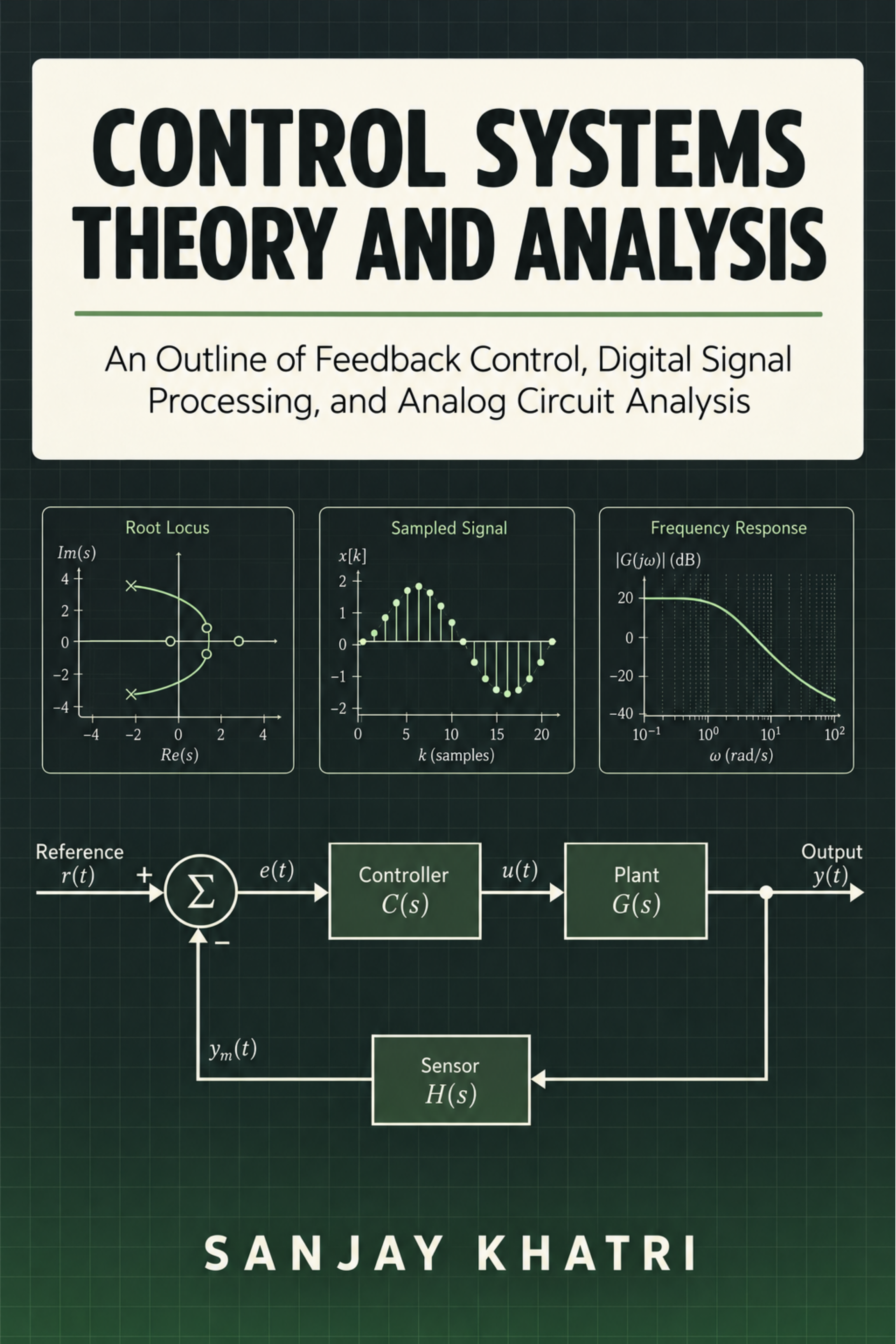
Control Systems Theory and Analysis
An Outline of Feedback Control, Digital Signal Processing, and Analog Circuit Analysis
by Sanjay Khatri
Most control texts bury the idea under transform algebra. This one tells you what each plot means before it derives anything.
Control Systems Theory and Analysis is a working outline of feedback control, digital signal processing and analog circuit analysis, written for readers who want to understand what a control system is doing before they wrestle with the mathematics behind it. The book opens with the circuit analysis and op-amp building blocks you need to model real hardware, then builds transfer functions and reads time-domain responses in terms of damping, overshoot and settling time. Stability is introduced through Routh-Hurwitz and pole locations, steady-state error through system type, and design through root locus, Bode plots, gain and phase margin and the Nyquist criterion.
From there the book moves into practical compensation: lead, lag and PID tuning, with windup and derivative-filtering fixes that matter when a controller meets a real plant. The later chapters extend the same ideas into state-space pole placement, observers, sampling, the z-transform and digital filtering. A single motor loop runs through every method, so you can compare designs honestly instead of learning each technique in isolation.
What you will learn:
- Circuit analysis and analog building blocks, including op-amp configurations used to model real hardware
- Laplace transforms, transfer functions and the modelling of physical systems
- Time-domain response: damping, overshoot, rise time and settling time
- Stability by Routh-Hurwitz and pole location, and steady-state error by system type
- Root locus, frequency response, Bode plots, gain and phase margin, and the Nyquist criterion
- Lead, lag and PID compensation, including windup and derivative-filtering fixes
- State-space methods: pole placement and observer design
- Sampling, the z-transform and digital control loops
- Digital signal processing techniques applied to control systems
Written for electrical and mechanical engineering students and for self-taught engineers who want a clear, method-by-method outline they can return to while studying or designing, this book keeps the focus on what each tool tells you about a system and when to reach for it.