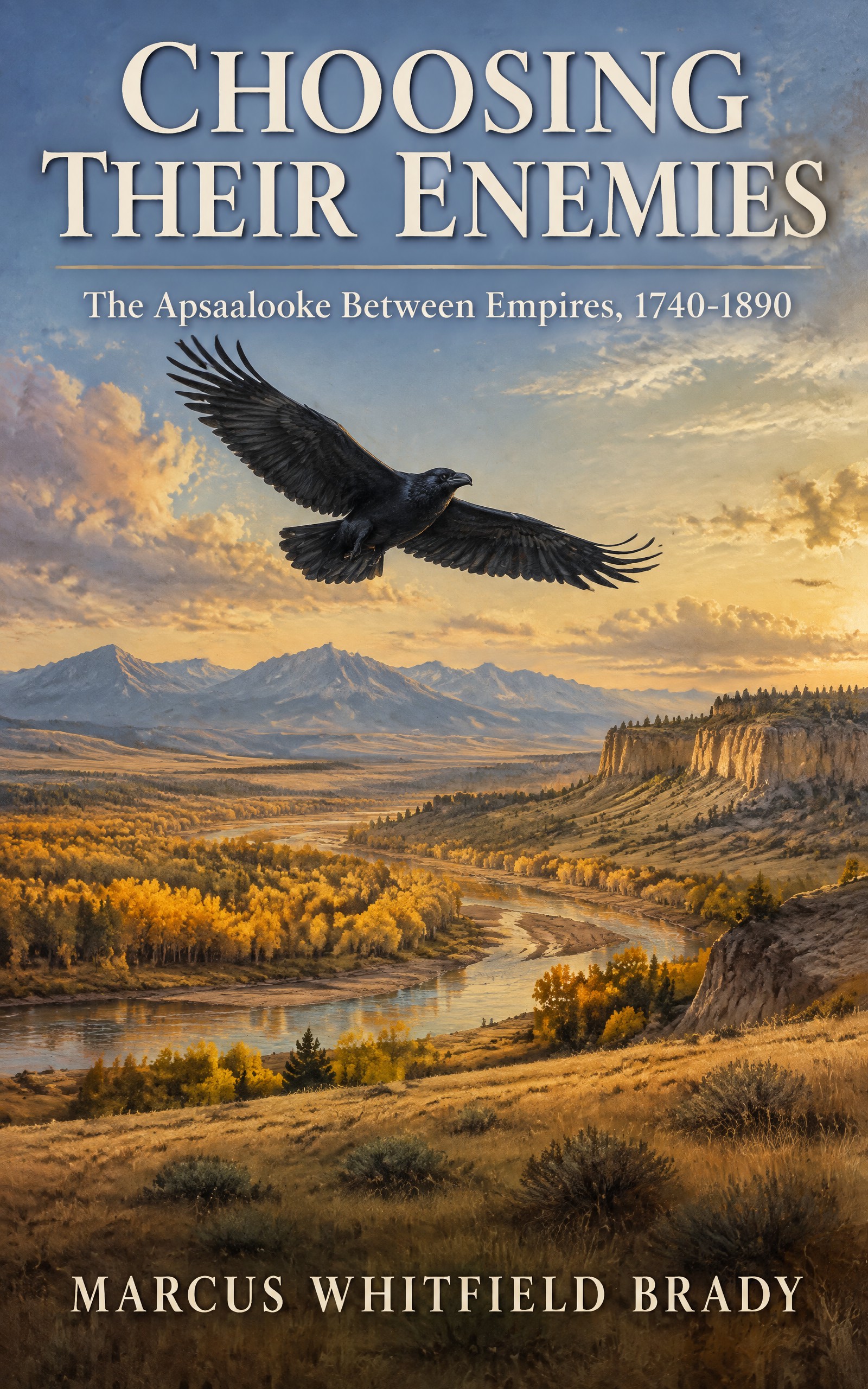
Choosing Their Enemies: The Apsaalooke Between Empires, 1740-1890
by Marcus Whitfield Brady
Some Hidatsa traditions remember it as an abandonment. The Apsaalooke remember it as a birth. In the story as it comes down, a woman sets a parfleche of dried corn and a horn spoon outside an earth-lodge door on the upper Missouri before dawn, walks to the river, and does not turn around. Her husband's family sleeps inside. Her father's family has already gone.
The split, sometime around 1700, was never quite a war and never quite a divorce. What made it possible was the horse. Corn does not run, and the settled Hidatsa towns had no need to chase the herds, but for the faction already halfway out the door, "the horse was the door." They rode west up the Yellowstone into the country of the Bighorn, the Musselshell and the Powder, and called themselves children of the large-beaked bird. Traders called them Crow.
Between 1740 and 1890 they defended that country between rival powers: the Blackfeet to the west, the Lakota pressing in from the east, and finally the United States. The fur-trade rendezvous, the Fort Laramie treaty of 1851, the Powder River war, the Crow scouts who rode with the Army, and the Nez Perce flight across their land in 1877 all come before the last of the bison, the reservation, and the long fight over its boundary.
Every August the Apsaalooke raise their lodges by the hundreds along the Little Bighorn for Crow Fair, where the book ends. They went looking for a better country, and they are still in it.