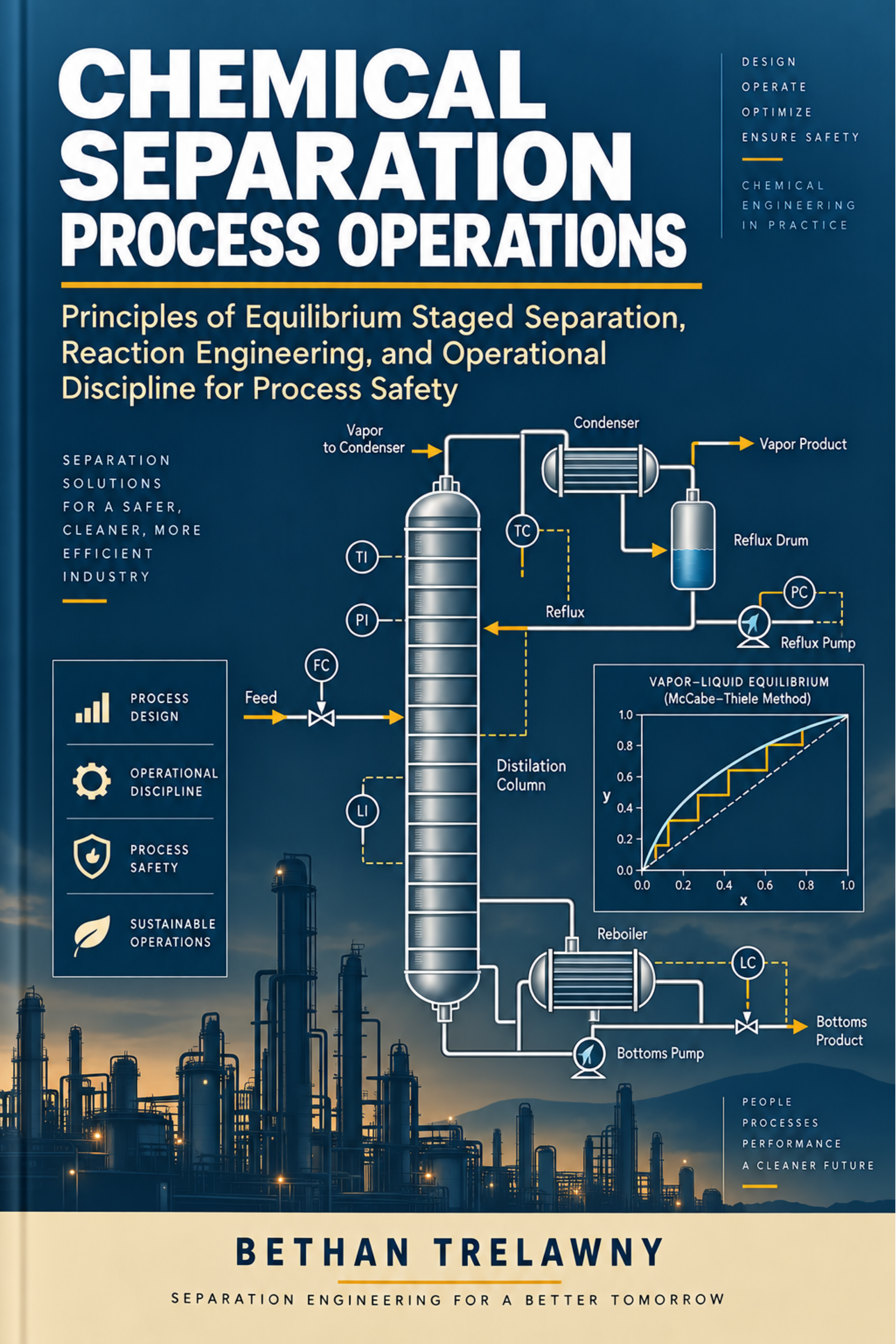
Chemical Separation Process Operations
Principles of Equilibrium Staged Separation, Reaction Engineering, and Operational Discipline for Process Safety
by Bethan Trelawny
Design on paper. Start up at 3 a.m. This book teaches both.
A distillation column designed at total reflux on paper still has to be started up by someone at three in the morning. Chemical Separation Process Operations keeps both realities in view. It begins with the phase equilibrium behind every separation, then builds the equilibrium stage into binary distillation by McCabe-Thiele, shortcut multicomponent design, and real tray and packing hydraulics with their flooding and turndown limits. Absorption, extraction, evaporation, crystallisation, drying, membranes and adsorption each get a sizing method and a failure mode. Reaction engineering follows, from rate laws and reactor design equations to non-isothermal operation, multiple steady states and heat integration with the separation train. Closing chapters cover procedures, management of change and startup discipline.
Written for chemical engineering students and plant process engineers, the book connects fundamental theory to the equipment, procedures and operational decisions that determine whether a process runs safely and profitably. Each chapter pairs design methods with the practical limits that appear on the plant floor, so readers can move from a textbook calculation to a real operating window.
What you will learn:
- Select unit operations from process basis, feed conditions and product requirements
- Apply phase equilibrium thermodynamics to flash and staged separation calculations
- Design binary distillation columns using McCabe-Thiele and shortcut multicomponent methods
- Evaluate tray and packed column hydraulics, including flooding, weeping and turndown
- Size absorption, stripping, liquid-liquid extraction, evaporation, crystallisation and drying operations
- Apply membranes and adsorption to separation duties with their characteristic failure modes
- Use rate laws and reactor design equations for chemical reaction engineering
- Analyse non-isothermal reactors, multiple steady states and heat integration with separation trains
- Implement operational discipline, management of change and safe startup procedures
This book is for chemical engineering students, process engineers, and plant operations personnel who need a working understanding of equilibrium staged separations, reaction engineering, and the operational discipline that keeps process plants safe. Whether you are studying for a degree, designing a new unit, or troubleshooting an existing column at three in the morning, the material here bridges calculation and practice.