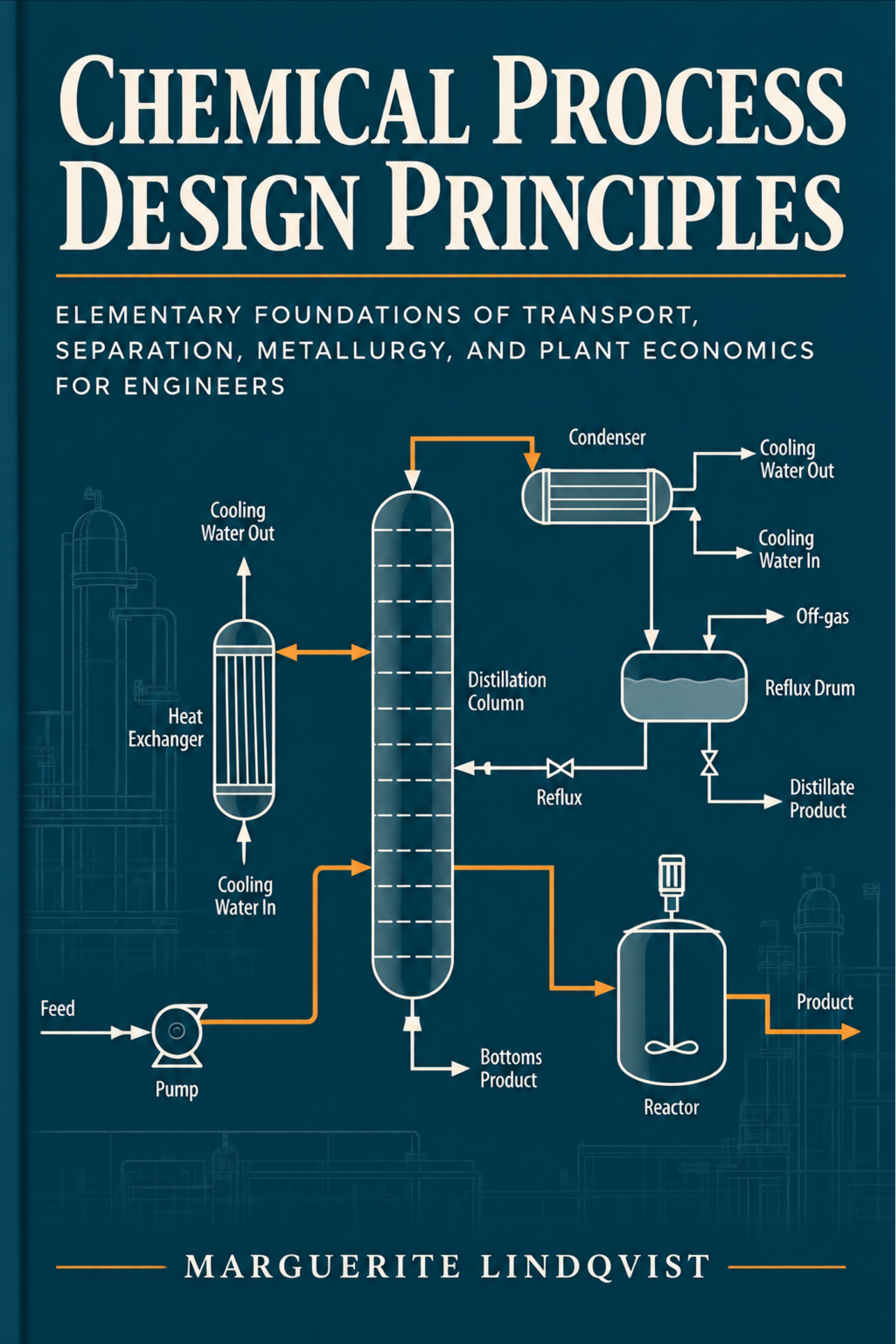
Chemical Process Design Principles
Elementary Foundations of Transport, Separation, Metallurgy, and Plant Economics for Engineers
by Marguerite Lindqvist
You can pass a transport course and still freeze in front of a blank flowsheet. This book closes that gap.
Chemical engineering fundamentals are often taught as separate subjects—fluid mechanics here, heat transfer there, thermodynamics somewhere else—leaving students and early-career engineers without a clear path from theory to a working process design. Chemical Process Design Principles bridges that gap by walking through the elementary foundations of transport, separation, metallurgy, and plant economics in one coherent sequence. You will set up material balances with recycle and purge, carry energy balances through reacting systems, size pipe and pumps with real friction and suction-head limits, and design a shell-and-tube exchanger from an overall coefficient and a corrected log mean temperature difference.
Distillation is built from equilibrium to McCabe-Thiele stages, minimum reflux, and column hydraulics, then extended to absorption, extraction, evaporation, and drying. Reactor sizing, a metallurgy chapter on phase diagrams, reduction thermodynamics, and corrosion-resistant alloy choice, and a closing block on flowsheets, capital cost estimation, cash flow, and hazard review complete the design picture. Each chapter connects directly to the next, so you finish with a working understanding of how unit operations fit into a complete process rather than a collection of isolated equations.
What you will learn:
- Apply dimensional analysis and consistent units to process variables and design calculations
- Set up material balances on non-reacting and reacting systems, including recycle and purge streams
- Carry energy balances and thermochemistry through reacting and non-reacting processes
- Use phase equilibrium and physical property data to support separation and reactor design
- Size pipe, pumps, and fluid movers with real friction and suction-head limits
- Design shell-and-tube heat exchangers using overall coefficients and corrected LMTD
- Build distillation designs from equilibrium stages to McCabe-Thiele, minimum reflux, and column hydraulics
- Extend mass transfer fundamentals to absorption, stripping, extraction, leaching, evaporation, drying, crystallisation, and mechanical separation
- Size reactors and select materials using phase diagrams, reduction thermodynamics, and corrosion-resistant alloy choice
- Read and create flowsheets, estimate capital costs, evaluate cash flow, and apply hazard review
Written for chemical and process engineering students and early-career plant engineers, this book is for anyone who needs to move from passing exams to producing defensible process designs. If you are preparing for a design course, starting a plant assignment, or returning to fundamentals after time in the field, the chapters here give you the elementary foundations and the confidence to fill in that blank flowsheet.