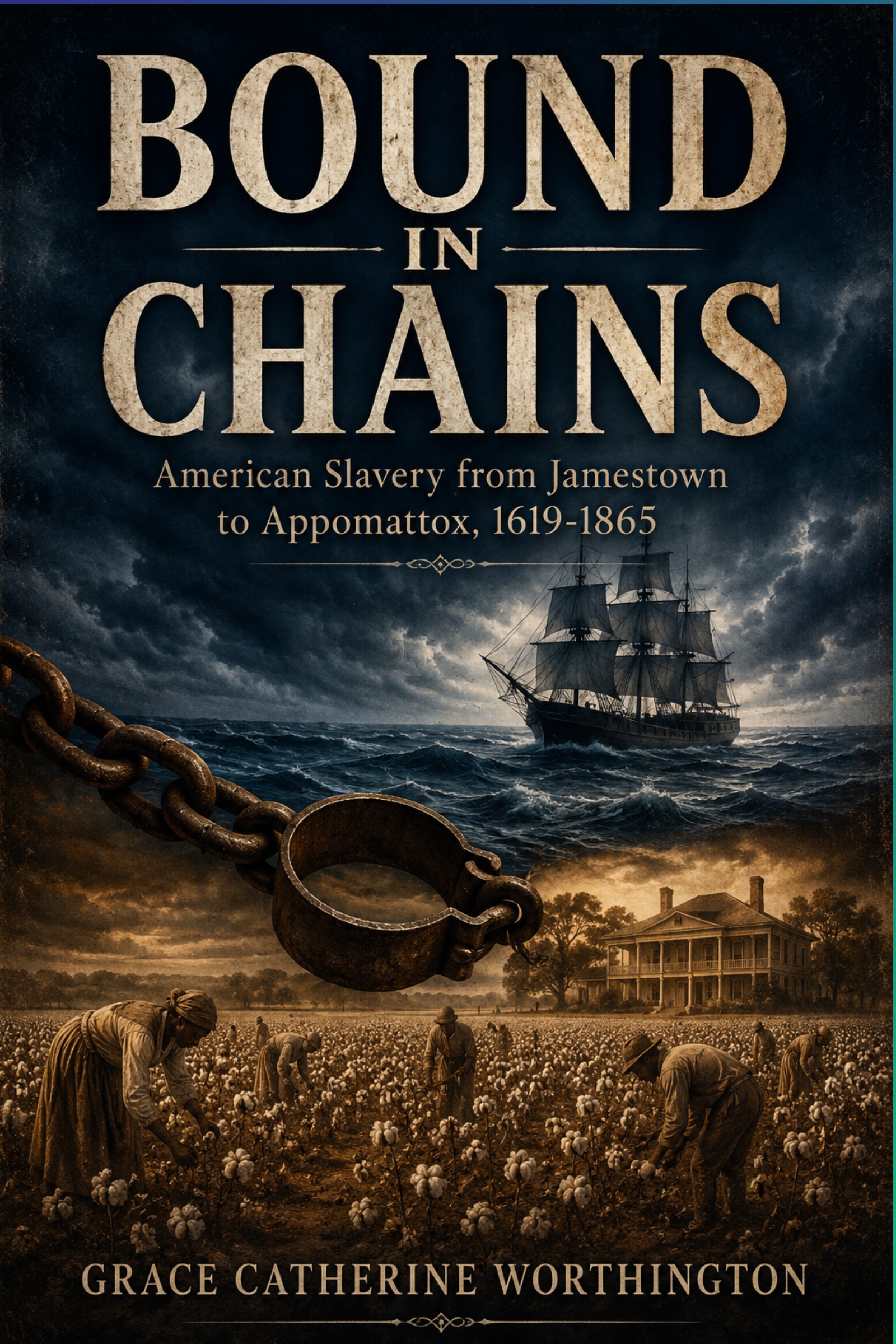
BOUND IN CHAINS
American Slavery from Jamestown to Appomattox, 1619-1865
by Grace Catherine Worthington
In August 1619, a Dutch warship arrived at Point Comfort, Virginia, and traded approximately twenty Africans to English colonists. Their legal status was genuinely ambiguous — some, like Anthony Johnson, eventually became free and acquired land. Within a generation that window had closed. Virginia's 1662 law declaring that a child's status followed the mother's transformed enslaved women's children into property, creating the mechanism of hereditary slavery and a legal incentive for the sexual exploitation that was one of slavery's most pervasive horrors.
This is the complete story — how slavery was built through deliberate legislative choices, sustained by a paternalist ideology that Jefferson called "a moral and political depravity" while holding more than a hundred people in bondage, and how Frederick Douglass, Harriet Tubman, William Lloyd Garrison, and 180,000 Black Union soldiers brought it down — and why its consequences have never stopped shaping American life.
Inside this American slavery history book:
- How racial slavery was built in law — the Virginia statutes of the 1660s–1680s that converted ambiguous servitude into hereditary chattel slavery, and why Bacon's Rebellion of 1676 accelerated the shift from white indentured servants to Black slaves (Chapter 3)
- The Middle Passage — 12.5 million Africans transported, mortality rates of 5–25 percent per voyage, the Amistad revolt of 1839, and why approximately 400,000 arrived in the United States while the Caribbean and Brazil received far more (Chapter 2)
- Gabriel, Vesey, and Nat Turner — the blacksmith who planned to march on Richmond, the free carpenter who recruited thousands using Old Testament prophecy, and the preacher whose forty-eight hours killed fifty-five people and produced Virginia's near-vote for gradual emancipation in 1832 (Chapter 10)
- Frederick Douglass's intellectual life — how Thomas Auld's warning that literacy would "forever unfit him to be a slave" became Douglass's blueprint, the 1845 Narrative that sold 11,000 copies in three years, and his 1852 "What to the Slave Is the Fourth of July?" (Chapter 14)
- Harriet Tubman's thirteen missions — why she started on Saturday nights, why she carried a gun, and how she guided the 1863 Combahee River Raid that freed more than 700 people — the largest single liberation of the Civil War (Chapter 15)
American slavery lasted 246 years and killed 620,000 people in the war required to end it. It was built deliberately, through specific legal choices, by specific people acting in their economic interests. Understanding how it was built — and how the ideology that justified it outlasted the institution — is essential to understanding the America it left behind.
For readers of Clint Smith's HOW THE WORD IS PASSED and Isabel Wilkerson's THE WARMTH OF OTHER SUNS.