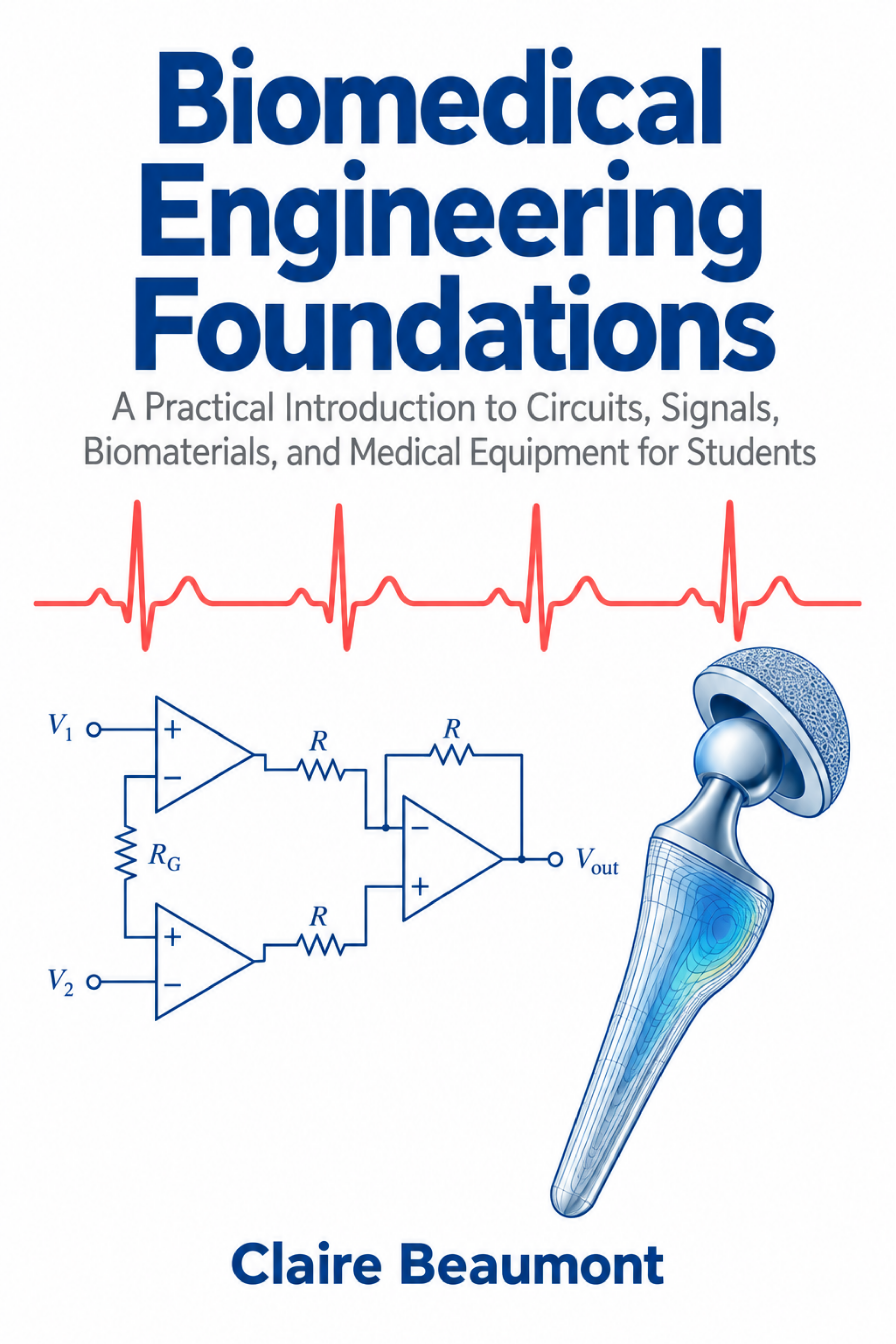
Biomedical Engineering Foundations
A Practical Introduction to Circuits, Signals, Biomaterials, and Medical Equipment for Students
by Claire Beaumont
Physiology and instrumentation are two languages. This book teaches you to speak both at once.
Biomedical engineering sits at the meeting point of living systems and engineered ones, and the professionals who thrive there are the ones who can move fluidly between the two. This practical introduction builds that fluency from the ground up. You will learn physiology as flows, pressures, and signals, then design the circuits that measure them, discovering along the way why common-mode rejection and leakage current are patient-safety issues rather than datasheet lines.
The book follows the arc of a real biomedical engineering curriculum. It opens with the scope of the field and the physiology engineers need, then develops circuit fundamentals and biopotential amplifiers before moving into signals and systems, digital biosignal processing, and the sensors and transducers that turn biology into data. From there you will sample and filter an ECG, detect QRS complexes, strip artefact, and understand how a pulse oximeter really works. Imaging chapters explain attenuation, reconstruction, ultrasound, and MRI from first principles. Materials chapters cover implant alloys, polymers, corrosion, wear, and the tissue response that decides whether a device lasts. A final chapter takes you onto the hospital floor for inspection, maintenance, and electrical safety testing.
Written for undergraduates, biomedical technicians, and career changers entering the field, the book keeps mathematics grounded in physical meaning and ties every concept to equipment you will actually encounter. Each chapter builds toward the next, so that by the end you can reason about a medical device from physiology to circuit to clinical use.
What you will learn:
- How biomedical engineers work across hospitals, industry, and research, and what the role demands
- Physiology for engineers: flows, pressures, and signals as measurable quantities
- Circuit fundamentals and the design of biopotential amplifiers for safe patient recording
- Signals and systems concepts applied to biosignals, including sampling, filtering, and artefact removal
- Digital biosignal processing techniques such as QRS detection and ECG analysis
- Sensors and transducers, including how a pulse oximeter really works
- Medical imaging principles: attenuation, reconstruction, ultrasound, and MRI from first principles
- Biomaterials, biocompatibility, and tissue response, including corrosion, wear, and implant alloys
- Biomechanics and clinical engineering, from equipment inspection to electrical safety testing
Who it is for: Undergraduates in biomedical engineering, biomedical technicians, and career changers entering the field who want a practical, integrated introduction that connects physiology, electronics, signals, materials, and clinical practice in one coherent path.