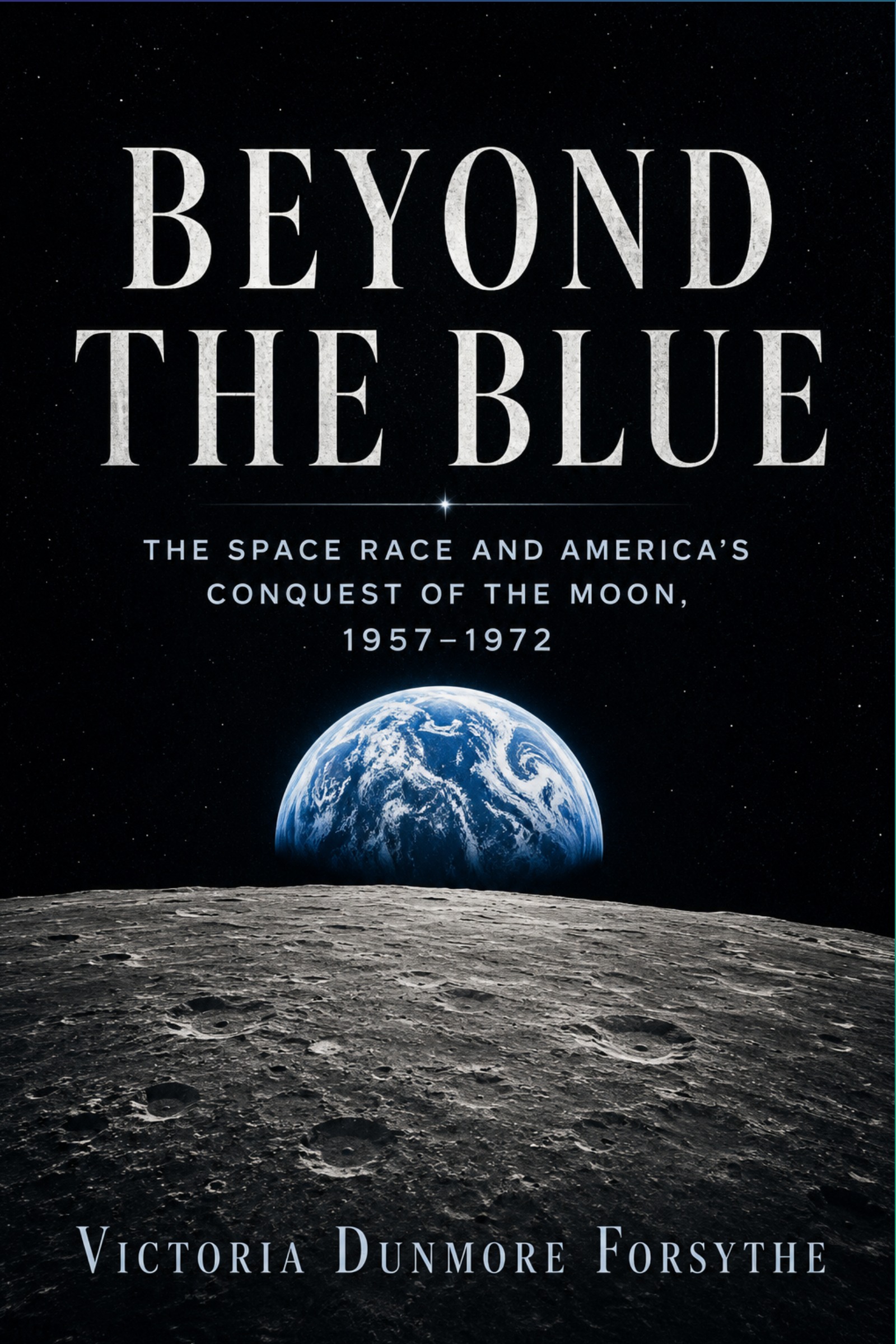
BEYOND THE BLUE
The Space Race and America's Conquest of the Moon, 1957–1972
by Victoria Dunmore Forsythe
On October 4, 1957, a polished aluminum sphere the size of a beach ball began transmitting a radio signal heard around the world. Sputnik 1 weighed 183 pounds and proved — with a beep — that the Soviet Union could put a payload into orbit and, by implication, a nuclear warhead on any American city. What followed was twelve years of the most concentrated scientific mobilization in peacetime history, ending with Neil Armstrong and Buzz Aldrin on the Moon.
This is the complete story — told through the Mercury Seven, Wernher von Braun, Sergei Korolev, Katherine Johnson, Gene Kranz, and the 300,000 Americans whose effort made Apollo possible. Historian Victoria Dunmore Forsythe traces the full arc: from Eisenhower's "small ball in the air" response to Sputnik, through Kennedy's 1961 Moon challenge and the Apollo 1 fire that killed Gus Grissom, Ed White, and Roger Chaffee, to Gene Cernan's last footstep in December 1972.
Inside this space race history book:
- Sputnik's shock — Eisenhower's classified U-2 knowledge prevented him from calming public fear, and "Flopnik" — the Vanguard TV3 that rose four feet and exploded on the pad — made the crisis worse (Chapters 1-2)
- The Mercury Seven and the Kennedy challenge — Life magazine's $500,000 deal and what John Glenn said before Friendship 7: "If Katherine Johnson says they're good, I'm ready to go" (Chapters 3-6)
- The Apollo 1 fire — how a damaged oxygen tank dropped two inches at the factory in 1967, nearly destroyed Apollo 13 three years later, and how Kranz's team improvised a CO2 scrubber from a plastic bag, a sock, and duct tape (Chapters 10, 13)
- The Hidden Figures — Katherine Johnson, Dorothy Vaughan, and Mary Jackson: the Black women mathematicians at Langley whose calculations flew the missions, and why Vaughan taught herself FORTRAN to keep her team relevant (Chapter 19)
- Wernher von Braun's moral reckoning — the SS officer whose V-2 rockets killed more people in construction than in combat, and the American government's deliberate decision to ask no uncomfortable questions (Chapter 18)
- The Soviet side — Sergei Korolev, the Gulag survivor kept secret until his death in 1966, and why Soviet secrecy prevented the institutional learning that saved Apollo (Chapter 22)
Apollo cost $25 billion — roughly $180 billion in 2023 dollars — and embedded American moral compromise in its most important rocket engineer. Understanding the Moon landing means understanding the Cold War, the civil rights era, and the human beings — celebrated, hidden, and compromised — who made it possible.
For readers of Tom Wolfe's THE RIGHT STUFF and Craig Nelson's ROCKET MEN.