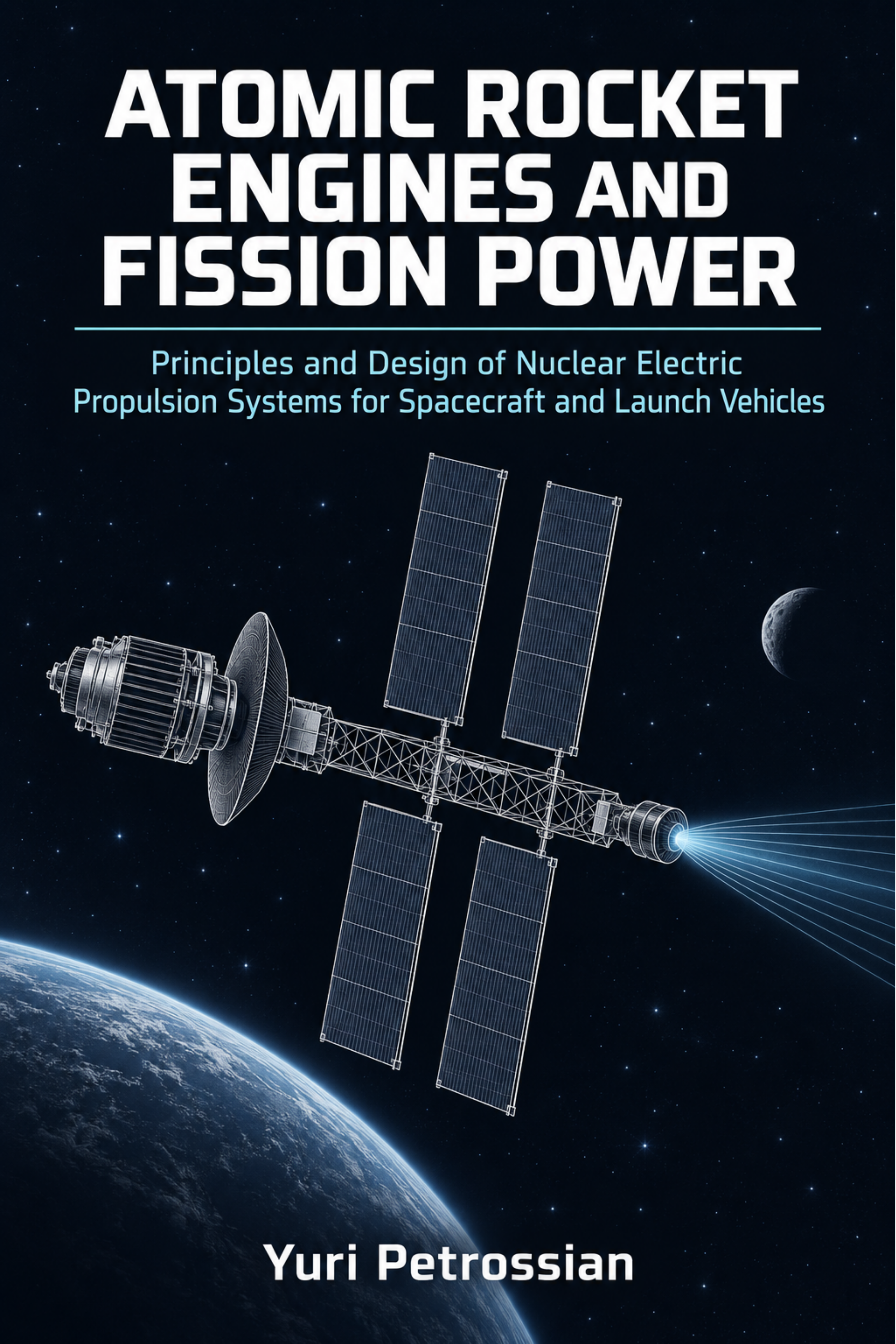
Atomic Rocket Engines and Fission Power
Principles and Design of Nuclear Electric Propulsion Systems for Spacecraft and Launch Vehicles
by Yuri Petrossian
Some missions simply cannot be flown on chemical propellant or sunlight. This book explains the alternative without assuming you have ever taken a nuclear course.
Nuclear electric propulsion and space fission power are no longer paper concepts—they are the enabling technologies for deep-space cargo, crewed Mars transits, and outer-planet science. But most aerospace engineers graduate without ever sizing a reactor, a radiator, or a shielding mass. This book closes that gap. It begins by quantifying the power and energy a mission actually demands, then builds the reactor physics that matters to a designer: neutron economy, reactivity feedback, and the temperature limits set by fuel form, moderator, and reflector choice. You will see why these material decisions cap core temperature—and therefore specific impulse—long before any engineering detail is drawn.
From there, the book moves to hardware. You will size a nuclear thermal propulsion (NTP) engine with its control drums and turbopump, then a space fission power plant using Stirling, Brayton, or thermoelectric conversion. You will calculate the radiator area that dominates system mass, and you will trade an electric propulsion stage on specific mass and trip time. Shielding geometry, ground testing, and launch approval close the book, giving you the full picture from neutron to nozzle to regulatory gate.
What you will learn:
- How to quantify mission power and energy requirements before choosing a nuclear system
- The reactor physics essentials—neutron economy, reactivity control, and feedback—that drive design
- How fuel form, moderator, and reflector choices set core temperature limits and achievable specific impulse
- Nuclear thermal propulsion principles and the architecture of an NTP engine, including control drums and turbopumps
- Reactor control and dynamics for safe, stable operation in space
- Space fission power systems with Stirling, Brayton, and thermoelectric conversion
- Heat rejection and the radiator area that dominates power plant mass
- Nuclear electric propulsion stage design traded on specific mass and trip time
- Shielding geometry, the radiation environment, ground testing, safety, and launch approval
Written for aerospace engineers, graduate students, and space systems analysts, this book assumes no prior nuclear coursework. If you design, analyze, or plan spacecraft and launch vehicles—or study to do so—this is your practical introduction to the nuclear option.