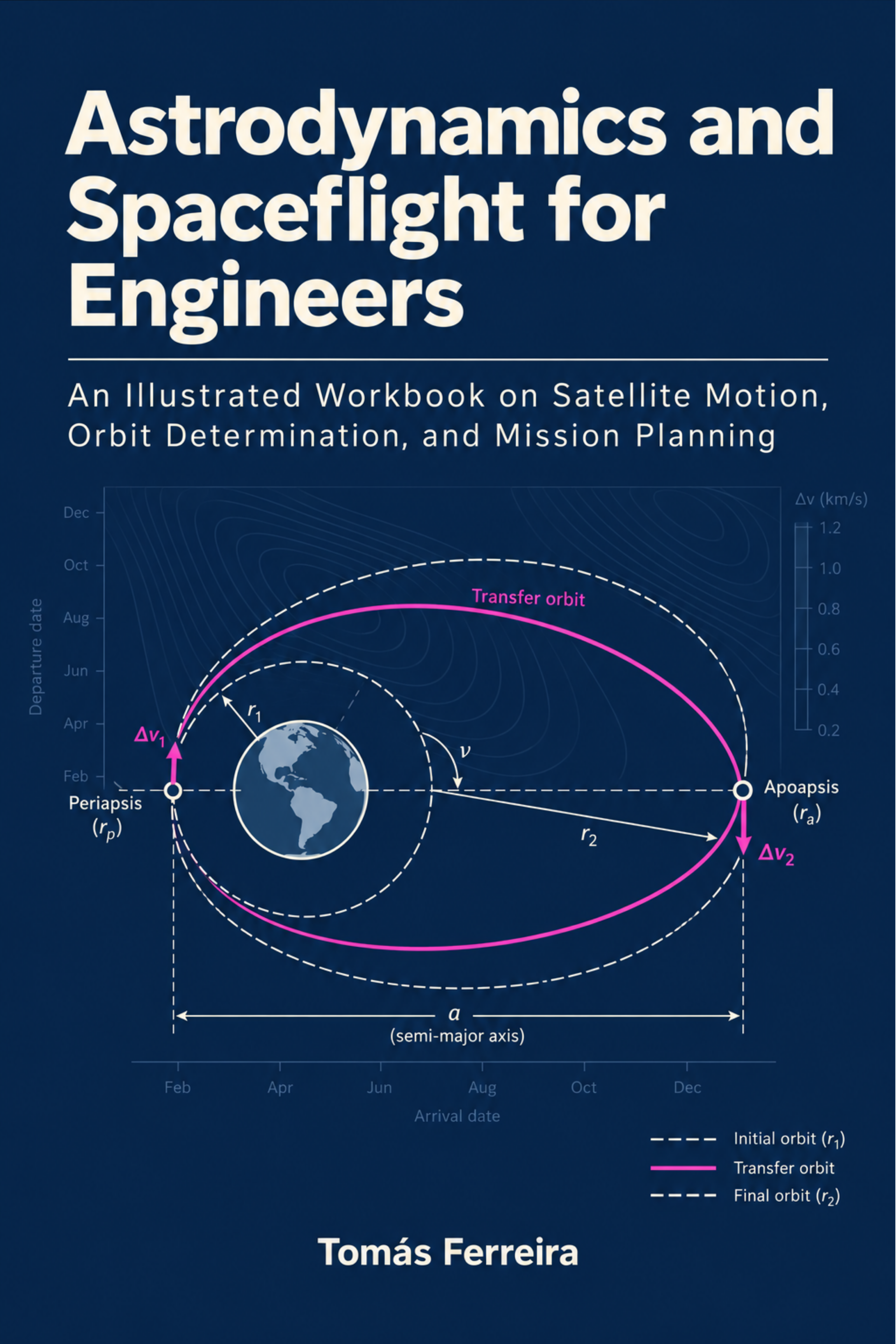
Astrodynamics and Spaceflight for Engineers
An Illustrated Workbook on Satellite Motion, Orbit Determination, and Mission Planning
by Tomás Ferreira
Astrodynamics is not hard because the ideas are strange; it is hard because one skipped substitution wrecks the answer. This workbook shows every step.
You set up frames and time systems properly, derive the two-body result, convert state vectors to elements and back, solve Kepler's equation by iteration, and build a delta-v budget from Hohmann transfers and plane changes. Then you take on rendezvous with Clohessy-Wiltshire, Lambert targeting with porkchop plots, gravity assists by patched conics, J2 drift used deliberately to design a sun-synchronous orbit, and orbit determination from real observation types. Four full mission case studies close the book.
Written for aerospace students, self-taught mission analysts and engineers preparing for spaceflight design work, this illustrated workbook treats every derivation as a sequence of checkable steps. Each chapter pairs the governing equations with worked numerical examples, so you can follow the algebra from first principles to a final answer and see exactly where a sign error or a unit slip would change the result. The mission case studies tie the individual techniques together into end-to-end design exercises.
What you will learn:
- Set up reference frames and time systems correctly before any orbit calculation
- Derive the two-body problem and convert between state vectors and orbital elements
- Solve Kepler's equation by iteration and compute time of flight for elliptic, parabolic and hyperbolic orbits
- Build delta-v budgets from impulsive manoeuvres, Hohmann transfers and plane changes
- Analyse rendezvous and relative motion using the Clohessy-Wiltshire equations
- Solve Lambert's problem and read porkchop plots for interplanetary transfer
- Apply patched conics and gravity assists to design planetary flybys
- Use J2 drift deliberately to design sun-synchronous and other special orbits
- Perform orbit determination from real observation types and close the loop with four full mission case studies
This book is for aerospace engineering students taking a first or second course in orbital mechanics, for self-taught mission analysts who need the missing steps, and for practising engineers moving into spaceflight design work who want a single illustrated reference that connects theory to mission planning.