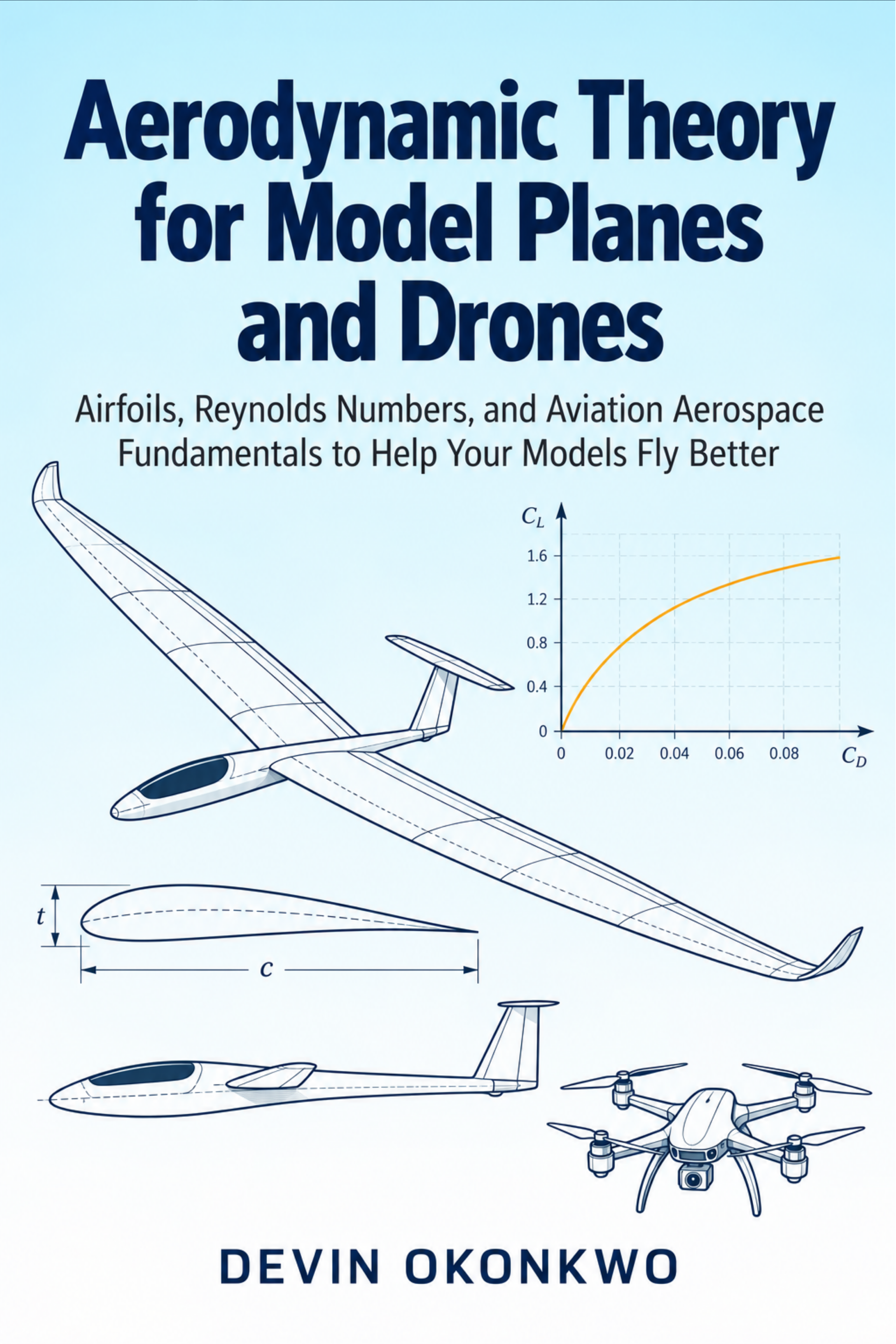
Aerodynamic Theory for Model Planes and Drones
Airfoils, Reynolds Numbers, and Aviation Aerospace Fundamentals to Help Your Models Fly Better
by Devin Okonkwo
Your model does not fly like a small airliner — and Reynolds number is the reason.
At model scale, air behaves differently. Boundary layers are thicker relative to the wing, laminar separation bubbles form and burst, and the airfoil data you find in textbooks often stops being useful right where your model actually operates. Aerodynamic Theory for Model Planes and Drones explains what changes at small scale, why it changes, and what you can do about it — in language aimed at builders and pilots rather than aerodynamicists.
The book starts with the forces acting on a model in flight and the vocabulary used to describe airfoils, then moves into Reynolds number and the laminar separation bubble: what it is, how it changes lift and drag, and how to recognize its effects from the way your glider mushes or your wing drops. From there it builds outward to three-dimensional wing effects, drag budgets, stability and control, propellers, multirotor aerodynamics, flight performance, gusts and turbulence, and finally a practical chapter on testing and tuning.
Rather than presenting theory as an end in itself, each chapter connects to decisions you make at the bench or on the field: how much washout to build in, which propeller to fit, where to set the center of gravity, how to interpret a glide test, and how to read a flight log. The goal is not to turn you into a mathematician but to give you reasons for the choices you make — and a way to tell whether they worked.
What you will learn:
- How air behaves at model scale and why full-size aerodynamic data often misleads
- How to read an airfoil polar and match an airfoil to your model's mission
- What laminar separation bubbles are and how to spot their effects in flight
- How washout, taper and aspect ratio shape a wing's behavior in three dimensions
- How to build a drag budget for a complete airframe and find where drag really comes from
- How stability and control are achieved, and how to set up a CG sweep that tells you something
- How to pick a propeller from an efficiency map instead of a guess
- How multirotors differ: disc loading, hover efficiency and ground effect
- How to use glide tests, flight-log analysis and tuning passes to improve a model systematically
Written for RC pilots, drone builders, design-build-fly students, and anyone who wants their aircraft to fly better for reasons they understand, this book assumes an interest in how things work but not a background in aerodynamics. If you have ever wondered why a model behaves the way it does — and wanted an answer you could act on — this is where to start.