
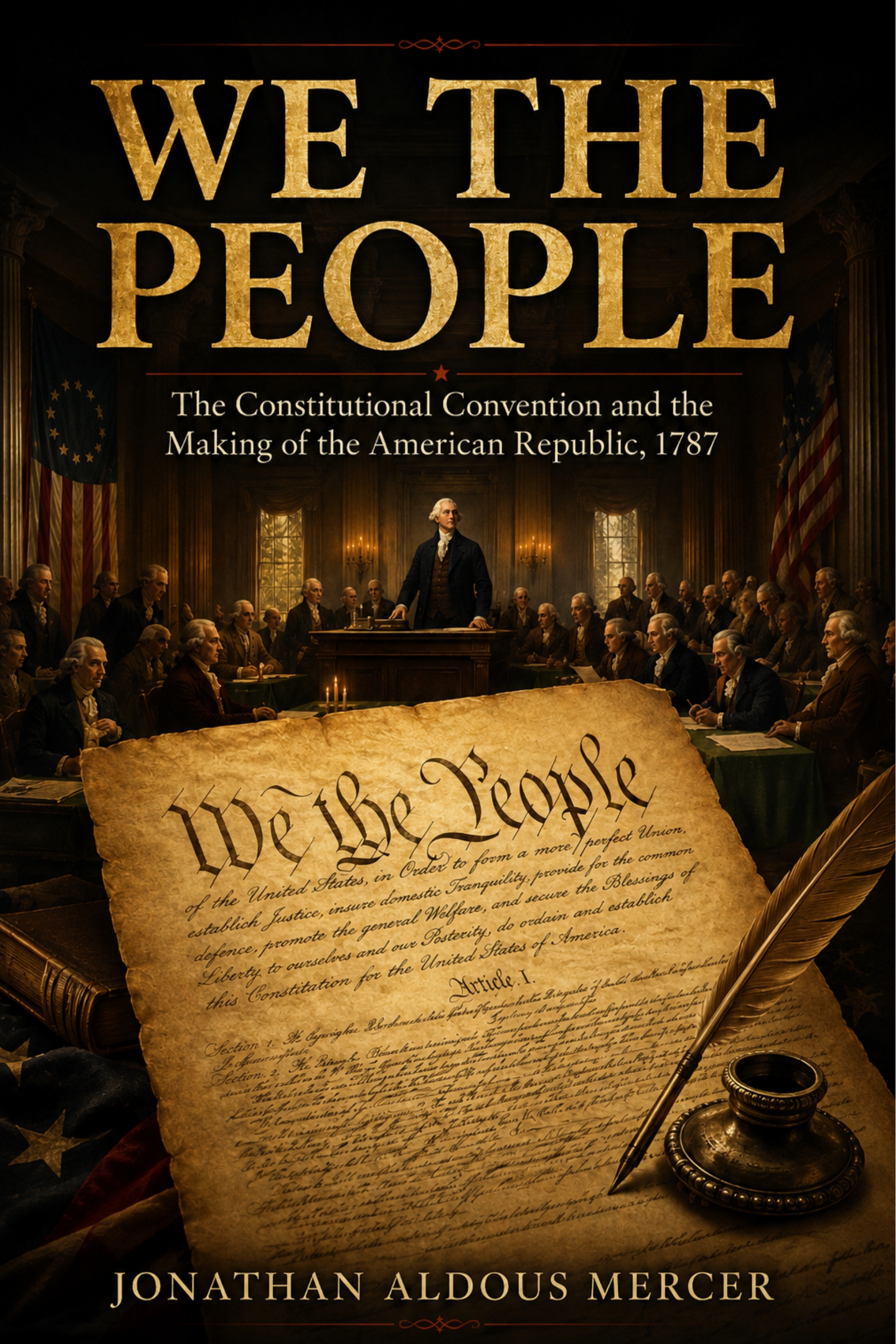
WE THE PEOPLE
The Constitutional Convention and the Making of the American Republic, 1787
by Jonathan Aldous Mercer
Sign in is required at checkout. You can add to cart anytime.
About this book
On June 15, 1787, William Paterson rose to present the small states' counter-proposal. The Convention was in deadlock. Several delegates had threatened to leave. Benjamin Franklin proposed sessions begin with prayer — the delegates declined, noting they had no chaplain and no funds to hire one. What saved the Convention was Roger Sherman of Connecticut: a self-educated shoemaker-turned-lawyer who proposed the bicameral solution giving large states proportional representation in the House and equal-state votes in the Senate, breaking the impasse that had threatened to end the republic before it began.
Historian Jonathan Aldous Mercer traces the full arc of the Constitutional Convention across 24 chapters: Shays' Rebellion and the crisis that forced the call to Philadelphia; Madison's Virginia Plan, drafted after he read every treatise on confederations from the Achaean League to the Dutch Republic; the Great Compromise; the Three-Fifths Compromise that embedded slavery into the republic's foundation; the ratification battles in Virginia and New York; and the Federalist Papers that James Madison and Alexander Hamilton produced to win public opinion.
Inside this Constitutional Convention history:
- Shays' Rebellion — Massachusetts veterans who had fought at Valley Forge tried to seize the Springfield arsenal in January 1787, shocking reluctant states into sending serious delegations (Chapters 2-3)
- Madison's Virginia Plan — a blueprint for a genuinely national government that Madison arrived with eleven days early, framing the entire summer's debate (Chapter 5)
- The Great Compromise — Roger Sherman's bicameral solution to the large-state/small-state deadlock that had delegates threatening to walk out (Chapter 7)
- Slavery and the Three-Fifths Compromise — how southern delegates shaped the Constitution's structure to protect slavery, the founding moral failure (Chapter 8)
- The Federalist Papers and ratification — Madison and Hamilton's 85-essay argument for the Constitution, and the close battles in Virginia and New York (Chapters 13-15)
The founding of the American republic was a political invention without precedent — fifty-five men designing institutions for a future they couldn't foresee, in a Philadelphia July, with Washington's silent authority holding the room. Mercer's narrative American history traces the genius and the moral compromise of the framers, and the 240-year experiment their arguments produced.
For readers of David McCullough's 1776 and Ron Chernow's ALEXANDER HAMILTON.
Secure checkout. After purchase it’s yours forever — read in your browser on any device.