
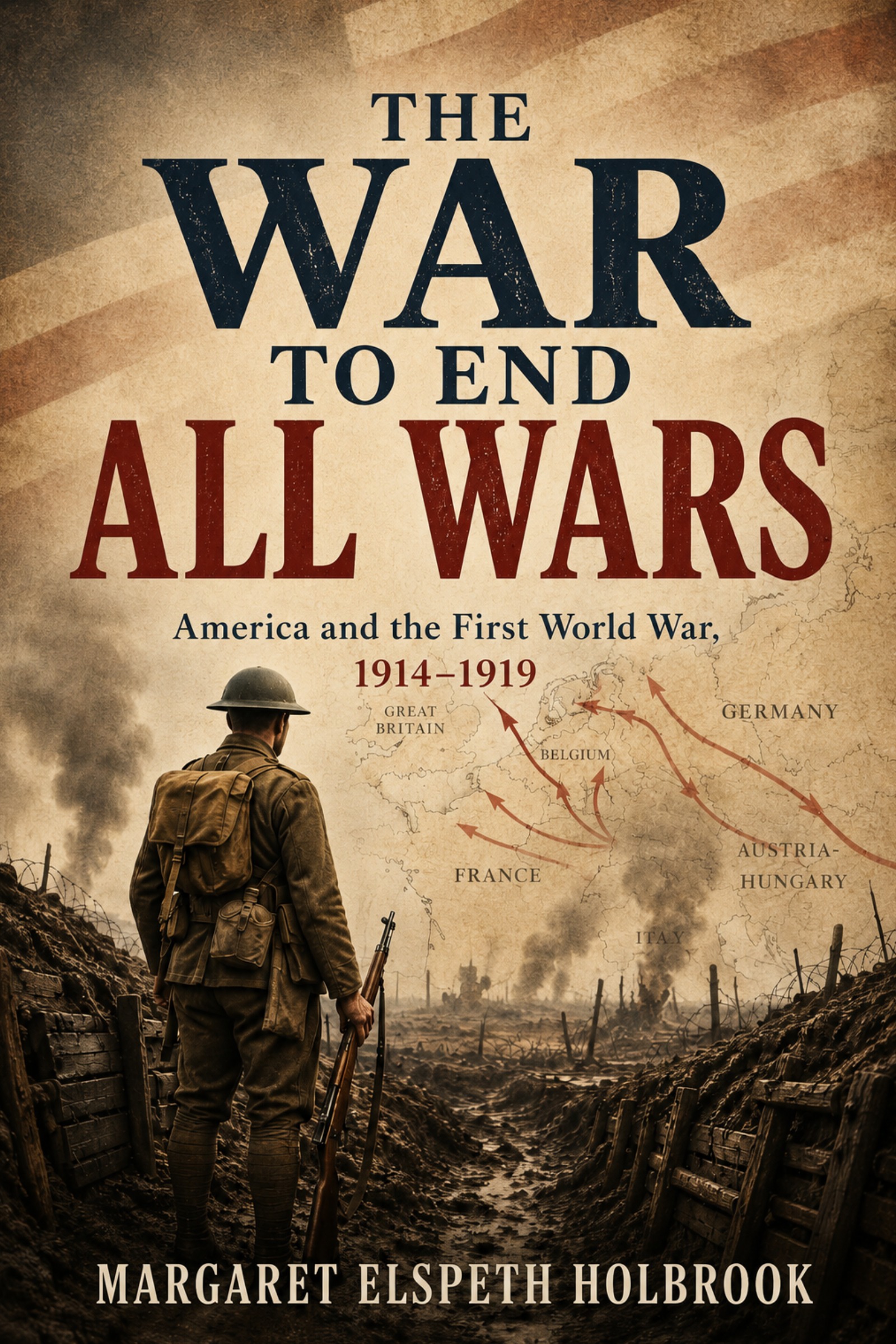
THE WAR TO END ALL WARS
America and the First World War, 1914–1919
by Margaret Elspeth Holbrook
Sign in is required at checkout. You can add to cart anytime.
About this book
On June 28, 1914, Gavrilo Princip stepped forward from the crowd outside a Sarajevo delicatessen and fired twice. Both the Archduke and his wife were dead within the hour. Within thirty-seven days, the alliance machinery of Europe had transformed a Balkan assassination into a continental war. The United States watched from three thousand miles away — and was dragged in anyway, not by any single act of will but by finance, submarines, propaganda, and the structural impossibility of neutrality when $2.3 billion in American bank loans had already tied the country's economy to an Allied victory.
This World War I history follows America's full arc from August 1914 through the Senate's rejection of the League of Nations in 1920. Woodrow Wilson, Henry Cabot Lodge, John Pershing, W.E.B. Du Bois, Eugene Debs, Colonel Edward House, Secretary William Jennings Bryan, and the two million doughboys of the American Expeditionary Forces — along with the 675,000 Americans killed by the influenza pandemic, more than all twentieth-century combat deaths combined — move across twenty-four chapters of the most transformative five years in modern American history.
Inside this World War I history:
- The Lusitania's 18 minutes — U-20's single torpedo, 1,198 dead including 128 Americans, and how Germany's legally defensible military argument was politically catastrophic (Chapter 3)
- The Western Front's industrial killing — 57,470 British casualties on July 1, 1916 alone; men walking upright into intact machine guns because commanders believed the artillery had cleared them (Chapter 9)
- Wilson's impossible neutrality — exports to the Allies rising from $824 million in 1914 to $3.2 billion by 1916; Bryan resigning rather than sign the second Lusitania note; the Sussex Pledge's fragility from the moment Wilson accepted it (Chapter 2)
- Influenza at the peace conference — Wilson's April 1919 illness, the cognitive changes his advisers noticed, and the concessions on reparations and the war guilt clause made in his final weeks at Paris (Chapter 16)
- Black Americans in the war — the 369th Infantry's 191 days in the French front line, more than any other American unit, and the race riots greeting their return in 1919 (Chapter 14)
- The Senate's fatal arithmetic — 23 Wilson-loyal Democrats voting against the treaty with reservations; a shift of 7 votes would have passed it; what the League's absence from American membership cost (Chapter 19)
Holbrook's World War I history delivers the complete American story: why a neutral nation became a belligerent, what it paid, what Wilson promised at Paris, and why the gap between the Fourteen Points and the Treaty of Versailles was the wound through which the next war entered.
Secure checkout. After purchase it’s yours forever — read in your browser on any device.