
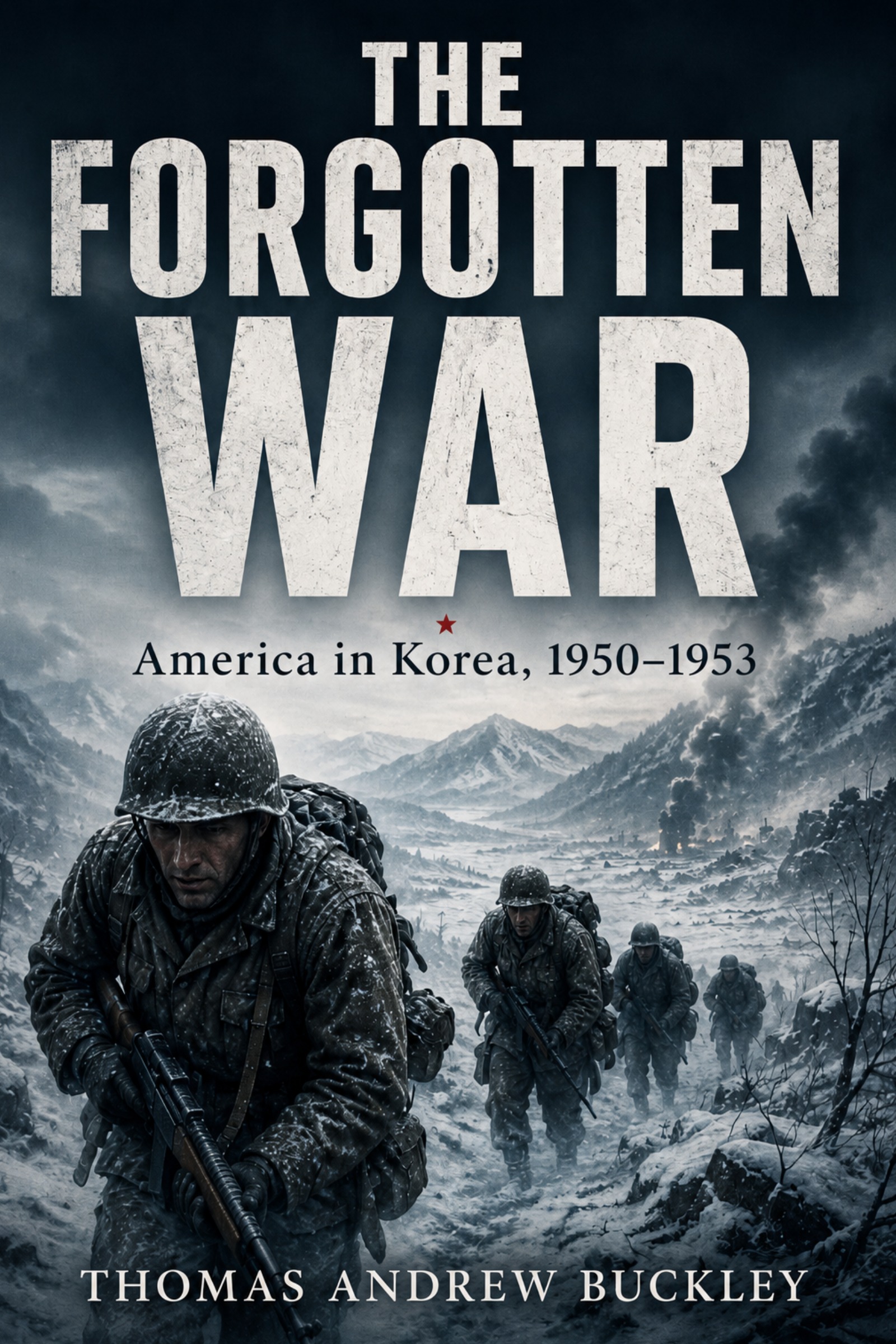
THE FORGOTTEN WAR
America in Korea, 1950-1953
by Thomas Andrew Buckley
Sign in is required at checkout. You can add to cart anytime.
About this book
President Truman called it a police action, and the phrase stuck in the craw of every soldier who fought it. Police actions did not kill 36,500 Americans. Police actions did not end without victory in a permanent division enforced by an armistice that never became peace. The Korean War was America's first limited war of the nuclear age — the first time the United States fought not for unconditional surrender but to restore a status quo, establishing the template for every limited conflict that followed.
Across twenty-four chapters, historian Thomas Andrew Buckley traces the Korean War from its origins — two Army colonels drawing the 38th parallel in thirty minutes on a National Geographic map — through MacArthur's Inchon masterstroke, the catastrophic Chinese intervention of November 1950, and the long stalemate on bloody hills. Along the way, Buckley examines Task Force Smith's disaster at Osan, the Pusan Perimeter's last stand, Truman's firing of MacArthur, military integration under Executive Order 9981, and the POW brainwashing controversy.
Inside this Korean War history:
- The 38th parallel — how Dean Rusk and Charles Bonesteel drew the line that defined seven decades in thirty minutes with a National Geographic map (Chapter 1)
- Task Force Smith — 540 men at Osan on July 5, 1950, their artillery bouncing off Soviet T-34 tanks, 180 casualties in the first engagement (Chapter 3)
- Inchon and the drive to the Yalu — MacArthur's masterstroke, Seoul's liberation, and the hubris that brought 300,000 Chinese troops across the Yalu (Chapters 6-7)
- Truman fires MacArthur — the general's letter to Joseph Martin and one of the clearest affirmations of civilian control in American history (Chapter 10)
- Military integration — Truman's Executive Order 9981 tested in combat, and what Thurgood Marshall found investigating Black soldiers' courts-martial (Chapter 14)
- The brainwashing controversy — 21 Americans who refused repatriation, the origins of SERE training, and the Code of Conduct (Chapter 15)
- Two Koreas — South Korea's economic miracle and the Kim dynasty's frozen state, and why the armistice has never legally ended (Chapters 22-23)
The Korean War was forgotten not because it didn't happen but because America had no category for a war that was neither victorious nor shameful — simply difficult, costly, and unresolved. Buckley restores it to its place as the conflict that militarized NATO, rebuilt Japan's economy, desegregated the American military, and established the limited-war template the United States has used ever since.
For readers of David Halberstam's THE COLDEST WINTER and Max Hastings's THE KOREAN WAR.
Secure checkout. After purchase it’s yours forever — read in your browser on any device.