
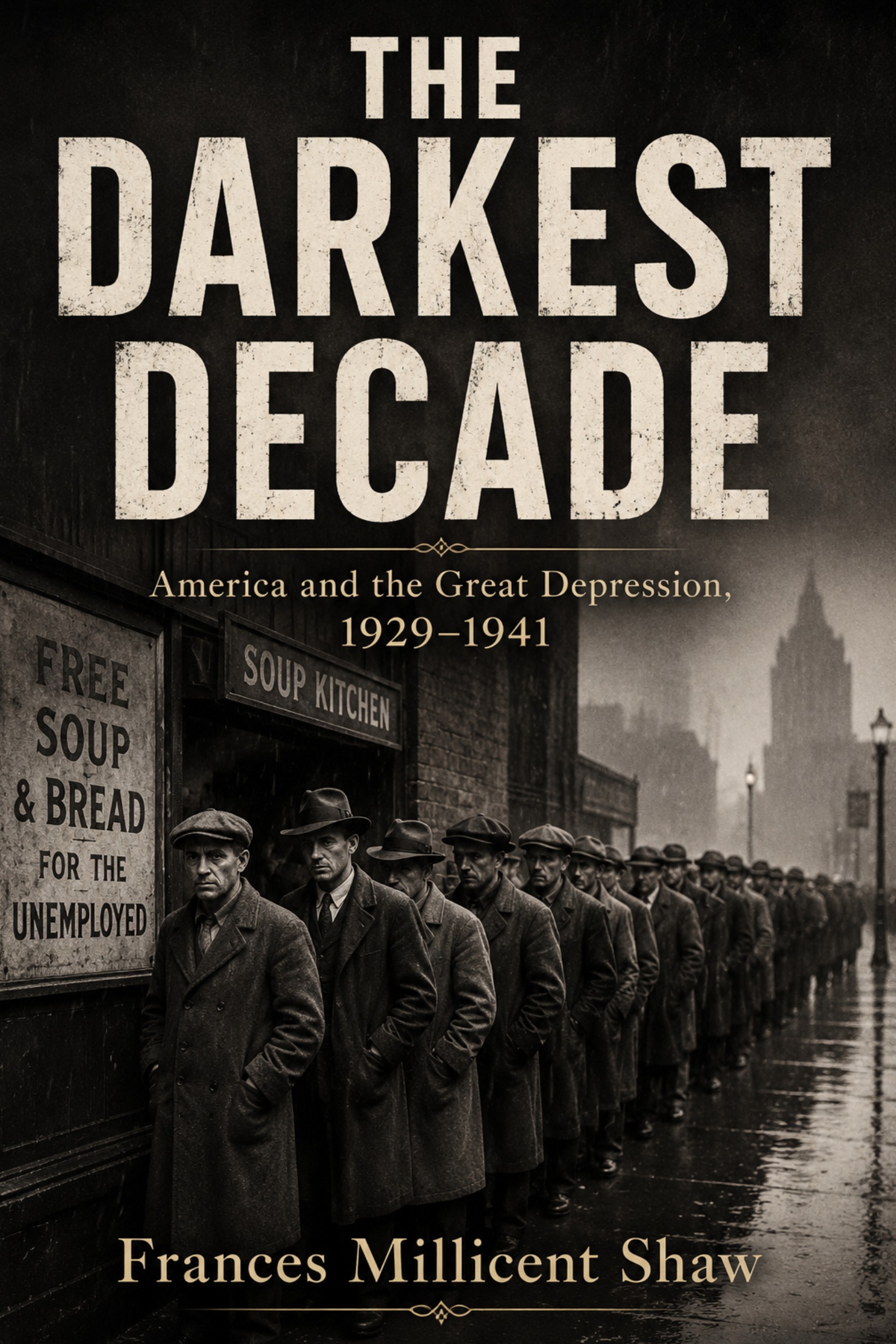
THE DARKEST DECADE
America and the Great Depression, 1929–1941
by Frances Millicent Shaw
Sign in is required at checkout. You can add to cart anytime.
About this book
On October 29, 1929, 16.4 million shares changed hands on the New York Stock Exchange. General Electric lost $1.7 billion in a single day. Radio Corporation of America fell from $505 per share to $26 before the year was out. American stocks shed $14 billion in one week — more than four times the entire federal budget. The ticker tape ran until midnight, still printing transactions from a world that had ceased to exist.
This is the story of what followed. Frances Millicent Shaw traces the full arc of America's Great Depression history across twenty-four chapters — from the structural causes of collapse, through Hoover's principled but catastrophic response, through FDR's Hundred Days and the New Deal's experiments, to the human stories statistics cannot tell. Named throughout: FDR, Eleanor Roosevelt, Frances Perkins, Dorothea Lange, and the 400,000 depositors of the Bank of the United States who lost everything on December 11, 1930.
Inside this Great Depression history:
- Black Tuesday and its causes — margin calls, 30,000 undiversified banks, Smoot-Hawley, and Mellon's "liquidate everything" philosophy (Chapters 1–4)
- The banking crisis and FDR's response — the national banking holiday, the Emergency Banking Act passed in 38 minutes, and the Fireside Chat that put deposits back in banks (Chapter 4)
- Social Security and the Second New Deal — Frances Perkins, the first female cabinet member, who drove both landmark laws through twelve years as Labor Secretary (Chapter 11)
- The New Deal and race — Walter White on anti-lynching, Mary McLeod Bethune's NYA division, and 100,000 Black sharecroppers evicted under AAA controls (Chapter 15)
- The WPA cultural explosion — Orson Welles in Harlem, John Cheever and Ralph Ellison on the Writers' Project payroll, Dorothea Lange's "Migrant Mother" (Chapter 16)
- Women and survival — women's employment rose from 10.7 to 13 million despite dismissal campaigns; flour-sack clothing, "Depression cake," and boarders kept families alive (Chapter 17)
- The honest reckoning — court-packing, the 1937 Roosevelt Recession, and why World War II — not the New Deal — ended the Depression (Chapters 21–24)
The New Deal left behind the FDIC, Social Security, the SEC, and the TVA. It left behind, too, an unfinished question: how much can democratic government do when markets fail? The Depression decade's answer was provisional. The debate has never ended.
For readers of David Kennedy's FREEDOM FROM FEAR and Jonathan Alter's THE DEFINING MOMENT.
Secure checkout. After purchase it’s yours forever — read in your browser on any device.